
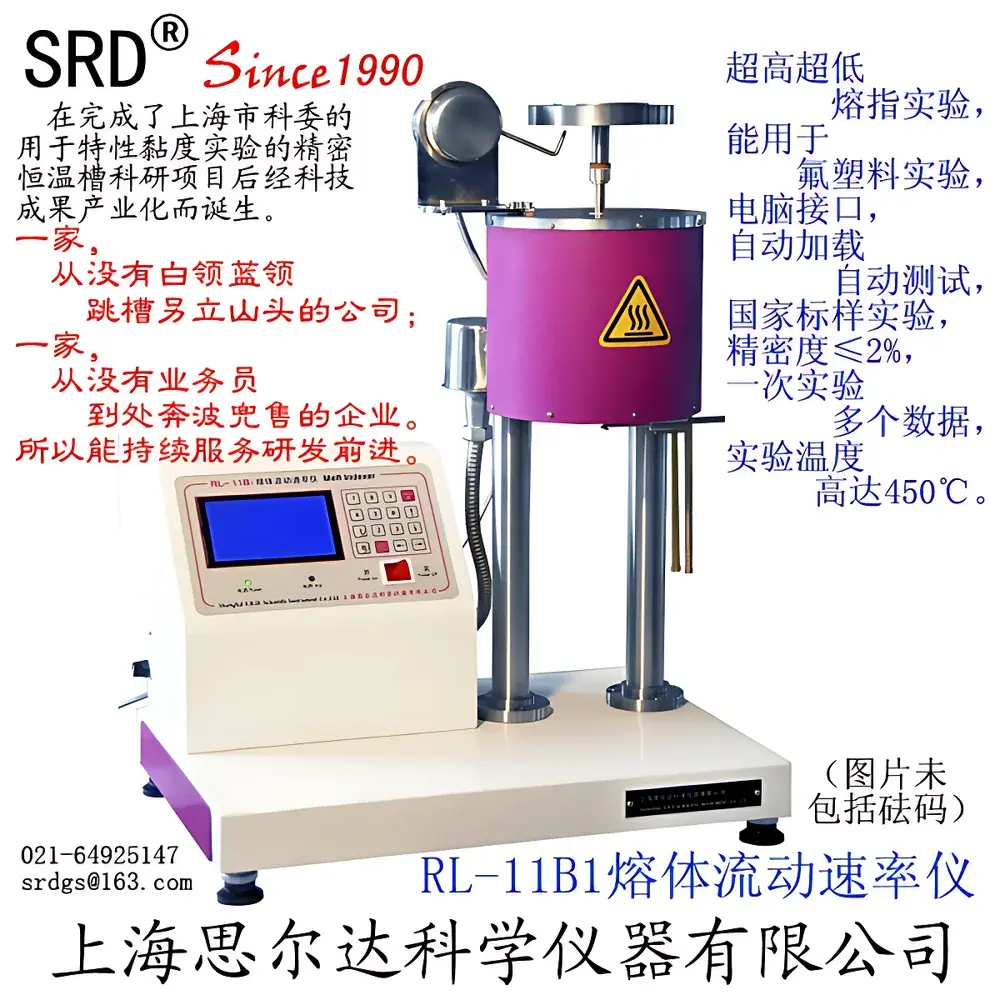
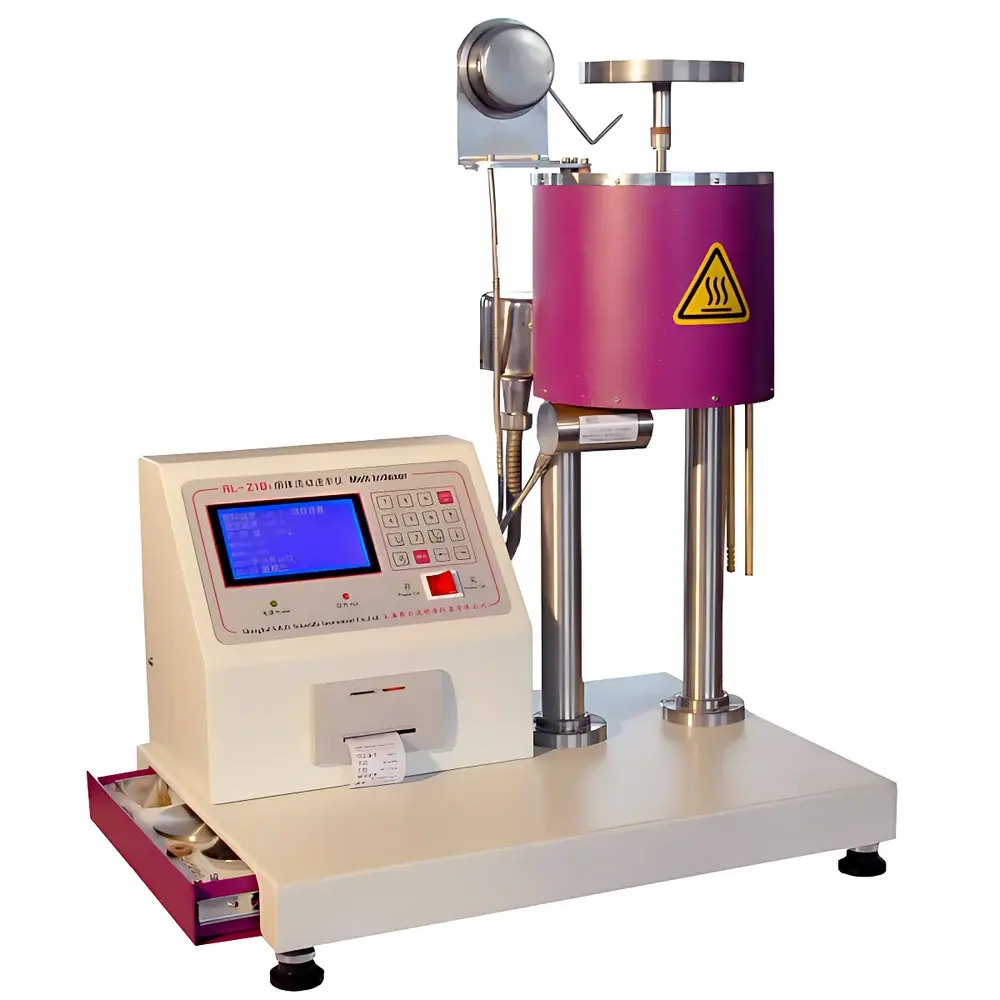
SRD RL-Z1B1 Melt Flow Rate Tester (MFR/MVR Instrument)
| Brand | SRD |
|---|---|
| Origin | Shanghai, China |
| Manufacturer Type | Authorized Distributor |
| Country of Origin | China |
| Model | SRD RL-Z1B1 |
| Price | USD 5,750 (FOB Shanghai) |
| Temperature Control Range | 100–400 °C |
| Temperature Display Accuracy | < 0.1 °C |
| 8-h Thermal Stability | < 0.10 °C |
| Temperature Recovery Time | ≤ 4 min |
| Standard Load Masses | 325, 1200, 2160, 3800, 5000, 10000, 12500, 21600 g |
| Die Orifice Diameters | Φ2.095 ± 0.005 mm and Φ1.18 ± 0.01 mm |
| Power Supply | 198–242 V AC, 50 Hz, 3 A |
| Dimensions (W×D×H) | 520 × 380 × 730 mm |
| Net Weight | Main Unit 40 kg, Weight Set 22 kg |
| Measuring Range | 0.01–9999 g/10 min (auto mode) |
| Compliance | ASTM D1238, ISO 1133-1 & ISO 1133-2, GB/T 3682.1–2018, GB/T 3682.2–2018 |
Overview
The SRD RL-Z1B1 Melt Flow Rate Tester is a precision-engineered instrument designed for the quantitative determination of Melt Flow Rate (MFR) and Melt Volume Rate (MVR) of thermoplastic polymers under standardized thermal and mechanical conditions. Operating on the principle of extrusion rheometry—where molten polymer is forced through a calibrated die under controlled temperature and defined gravitational load—the RL-Z1B1 delivers traceable, repeatable results essential for quality control, material specification verification, and process development in polymer manufacturing and R&D laboratories. Its design conforms to internationally recognized test standards including ASTM D1238 (Procedure A for MFR, Procedure B for MVR), ISO 1133-1 (for MFR) and ISO 1133-2 (for MVR), as well as Chinese national standards GB/T 3682.1 and GB/T 3682.2. The instrument employs a microprocessor-controlled heating system with active thermal compensation, minimizing drift from ambient fluctuations or line voltage variation—a critical feature for long-duration tests requiring high inter-laboratory reproducibility.
Key Features
- Microcontroller-based operation with intuitive Chinese-language LCD interface supporting dual-mode measurement (MFR and MVR) and automatic calculation of melt density (ρ) when MVR is selected
- Integrated electronic auto-cutter with programmable time intervals (e.g., 10 s, 30 s, 60 s), ensuring consistent specimen sampling even during manual intervention or non-standard test protocols
- High-stability PID temperature control system with real-time deviation monitoring; user-accessible offset correction allows field calibration against NIST-traceable reference thermometers
- Robust barrel and die assembly constructed from high-temperature alloy steel resistant to fluorinated polymer degradation (e.g., FEP, PFA, F46), enabling extended service life in aggressive melt environments
- Modular weight set covering full ASTM/ISO load spectrum (325 g to 21,600 g), compatible with both standard (Φ2.095 mm) and mini-die (Φ1.18 mm) configurations per ISO 1133-2 Annex A
- Thermal recovery time ≤ 4 minutes after load change or temperature step—validated per ISO 1133 Annex C—ensuring throughput efficiency without compromising thermal equilibrium integrity
Sample Compatibility & Compliance
The RL-Z1B1 supports routine testing of polyolefins (PE, PP), engineering thermoplastics (PC, PA6/66, POM, PBT), styrenics (PS, ABS), acrylics (PMMA), cellulose esters, and fluoropolymers. Its dual-orifice configuration accommodates both conventional MFR testing (Φ2.095 mm die) and low-flow/high-viscosity applications (Φ1.18 mm die), aligning with ISO 1133-2 requirements for MVR determination. All operational parameters—including temperature setpoint, load selection, cut interval, and dwell time—are fully configurable and stored in non-volatile memory. The instrument meets essential regulatory expectations for GLP-compliant environments: audit trails are maintained via printed output (date/time-stamped), and all test parameters are logged alongside results. While not inherently 21 CFR Part 11 compliant, the system supports integration with validated LIMS platforms via RS232 output for electronic record retention.
Software & Data Management
The RL-Z1B1 operates as a standalone embedded system with no external PC dependency. All test execution, arithmetic computation (including MFR = m × 600 / t, where m = cut specimen mass in g, t = cutting interval in s), and result formatting occur onboard. Final outputs include MFR (g/10 min), MVR (cm³/10 min), calculated melt density (g/cm³), and statistical summary (mean, SD, CV%) across up to 10 replicate cuts. Thermal stability data (8-hour drift < 0.10 °C) and display accuracy (< 0.1 °C) are verified during factory calibration using PT100 sensors traceable to national metrology institutes. Printed reports comply with ISO/IEC 17025 documentation requirements for accredited testing laboratories, listing operator ID, sample ID, test standard, environmental conditions, and equipment identification.
Applications
- Raw material acceptance testing per supplier specifications (e.g., PE resin grade verification against ASTM D1238 Classifications)
- In-process QC in extrusion and injection molding facilities to monitor batch-to-batch consistency and detect thermal degradation
- R&D evaluation of polymer blends, filler effects, and stabilizer performance under accelerated aging protocols
- Validation of rheological behavior correlation between MFR and capillary rheometry data (e.g., apparent viscosity at 190 °C/2.16 kg)
- Regulatory submission support for medical-grade polymers (ISO 5832-7, USP ) where flow characteristics impact biocompatibility processing
- Educational use in polymer science curricula for hands-on demonstration of shear-thinning behavior and thermal sensitivity of melt viscosity
FAQ
What standards does the RL-Z1B1 comply with?
It is fully aligned with ASTM D1238 (Procedures A and B), ISO 1133-1 (MFR) and ISO 1133-2 (MVR), and Chinese national standards GB/T 3682.1–2018 and GB/T 3682.2–2018.
Can the instrument test fluoropolymer melts such as F46 without corrosion damage?
Yes—the barrel, piston, and die components utilize high-alloy tool steel engineered for resistance to hydrofluoric acid vapors generated during FEP/PFA/F46 decomposition, extending service life beyond conventional carbon steel systems.
Is melt density (ρ) measured directly or calculated?
Melt density is calculated automatically when MVR mode is selected, using the formula ρ = MFR / MVR, with both values derived from gravimetric and volumetric measurements performed sequentially in a single test cycle.
Does the system support automated data export to Excel or LIMS?
The unit provides RS232 serial output for connection to external PCs or lab networks; ASCII-formatted data streams (including timestamps, parameters, and results) can be parsed by third-party software for automated reporting and database ingestion.
How is temperature uniformity verified across the barrel zone?
Factory calibration includes axial temperature profiling using calibrated thermocouples at three vertical positions (top, middle, bottom); compliance with ISO 1133 temperature gradient limits (±0.5 °C over 50 mm) is documented in the Certificate of Conformance supplied with each instrument.





