
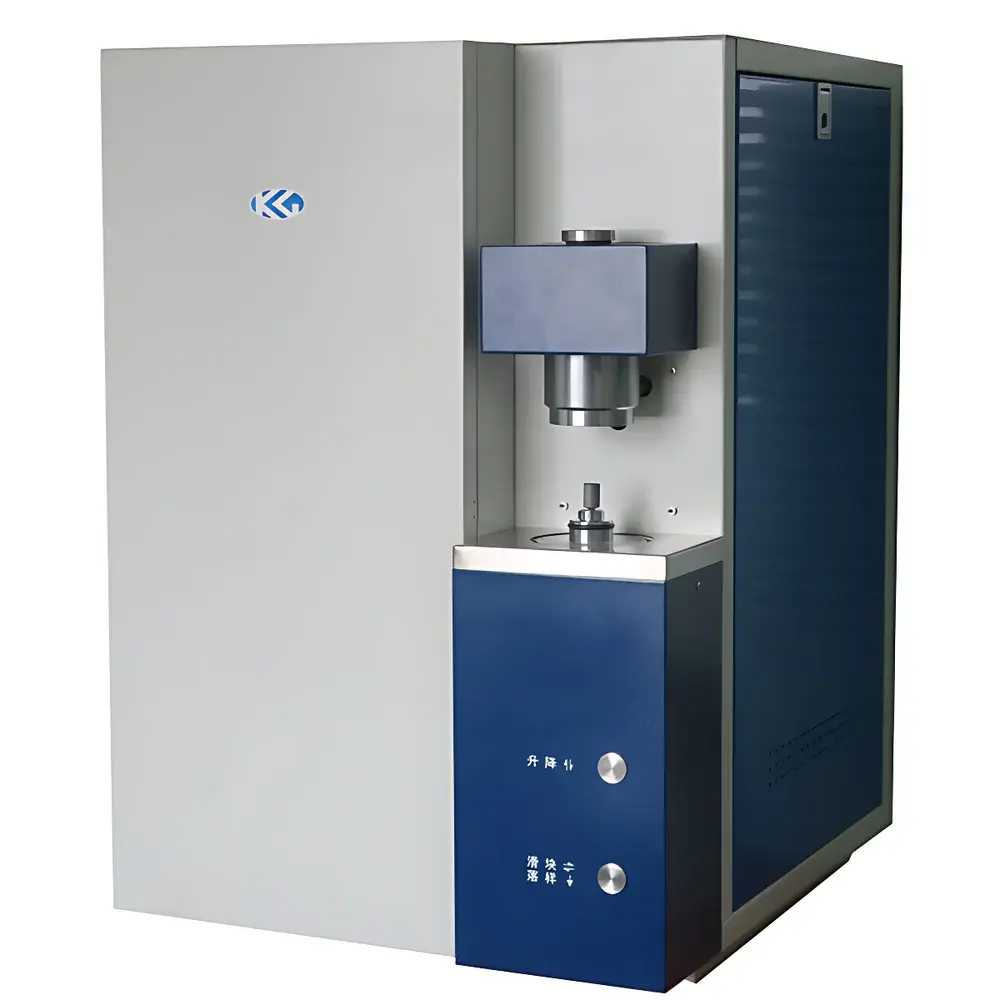
KEGUO ONH-500 Oxygen-Nitrogen-Hydrogen Analyzer (Inert Gas Fusion with IR/TCD Detection)
| Brand | KEGUO |
|---|---|
| Origin | Shanghai, China |
| Model | ONH-500 |
| Oxygen Detection Method | Non-dispersive Infrared (NDIR) Absorption at 4.26 µm |
| Nitrogen & Hydrogen Detection Method | High-Sensitivity Thermal Conductivity Detection (TCD) |
| Oxygen Range | 0.01 ppm – 20 wt% |
| Nitrogen Range | 0.01 ppm – 50 wt% |
| Hydrogen Range | 0.01 ppm – 2.0 wt% |
| Oxygen Precision | ±1 ppm or RSD ≤ 1.0% |
| Nitrogen Precision | ±1 ppm or RSD ≤ 1.0% |
| Hydrogen Precision | ±0.2 ppm or RSD ≤ 2.0% |
| Sensitivity | 0.01 ppm |
| Analysis Time | 120–240 s |
| Pulse Furnace Power | 8.5 kVA, Max Temp: 3000 °C |
| Cooling System | External Chiller (5.2 kW), 2 HP |
| Dimensions (W×D×H) | 600 × 700 × 900 mm |
| Weight | 160 kg |
| Operating Environment | 15–35 °C, 20–80% RH |
| Power Supply | 220 V AC, 50 Hz, 50 A, Single Phase |
Overview
The KEGUO ONH-500 Oxygen-Nitrogen-Hydrogen Analyzer is a high-performance inert gas fusion (IGF) elemental analyzer engineered for precise quantification of interstitial elements—oxygen (O), nitrogen (N), and hydrogen (H)—in metals, alloys, ceramics, refractory materials, and inorganic powders. It operates on the principle of high-temperature pulse furnace fusion under controlled inert atmosphere: samples are rapidly heated to up to 3000 °C in a graphite crucible under helium carrier gas, releasing O, N, and H as gaseous species. Oxygen combines with graphite to form CO and CO2; nitrogen evolves as elemental N2; and hydrogen is liberated as H2. The evolved gases undergo selective detection via dual physical methods: non-dispersive infrared (NDIR) absorption at 4.26 µm for CO2 (enabling oxygen calculation), and thermal conductivity detection (TCD) for N2 and H2, differentiated by carrier gas switching (He for O/N; high-purity N2 for H). This architecture ensures trace-level sensitivity (0.01 ppm), wide dynamic range, and robustness against matrix effects common in ferrous and non-ferrous metallurgical analysis.
Key Features
- Integrated pulse furnace with closed-loop power feedback control (8.5 kVA, 3000 °C max), delivering stable thermal profiles and reproducible release kinetics.
- Dual-path TCD modules: one optimized for nitrogen detection in He carrier stream (detection limit <0.1 ppm), another for hydrogen in N2 carrier—each featuring platinum-filament sensors with active gas-flow protection and ±0.1 °C thermostatic control.
- High-stability NDIR system using imported pyroelectric CO2 detectors, gold-coated optical path, and long-life Pt filament IR source—ensuring baseline stability and minimal drift.
- Modular conversion furnace with quick-release quartz tube and pre-packed rare-earth copper oxide catalyst; optional Schütz reagent tube for hydrogen-specific analysis without water formation.
- Intelligent software with automatic range switching, real-time furnace temperature/power monitoring, chiller temperature alarm, and baseline drift compensation—achieving operational readiness within 30 minutes after startup.
- Helium-conserving gas management: optimized flow sequencing reduces He consumption by ~50% versus conventional IGF systems, lowering long-term operating cost without compromising detection integrity.
- Compact benchtop design (600 × 700 × 900 mm) with integrated water-cooled transformer and CAMOZZI-sourced pneumatic components for reliability and service longevity.
Sample Compatibility & Compliance
The ONH-500 supports solid metallic and ceramic specimens—including steels, titanium alloys, zirconium, copper, rare-earth metals, sintered powders, and advanced ceramics—with sample mass typically ranging from 0.1 to 1.0 g. Its inert gas fusion methodology conforms to core principles outlined in ASTM E1019, ISO 14284, and GB/T 11261. While not pre-certified for FDA 21 CFR Part 11, the instrument’s audit-trail-capable software (with user authentication, method versioning, and electronic signature support) enables laboratories to configure it for GLP/GMP environments. All critical parameters—including furnace power, gas flows, detector voltages, and calibration history—are timestamped and exportable in CSV or PDF format for regulatory documentation.
Software & Data Management
Controlled via Windows-based application (compatible with Windows 7/10/11), the ONH-500 software provides full method scripting, multi-point calibration curve generation, and automated blank subtraction. It supports both single-point and multi-point standardization using certified reference materials (CRMs) traceable to NIST or equivalent national standards. Raw detector signals, temperature profiles, and gas flow logs are stored in a structured local database with configurable retention policies. Data export complies with LIMS integration requirements (ODBC, ASCII, XML); spectral overlays and trend charts support root-cause analysis of batch anomalies. All analytical sessions include metadata tags (operator ID, sample ID, CRM lot, environmental conditions), satisfying traceability requirements per ISO/IEC 17025 Clause 7.8.
Applications
- Quality control of specialty steels and superalloys where oxygen embrittlement or nitrogen-induced precipitation must be monitored below 10 ppm.
- Hydrogen content verification in titanium and zirconium ingots prior to aerospace forging—critical for avoiding hydride-induced cracking.
- Process validation in powder metallurgy: quantifying residual O/N/H in atomized metal powders (e.g., Ni-based, Co-Cr, stainless steel) to ensure sintering integrity.
- Research-grade analysis of ceramic oxides (Al2O3, SiC, ZrO2) and refractories where stoichiometric deviations directly impact thermal and mechanical performance.
- Failure analysis labs assessing hydrogen-induced stress cracking (HISC) in offshore pipeline steels or nuclear-grade cladding materials.
FAQ
What carrier gases are required, and why are two different gases needed?
Helium (99.99% purity, 0.20 MPa) is used for oxygen and nitrogen determination; high-purity nitrogen (99.99%, 0.20 MPa) is required for hydrogen analysis to avoid interference from background N2 and prevent oxidation of H2 in the conversion furnace.
Is external cooling mandatory?
Yes. The pulse furnace and IR/TCD detectors require continuous thermal stabilization. A dedicated 2 HP chiller (5.2 kW cooling capacity) is included; tap water cooling is not recommended due to mineral deposition risk and temperature instability.
How often must the graphite crucibles be replaced?
Crucible lifetime depends on sample type and frequency. For routine steel analysis, outer crucibles last ~100 runs and inner crucibles ~300 runs. A full set of spares is supplied with initial delivery.
Can the instrument analyze non-metallic samples such as silicon carbide or boron nitride?
Yes—provided the material is compatible with graphite crucible chemistry and does not react exothermically above 2500 °C. Pre-testing with low-mass samples and inert flux addition is advised for highly refractory ceramics.
Does the system support automated sample loading?
No. The ONH-500 uses manual crucible insertion. However, its compact footprint and intuitive workflow enable high-throughput operation (>20 samples/day) with minimal operator training.





