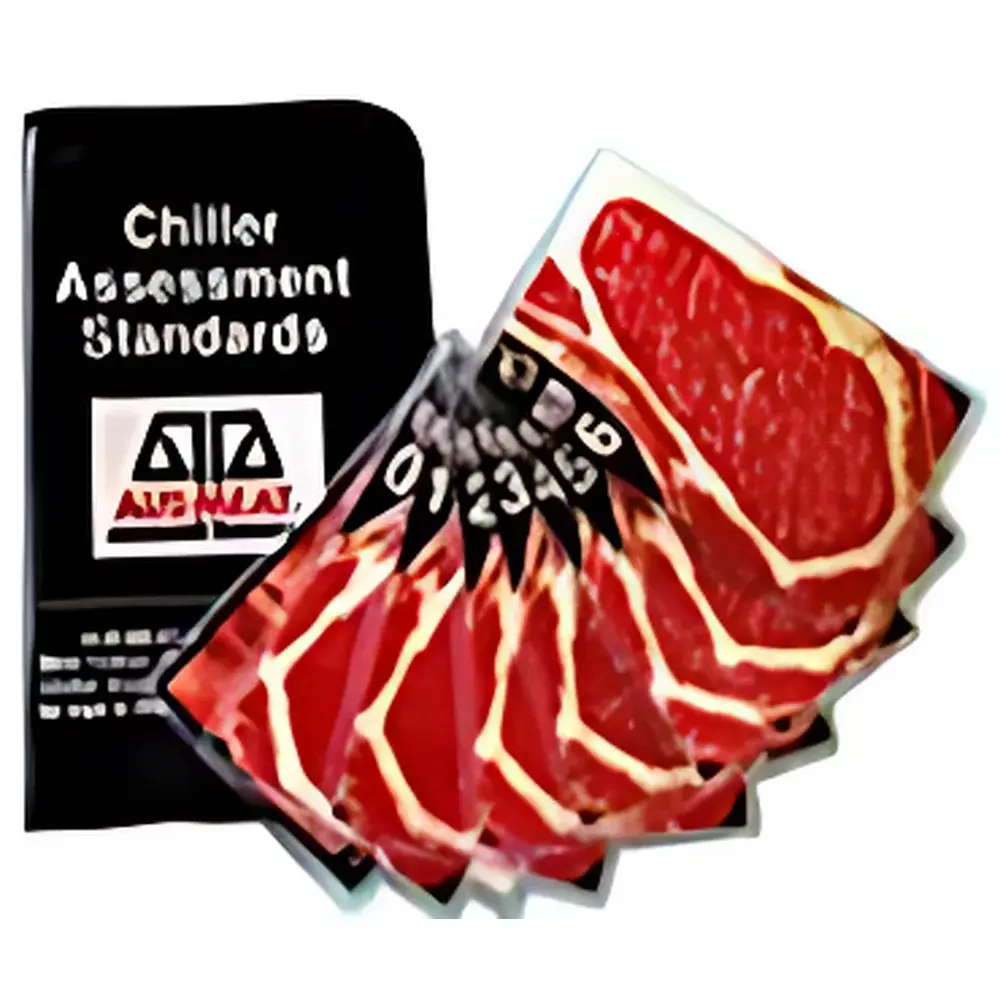
AUS-MEAT Beef Marbling Reference Standard Card
| Origin | Australia |
|---|---|
| Manufacturer Type | Distributor |
| Origin Category | Imported |
| Model | AUS-MEAT |
| Price | Upon Request |
Overview
The AUS-MEAT Beef Marbling Reference Standard Card is a calibrated visual assessment tool engineered for objective, repeatable evaluation of intramuscular fat (marbling) in beef carcasses and primal cuts. Developed under the joint technical governance of AUS-MEAT Limited and the Meat Standards Australia (MSA) program, this standardized reference card implements the internationally recognized AUS-MEAT & MSA Marbling Reference Standards—designed to unify marbling scoring across both classification systems without requiring separate physical references. The card operates on the principle of comparative visual metrology: trained assessors match the observed marbling pattern and density in a ribeye cross-section (typically between the 10th and 11th ribs) against a sequence of nine graded photographic standards printed on archival-grade, color-stable polypropylene substrate. Each grade corresponds to a defined marbling score (from 0 = no marbling to 9 = extremely abundant), aligned with the official AUS-MEAT Marbling Scale and MSA Marbling Score thresholds. Its design eliminates subjectivity inherent in unaided visual estimation, supporting compliance with Australian meat grading protocols and facilitating consistency across abattoirs, feedlots, export inspection facilities, and research laboratories.
Key Features
- Single-reference dual-system compatibility: Validated for use with both AUS-MEAT Marbling Grading and MSA Marbling Scoring protocols.
- Photographically calibrated standards: Nine high-fidelity, spectrally matched images representing incremental marbling densities, printed using ISO 12233-compliant color reproduction methodology.
- Durable, hygienic construction: Laminated polypropylene substrate resistant to moisture, grease, abrasion, and common sanitation agents used in meat processing environments.
- Portable field usability: Compact A5 format with integrated hanging hole and non-slip backing for stable placement on grading tables or carcass rails.
- Traceable calibration: Supplied with batch-specific documentation referencing alignment to the latest revision of the AUS-MEAT & MSA Joint Marbling Reference Standard (current as of 2023 edition).
Sample Compatibility & Compliance
The AUS-MEAT Beef Marbling Reference Standard Card is intended exclusively for visual assessment of marbling in chilled or frozen beef longissimus dorsi (ribeye) muscle sections, cut perpendicular to the muscle fiber orientation at the 10th–11th rib interface. It is not applicable to other species, cooked samples, or non-ribeye anatomical locations. The card complies with the mandatory requirements of the Australian Standard AS 4696:2022 – Meat and meat products – Grading of beef carcases, and supports adherence to MSA’s independently audited grading framework. Its use satisfies traceability and repeatability criteria required under Export Control (Meat and Meat Products) Order 2021 and is accepted by DAFF (Department of Agriculture, Fisheries and Forestry) for official export certification assessments. While not a regulatory instrument per se, it serves as an essential component of GLP-aligned internal quality assurance programs in accredited meat laboratories.
Software & Data Management
This is a physical reference standard; no embedded electronics, firmware, or software are included. However, the card integrates seamlessly into digital quality management ecosystems. Marbling scores recorded using the card may be entered into enterprise-grade platforms such as MeatSuite®, AgriWebb, or custom LIMS solutions compliant with ISO/IEC 17025:2017 for data integrity. When paired with validated image-capture workflows (e.g., standardized lighting, fixed-focus macro photography), the card enables semi-automated scoring via machine vision algorithms trained on AUS-MEAT reference imagery—subject to validation per ASTM E3085-21 for optical measurement system verification. Audit trails for manual scoring must include assessor ID, date/time stamp, carcass ID, and grade assignment, consistent with FDA 21 CFR Part 11 principles where electronic records are maintained.
Applications
- Carcass grading in federally inspected abattoirs and export-approved processing plants.
- Feedlot performance monitoring and genetic selection programs targeting marbling heritability.
- Research studies evaluating nutritional interventions, aging protocols, or breed comparisons on intramuscular fat deposition.
- Training and competency assessment for new graders under AUS-MEAT-accredited programs.
- Import inspection verification for Australian beef entering markets with marbling-based tariff classifications (e.g., Japan, South Korea, EU).
FAQ
Is the AUS-MEAT Marbling Card legally mandated for Australian beef grading?
No—it is the officially endorsed reference standard, but grading personnel must hold current AUS-MEAT accreditation; the card itself supports, but does not replace, formal assessor certification.
Can this card be used for lamb or pork marbling assessment?
No. It is technically validated only for beef longissimus dorsi; marbling morphology and scoring thresholds differ significantly across species.
How often should the card be replaced?
AUS-MEAT recommends replacement every 12 months or upon visible fading, scuffing, or exposure to direct UV light exceeding 500 hours—whichever occurs first.
Does the card require annual recalibration?
No. It is a stable visual reference; however, users must verify perceptual consistency through inter-assessor agreement trials (target κ ≥ 0.85) at least quarterly.
Is digital scanning of the card permitted for remote training?
Yes, provided the display device is calibrated to sRGB IEC 61966-2-1 and viewed under D65 illumination; however, physical card use remains mandatory for official grading.