
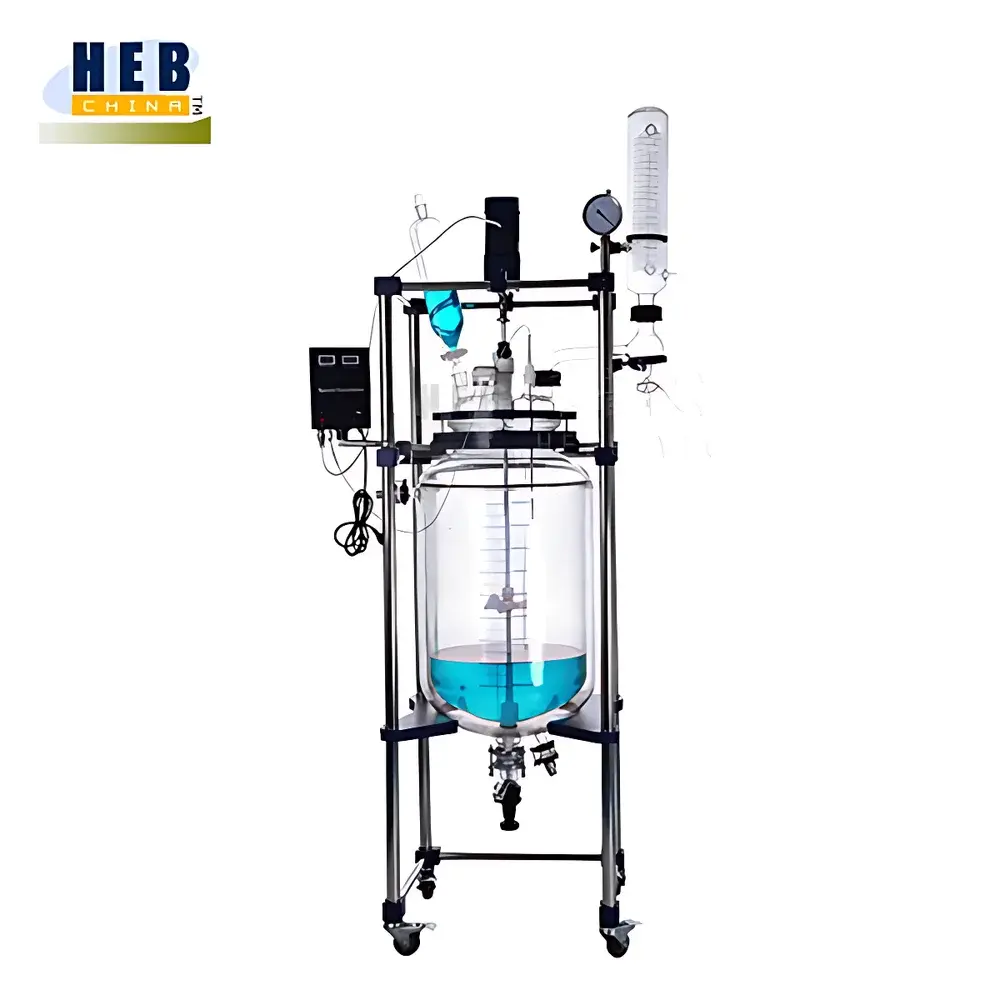
HEB-100L Dual-Jacketed Glass Reactor (Jihepu)
| Brand | Jihepu |
|---|---|
| Origin | Shandong, China |
| Model | HEB-100L |
| Capacity | 100 L |
| Working Pressure | Low-pressure |
| Vacuum Degree | 0.098 MPa |
| Jacket Volume | 18 L |
| Stirring Speed Range | 0–450 rpm |
| Motor Power | 200 W |
| Temperature Range | –80 °C to +250 °C |
| Material | GG-17 borosilicate glass |
| Sealing Type | Mechanical seal with ceramic bearing |
| Stirring Shaft Diameter | 15 mm |
| Overall Dimensions (L×W×H) | 610 × 610 × 2500 mm |
| Net Weight | 125 kg |
Overview
The HEB-100L Dual-Jacketed Glass Reactor is an engineered laboratory-scale reaction system designed for controlled synthesis, distillation, reflux, concentration, and separation under precisely regulated thermal and mechanical conditions. Its core operational principle relies on double-wall jacketed geometry: a circulating medium—such as silicone oil, glycol-water mixture, or chilled ethanol—is introduced into the annular space between the inner and outer glass walls to maintain uniform temperature control across the reaction volume. Simultaneously, a magnetically coupled or mechanically sealed agitator ensures homogeneous mixing without compromising vacuum integrity. This architecture enables precise isothermal or programmed thermal profiles while sustaining stable vacuum levels up to 0.098 MPa (≈98 kPa absolute), making it suitable for low-boiling-point solvent handling, high-temperature catalytic reactions, and moisture-sensitive chemistry.
Key Features
- GG-17 borosilicate glass vessel (ASTM E438 Type I, Class A) offering exceptional thermal shock resistance (ΔT ≥ 120 °C), chemical inertness toward most organic solvents and mild acids/bases, and optical clarity for real-time visual monitoring of reaction progress.
- Stainless steel support frame with aluminum alloy structural components providing corrosion resistance, dimensional stability, and load-bearing capacity for full 100 L operation.
- PTFE-coated stainless steel stirring shaft and impeller ensuring compatibility with aggressive reagents and eliminating metal ion leaching.
- Brushless AC motor with variable-frequency drive delivering smooth torque transmission from 0–450 rpm, zero sparking risk, and extended service life under continuous duty cycles.
- Double mechanical seal assembly incorporating ceramic rotating face and PTFE stationary components, validated for long-term vacuum retention at ≤0.098 MPa and minimal maintenance intervals.
- Dual digital display controller showing both setpoint and real-time internal temperature (via PT100 sensor) and rotational speed, enabling synchronized thermal–mechanical process parameter logging.
- 6-port standardized ground-glass joint lid (ISO 29/32 or NS 29/32 equivalents) supporting modular integration of condensers, dropping funnels, thermometers, gas inlets, and vacuum lines.
- Zero-dead-volume PTFE-lined discharge valve with inclined glass port geometry minimizing residual material retention and facilitating quantitative sample recovery.
- Integrated casters with locking brakes allow safe relocation within laboratory environments without disassembly.
Sample Compatibility & Compliance
The reactor accommodates heterogeneous and homogeneous reaction mixtures ranging from viscous polymer solutions to volatile low-molecular-weight organics. Its GG-17 construction complies with ISO 3585 for laboratory glassware and meets general requirements of USP for pharmaceutical apparatus. While not intrinsically rated for explosion-proof operation, optional ATEX-compliant motor and ignition-safe sealing upgrades are available upon request. The system supports GLP-aligned documentation when paired with external data loggers compliant with FDA 21 CFR Part 11 (electronic records/signatures) via analog output interfaces. All mechanical components conform to RoHS directives; no cadmium, lead, or hexavalent chromium is used in manufacturing.
Software & Data Management
The HEB-100L operates as a stand-alone instrument with local analog/digital control. For integrated process monitoring, optional RS-485 or 4–20 mA outputs enable connection to third-party SCADA systems (e.g., LabVIEW, DeltaV, or Siemens Desigo). Temperature and speed signals can be time-stamped and archived using external chart recorders or programmable logic controllers. Traceability is supported through manual logbook entries aligned with ISO/IEC 17025 clause 7.7 (result reporting) and ASTM E2500-13 (verification of laboratory equipment). Firmware updates are delivered via USB interface; version history and calibration logs are retained in non-volatile memory.
Applications
- Small-to-medium scale synthesis of fine chemicals, APIs, and intermediates under inert atmosphere or reduced pressure.
- Controlled esterification, amidation, and Friedel-Crafts reactions requiring precise exotherm management.
- Solvent recovery via rotary evaporation-compatible reflux/distillation configurations.
- Polymerization studies (e.g., free-radical, condensation) where viscosity evolution must be tracked in situ.
- Biochemical extractions involving heat-labile natural products, utilizing low-temperature vacuum concentration.
- Materials science applications including nanomaterial precursor hydrolysis and sol-gel processing.
- Process development and tech-transfer support for GMP-compliant pilot plants (when validated per ICH Q5A–Q5E).
FAQ
What is the maximum allowable operating temperature for the glass vessel?
The GG-17 borosilicate glass body is rated for continuous use from –80 °C to +250 °C; short-term excursions up to +300 °C are permissible with appropriate thermal ramping protocols.
Can this reactor be used under full vacuum (<1 mbar)?
The standard configuration maintains vacuum down to 0.098 MPa (≈20 mbar absolute); for sub-millibar operation, optional high-vacuum mechanical seals and reinforced jacket design are required.
Is the motor compatible with 110 V / 60 Hz power supplies?
The base unit ships with 220 V / 50 Hz input; universal voltage (100–240 V, 50/60 Hz) motor drivers are available as factory-installed options.
How is temperature measured inside the reaction chamber?
A calibrated PT100 RTD probe is inserted through a dedicated port in the lid, positioned near the center of the liquid phase to minimize wall-effect bias.
Does the system include validation documentation for GxP environments?
Factory calibration certificates (traceable to NIST standards) are provided; IQ/OQ protocols and URS templates can be supplied separately for user-executed qualification.



