
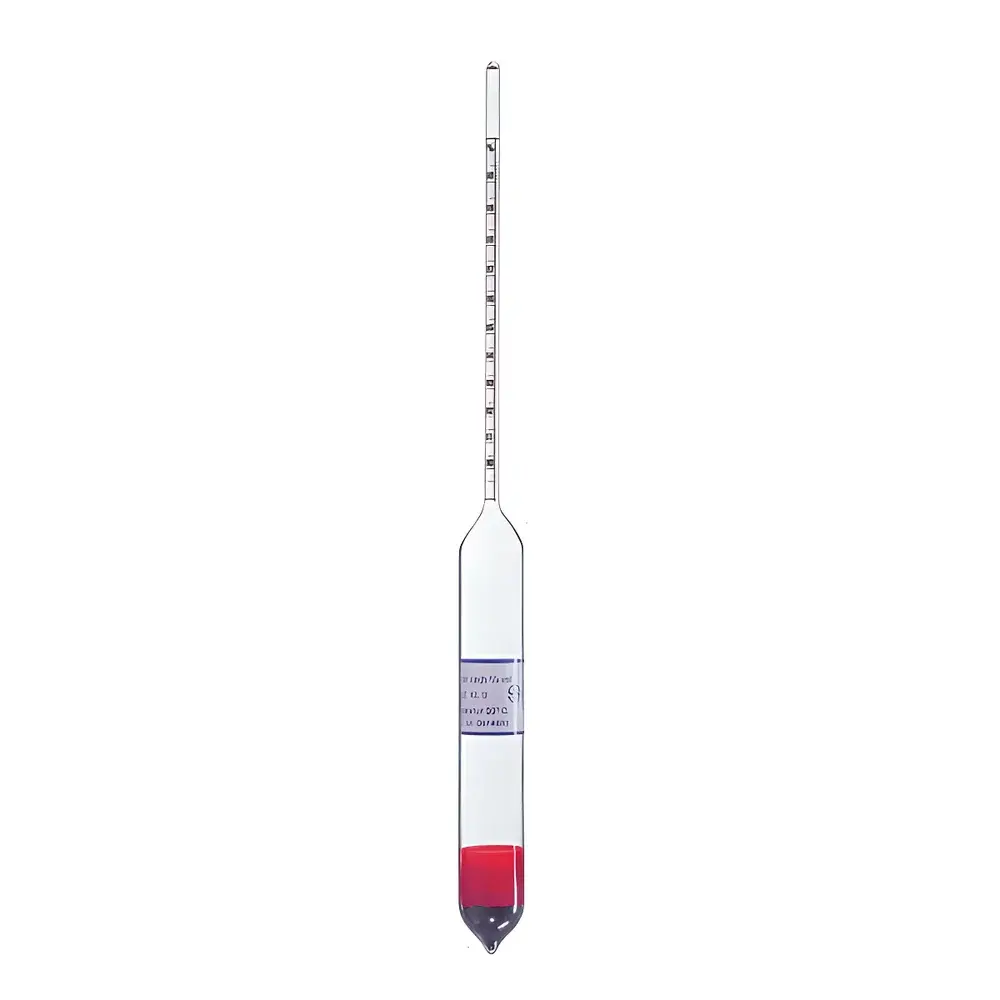
Julabo Density and Specific Gravity Hydrometers
| Brand | Julabo |
|---|---|
| Origin | Germany |
| Manufacturer Type | Authorized Distributor |
| Product Category | Imported Instrument |
| Model Range | Density & Specific Gravity Hydrometers |
| Calibration Options | DKD-accredited, Factory-calibrated, or PTB-traceable |
| Density Range | 450–2000 kg/m³ |
| Alcohol Range | 0–100 % v/v |
| Brix Range | 0–70 °Bx |
| Compliance | DIN 12797, ISO 3675, ASTM D1298, BS 684-2.1, EN ISO 1675 |
Overview
Julabo density and specific gravity hydrometers are precision-manufactured glass or polymer instruments engineered for direct, buoyancy-based measurement of liquid density and related concentration parameters. Based on Archimedean principle and calibrated according to internationally recognized hydrostatic weighing methodology (Cuckow method), these hydrometers deliver traceable, reproducible results across diverse industrial and laboratory environments. Each unit is individually calibrated against reference standards traceable to the Physikalisch-Technische Bundesanstalt (PTB), Germany’s national metrology institute (Certificate No. DKD-K-06701). Designed for use in controlled temperature conditions—often paired with Julabo’s certified thermostatic baths—the instruments operate within a defined thermal stability envelope to minimize thermal expansion errors. Their application spans routine quality control, regulatory compliance testing, and research-grade characterization where primary-standard-level density data is required without electronic instrumentation.
Key Features
- Traceable calibration options: DKD-accredited (Deutscher Kalibrierdienst), factory-certified, or PTB-reference certified—fully compliant with ISO/IEC 17025 requirements for calibration laboratories.
- Material variants: Borosilicate glass (for chemical resistance and optical clarity) and high-strength polymer (for impact-sensitive or field-deployed applications).
- Integrated temperature compensation: Most models feature built-in calibrated thermometers (±0.1 °C accuracy) enabling real-time thermal correction per ASTM D1298 Annex A1 and ISO 3675 Clause 7.
- Application-specific scale engineering: Scales optimized for linear or non-linear response characteristics—e.g., alcohol by volume (ABV), Brix (sucrose mass fraction), API gravity, Baumé, or milk lactometer scales—each validated per relevant standard methodology.
- Custom scale development: Julabo supports bespoke hydrometer design—including specialized ranges, dual-scale configurations, or custom buoyancy profiles—for OEM integration or niche process monitoring.
- Robust packaging and documentation: Individually shock-absorbed in ISO-compliant transport containers; supplied with calibration certificate, traceability statement, and conformity declaration per EU Regulation (EC) No. 765/2008.
Sample Compatibility & Compliance
These hydrometers are validated for use with aqueous solutions, hydrocarbons, alcohols, glycols, dairy emulsions, battery electrolytes, antifreeze mixtures, and liquefied petroleum gases (LPG). Compatibility extends to aggressive media including sulfuric acid (battery acid), ethanol-water blends, crude oil fractions, and fruit musts—subject to material selection (glass vs. chemically resistant polymer). All standard models conform to DIN 12797 (density hydrometers), ISO 3675 (crude petroleum), ASTM D1298 (petroleum products), BS 684-2.1 (food oils), and EN ISO 1675 (plastics). DKD certification ensures compliance with GLP and GMP audit requirements for pharmaceutical and food manufacturing facilities, particularly under FDA 21 CFR Part 11–aligned documentation workflows.
Software & Data Management
While inherently analog instruments, Julabo hydrometers integrate seamlessly into digital QA/QC ecosystems via companion calibration management software (Julabo CaliSoft™, optional). This platform supports electronic archiving of calibration certificates, expiry tracking, instrument history logs, and automated generation of audit-ready reports aligned with ISO 9001, ISO 17025, and 21 CFR Part 11 electronic record requirements. All DKD-certified units include QR-coded traceability identifiers linking directly to secure cloud-hosted calibration metadata—including uncertainty budgets, environmental conditions at time of calibration, and PTB reference standard IDs.
Applications
- Pharmaceutical manufacturing: Excipient density verification, solvent purity assessment, and USP specific gravity testing.
- Petroleum refining: Crude assay, distillate grading, and API gravity determination per ASTM D287 and D1298.
- Fermentation & beverage production: Real-time alcohol titration in wine, beer, and spirits; Brix-to-sugar conversion in juice and syrup processing.
- Foods & dairy: Lactometer-based fat content estimation in raw milk; density profiling of cream, whey, and plant-based alternatives.
- Automotive & energy: Electrolyte density monitoring in lead-acid batteries; ethylene glycol/water ratio verification in coolant formulations.
- Marine & environmental: Seawater salinity estimation, ballast water density verification, and sediment suspension characterization.
FAQ
What calibration accreditation options are available?
DKD-accredited calibration (valid for 12 months), factory calibration (with NIST-traceable reference), or PTB-direct certification—each includes full uncertainty budget and compliance statement.
Can hydrometers be used at elevated temperatures?
Yes—provided the liquid temperature remains within the instrument’s specified operating range (typically 15–40 °C); simultaneous temperature measurement is mandatory for correction per ISO 3675 Clause 7.
Are polymer hydrometers as accurate as glass models?
Polymer variants maintain equivalent scale resolution and buoyancy fidelity for designated applications (e.g., field LPG testing), though long-term dimensional stability is verified per ISO 17025 Annex C for each batch.
How often should recalibration occur?
Annually for DKD-certified units; biannually for factory-calibrated instruments under stable usage conditions—frequency may increase per internal QA protocols or regulatory mandates (e.g., FDA, EMA).
Do you support custom scale development for proprietary formulations?
Yes—Julabo’s metrology team collaborates with clients to define buoyancy profiles, density-concentration algorithms, and scale graduation per application-specific validation protocols.



