
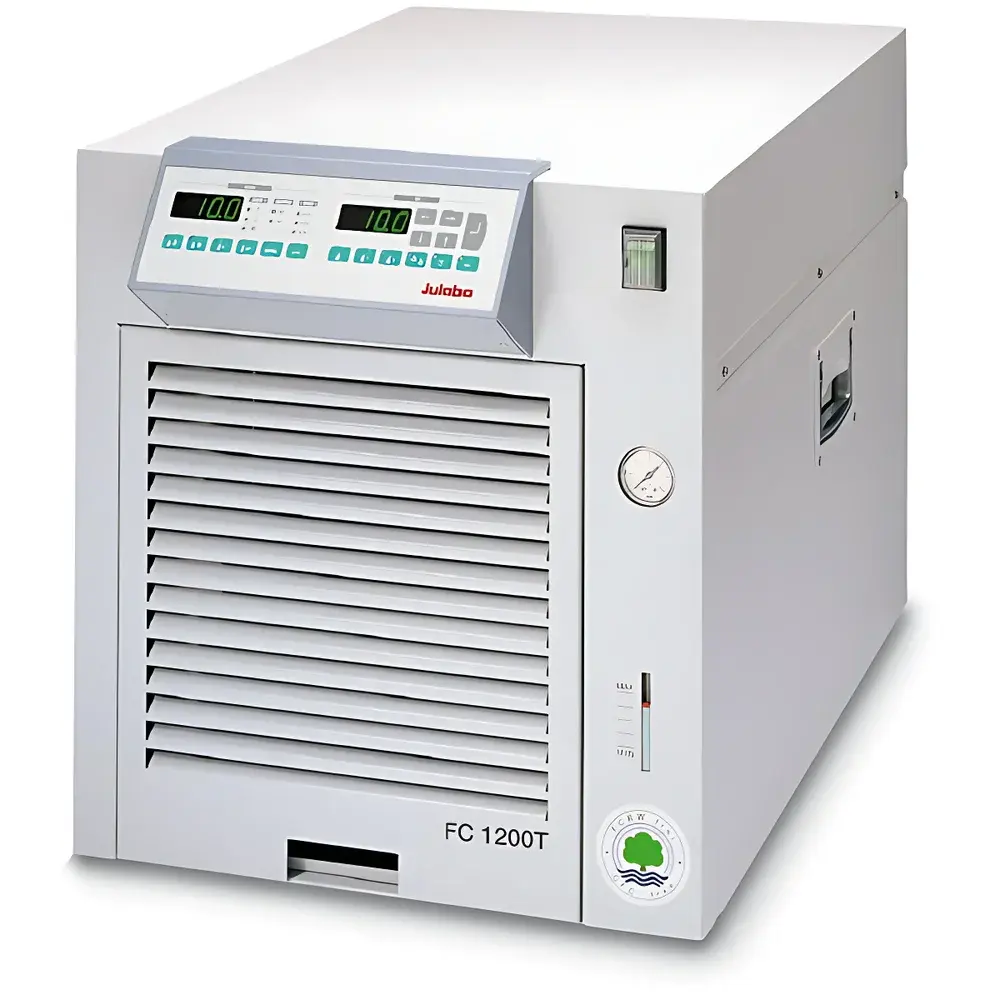
Julabo FC1200T Circulating Chiller
| Brand | Julabo |
|---|---|
| Origin | Germany |
| Model | FC1200T |
| Instrument Type | Integrated Circulating Chiller |
| Cooling Method | Air-Cooled |
| Temperature Range | –10 °C to +80 °C |
| Temperature Stability | ±0.2 °C |
| Refrigeration Capacity | 1100 W at 20 °C |
| Heating Power | 1.2 kW |
| Pump Flow Rate | 28 L/min |
| Pump Pressure | 3.5 bar |
| Reservoir Volume | 8–11 L |
| Operating Mode | Continuous |
| External Pt100 Sensor Interface | Integrated |
| Analog I/O | 0–10 V / 0–24 mA |
| Communication | RS232 (optional), Profibus (optional) |
| Sound Pressure Level (1 m) | ≤58 dBA |
| Dimensions (W×L×H) | 46×61×49 cm |
| Weight | 67 kg |
Overview
The Julabo FC1200T Circulating Chiller is an integrated, air-cooled temperature control system engineered for precision thermal management in demanding laboratory and pilot-scale industrial applications. Based on vapor-compression refrigeration with a hermetically sealed scroll compressor and R-404A/R-134a blended refrigerant circuit (compliant with EU F-Gas Regulation No. 517/2014), the FC1200T delivers stable, programmable cooling and heating across a broad operating range of –10 °C to +80 °C. Its dual-function design—combining active refrigeration and resistive heating (1.2 kW)—enables precise setpoint control without external heaters or chillers, making it suitable for applications requiring tight thermal regulation of spectrophotometers, laser sources, rotary evaporators, calorimeters, and reactor jackets. The unit operates continuously under ambient conditions of 5–40 °C and is designed to replace wasteful tap-water cooling, reducing water consumption while maintaining consistent heat exchange performance.
Key Features
- Integrated dual-mode temperature control: simultaneous refrigeration (up to 1100 W at 20 °C) and electric heating (1.2 kW) for seamless ramping and overshoot suppression
- High-flow, high-pressure circulation system: 28 L/min flow rate at 3.5 bar maximum head pressure, optimized for low-impedance and moderate-resistance external loops
- Dual LED display interface: independent real-time readouts for outlet and inlet temperatures, with 0.1 °C resolution and user-configurable temperature differential (ΔT) control
- Intuitive top-fill reservoir with transparent level indicator and dual hose fittings (8 mm and 12 mm ID) pre-installed on M16×1 male threaded pump ports
- Embedded analog I/O (0–10 V / 0–24 mA) for external temperature feedback integration and process synchronization with PLCs or data loggers
- Optional digital communication modules: RS232 for basic remote parameter setting and Profibus-DP for integration into industrial automation networks compliant with IEC 61158
- Acoustically optimized enclosure: sound pressure level ≤58 dBA at 1 m distance, meeting ISO 3744 requirements for laboratory noise environments
Sample Compatibility & Compliance
The FC1200T is compatible with aqueous and water-glycol mixtures (up to 35% v/v ethylene or propylene glycol) as heat transfer fluids. It supports external loop configurations with maximum return fluid temperatures of 80 °C and minimum inlet temperatures down to –10 °C, ensuring compatibility with cryogenic condensers and high-temperature reactors. All wetted components—including stainless steel reservoir, brass pump housing, and EPDM/NBR seals—are chemically resistant to common laboratory coolants. The unit conforms to EN 61000-6-3 (EMC emission), EN 61000-6-2 (immunity), and EN 61010-1 (safety for electrical equipment for measurement, control, and laboratory use). Its analog and digital interfaces support traceable temperature logging in accordance with FDA 21 CFR Part 11 when paired with validated third-party software, and its stable thermal output meets ASTM E2877-21 criteria for chiller performance verification in analytical instrument cooling.
Software & Data Management
While the FC1200T operates autonomously via its front-panel controls, its optional RS232 interface enables bidirectional communication using ASCII-based command protocols for remote start/stop, setpoint adjustment, and status interrogation (e.g., actual temperature, pump speed, compressor state, error codes). When connected to a PC or industrial controller, the device supports time-stamped data export for trend analysis. Analog outputs allow continuous recording of outlet temperature or ΔT on strip-chart recorders or SCADA systems. For GLP/GMP environments, audit trails can be maintained externally through synchronized timestamping of analog signals and serial commands—no internal storage or user-accessible firmware is required, minimizing validation burden.
Applications
- Cooling of high-power lasers and optical benches requiring sub-0.3 °C thermal drift over 8-hour operation
- Temperature stabilization of HPLC column ovens and detector cells during gradient elution
- Heat removal from vacuum pump jackets and distillation condensers in organic synthesis workflows
- Controlled cooling of calorimetric cells in reaction enthalpy studies (ISO 11357-4)
- Thermal conditioning of environmental test chambers and material testing fixtures
- Support of automated sample preparation systems where consistent coolant supply is critical to assay reproducibility
FAQ
What is the maximum allowable return fluid temperature?
The FC1200T accepts return fluid up to 80 °C, enabling direct connection to heated reactor jackets without intermediate heat exchangers.
Can the unit maintain stability at the lower end of its temperature range (–10 °C)?
Yes—temperature stability remains ±0.2 °C across the full –10 °C to +80 °C range, verified per ISO/IEC 17025-accredited calibration procedures using traceable Pt100 reference probes.
Is glycol mixture compatibility validated by Julabo?
The FC1200T is tested and warranted for operation with up to 35% (v/v) propylene glycol/water solutions; ethylene glycol is permitted but requires adherence to local occupational safety guidelines due to toxicity classification.
Does the unit support external temperature feedback for cascade control?
Yes—the integrated Pt100 input allows connection of an external sensor placed at the process load, enabling true process-temperature-regulated operation rather than chiller-outlet-only control.
What maintenance intervals are recommended for long-term reliability?
Compressor oil and refrigerant integrity should be verified every 24 months under continuous operation; filter-drier replacement and system leak checks are advised annually per Julabo Technical Bulletin TB-FC-02.



