
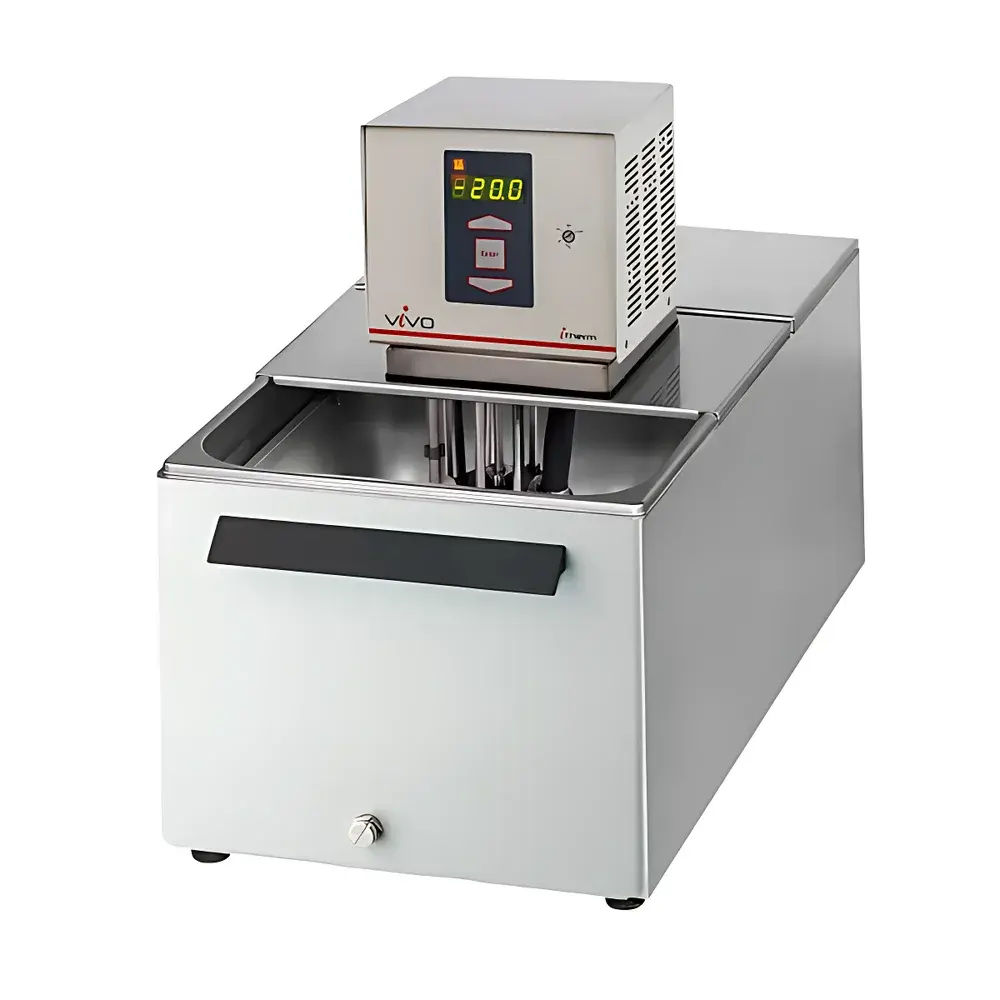
JULABO VIVO RT5F Heating and Cooling Circulator
| Brand | JULABO |
|---|---|
| Origin | Germany |
| Model | RT5F |
| Temperature Range | −25 to +100 °C |
| Temperature Stability | ±0.05 °C |
| Heating Power | 1.5 kW |
| Refrigeration Capacity (at 20/10/0/−10/−20 °C) | 300/280/220/170/70 W |
| Pump Flow Rate | 10 L/min |
| Max. Pump Pressure | 0.23 bar |
| Bath Opening × Depth (W × L × D) | 15 × 15 × 15 cm |
| Fill Volume | 4–6 L |
| Refrigerant | R134a (non-ozone-depleting) |
| Internal/External Circulation | Yes |
| Safety Features | Dry-run protection with float-level sensor, overtemperature cutoff, Active Cooling Control™ |
Overview
The JULABO VIVO RT5F is a precision-engineered heating and cooling circulator designed for demanding laboratory applications requiring stable, bidirectional temperature control across a wide operational range (−25 to +100 °C). Based on Julabo’s proprietary Active Cooling Control™ technology, the unit delivers continuous refrigeration capability at any point within its full temperature span—eliminating thermal lag during dynamic setpoint transitions. Its core architecture integrates a high-efficiency hermetic compressor, corrosion-resistant stainless-steel heating coil, and a low-noise centrifugal circulation pump capable of sustaining consistent flow against backpressure in external systems. Unlike basic thermostatic baths, the RT5F functions both as an open-bath constant-temperature reservoir and as a closed-loop external temperature controller—making it suitable for jacketed reactors, calorimeters, viscometers, and analytical instrumentation requiring precise thermal conditioning.
Key Features
- Active Cooling Control™: Full-range refrigeration activation ensures immediate response to cooling demand at any setpoint between −25 and +100 °C.
- PID-based digital temperature regulation with ±0.05 °C stability (measured at bath sensor under standard conditions per DIN 12876-1).
- Dual-mode operation: Internal bath mode for sample immersion or external circulation mode for process temperature control via flexible hose connections.
- Integrated safety architecture including float-level sensor with audible/visual low-fluid alarm and automatic power cutoff to prevent dry-run damage.
- Overtemperature protection circuitry compliant with IEC 61010-1:2010 for laboratory equipment safety.
- Ergonomic front-panel interface with three tactile keys and high-contrast LCD display for intuitive parameter entry and real-time status monitoring.
- Front-mounted drain valve enables rapid, spill-free bath fluid replacement without disassembly.
- Optimized thermal management design featuring enlarged heat sink surface area and directional airflow channels for sustained performance under continuous load.
Sample Compatibility & Compliance
The RT5F accommodates a broad spectrum of heat-transfer media—including water, water-glycol mixtures, silicone oils, and low-viscosity synthetic heat transfer fluids—enabling compatibility with diverse sample types and experimental constraints. Its stainless-steel bath chamber and heating coil resist corrosion from aqueous and mildly aggressive solutions. The device meets key international standards for laboratory equipment: EN 61010-1 (safety), EN 61326-1 (EMC), and complies with RoHS and REACH directives. While not intrinsically rated for hazardous environments, it supports GLP/GMP workflows through traceable calibration records and configurable logging intervals when paired with optional software modules.
Software & Data Management
The RT5F operates autonomously but supports optional PC connectivity via RS232 or USB interfaces for remote monitoring and parameter configuration using JULABO’s WinWTC software. This platform enables time-stamped temperature logging, multi-device synchronization, and export of CSV-formatted datasets compatible with LIMS integration. Audit trails—including operator ID, setpoint changes, alarm events, and runtime statistics—are retained locally and can be exported for FDA 21 CFR Part 11-compliant documentation upon installation of user-authenticated access controls.
Applications
- Temperature control of jacketed glass reactors in synthetic chemistry and process development.
- Thermal conditioning of detectors and optical components in spectroscopy and chromatography systems.
- Stabilization of viscosity measurement cells in rotational rheometry (e.g., Brookfield, Anton Paar).
- Calibration of temperature-sensitive sensors and transducers across extended ranges.
- Material testing under controlled thermal stress (e.g., polymer crystallinity studies, thermal expansion coefficient determination).
- Cell culture incubator auxiliary cooling in biotechnology labs where ambient heat rejection exceeds HVAC capacity.
FAQ
What is the minimum recommended fill volume for stable temperature control?
For optimal thermal homogeneity and sensor accuracy, maintain fluid level above the minimum mark indicated on the internal scale—typically ≥4 L for the RT5F model.
Can the RT5F operate continuously at −25 °C with external circulation?
Yes; the unit maintains specified refrigeration capacity down to −25 °C under defined ambient conditions (≤25 °C, ≤60% RH) and nominal backpressure (<0.23 bar). Continuous operation requires adequate ventilation and avoidance of condensation ingress.
Is R134a refrigerant compliant with current EU F-Gas regulations?
R134a has a GWP of 1430 and is subject to phase-down under EU Regulation (EU) No 517/2014; however, it remains permitted for use in existing laboratory equipment until technical alternatives achieve equivalent performance and safety certification.
Does the RT5F support programmable ramp/soak profiles?
No; the RT5F features fixed-setpoint control only. For multi-step thermal protocols, integration with external programmable logic controllers (PLCs) or third-party software via serial communication is required.
How often should the bath fluid be replaced?
Replacement frequency depends on fluid type and usage intensity; distilled water should be changed every 2–4 weeks in high-use environments, while silicone oils may last 6–12 months. Visual inspection for discoloration, particulates, or viscosity change is advised.



