
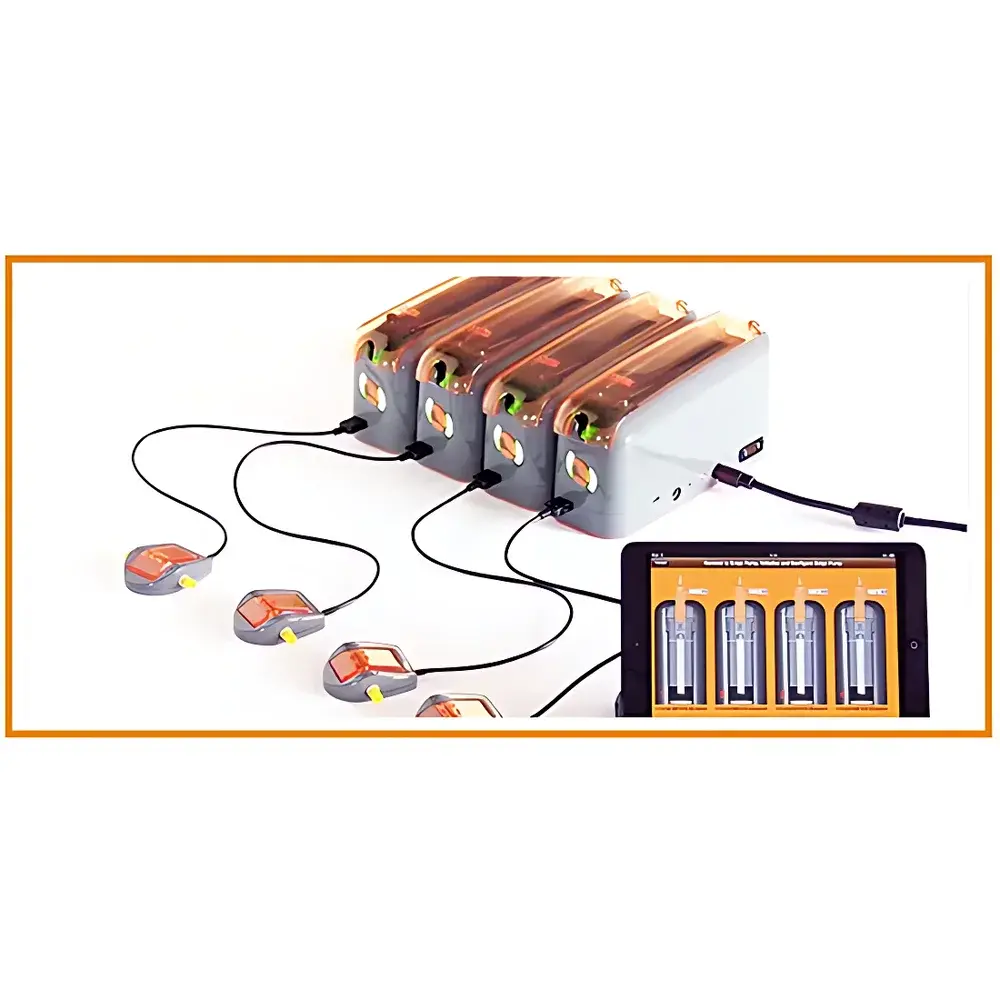
Cellix UniGO Pump High-Precision Microfluidic Pressure Pump
| Brand | Cellix |
|---|---|
| Origin | Ireland |
| Model | UniGO Pump |
| Flow Range | 1 µL/min – 1 mL/min |
| Flow Accuracy | ±120 nL/min (with FS-80.0 sensor) / ±2 µL/min (with FS-1000 sensor) |
| Max Operating Pressure | 10 bar (145 psi) |
| Control Interface | Wi-Fi (iPad mini SmartFlo app) & USB (LabVIEW) |
| Dimensions | 225 × 69 × 122 mm |
| Weight | ~1.3 kg |
| Power | 110/220 V, 50/60 Hz, 60 W |
| Sensor Dead Volume | 1–25 µL |
| Max Sensor Pressure Rating | 2 bar (30 psi) |
| Pump Modes | Manual flow setpoint or pre-programmed profiles (constant, ramp, step, sine) |
| Channel Configuration | Single-channel, scalable up to 4 units (UniGO + ExiGO combinations) |
| Flow Direction | Unidirectional (push-only) |
| Flow Pulsatility | Non-pulsatile |
Overview
The Cellix UniGO Pump is a high-precision, single-channel microfluidic pressure-driven pump engineered for applications demanding stable, repeatable, and pulse-free fluid delivery at the microliter-to-milliliter per minute scale. Unlike syringe-based displacement pumps, the UniGO operates on regulated pneumatic pressure actuation—applying controlled positive pressure to reservoirs via gas-tight tubing—to generate highly linear, low-noise flow profiles across its full operational range. This pressure-driven architecture eliminates mechanical back-driving, stiction-related hysteresis, and pulsation artifacts commonly observed in stepper-motor-driven systems, making it particularly suitable for shear-sensitive biological assays, laminar interface studies, and droplet generation where temporal fidelity and inter-run reproducibility are critical. Designed and manufactured in Ireland, the UniGO complies with CE marking requirements and meets electromagnetic compatibility (EMC) standards per IEC 61326-1 for laboratory instrumentation.
Key Features
- Two operational modes: real-time manual flow setpoint adjustment or pre-programmed dynamic profiles—including constant, linear ramp, discrete step, and sinusoidal waveforms—enabling complex flow transients without external scripting.
- Integrated PID feedback loop via plug-and-play flow sensors (FS-80.0 or FS-1000), delivering closed-loop flow regulation with sub-microliter resolution and drift-compensated stability over extended runtimes.
- Modular scalability: up to four UniGO units—or mixed configurations with ExiGO syringe pumps—can be synchronized and independently addressed via a single SmartFlo interface, supporting multi-parameter experimental designs.
- Dual-control ecosystem: native iPad mini application (SmartFlo) for rapid prototyping and field deployment; LabVIEW-compatible drivers (NI-VISA compliant) for integration into automated test benches and GLP-compliant data acquisition workflows.
- Compact, benchtop-ready form factor (225 × 69 × 122 mm) with low thermal signature and passive cooling—optimized for use inside biosafety cabinets, environmental chambers, and integrated microfluidic workstations.
Sample Compatibility & Compliance
The UniGO Pump supports aqueous, organic, and low-viscosity non-corrosive fluids compatible with standard fluoropolymer (e.g., FEP, PTFE) and stainless-steel wetted path components. Its pressure-driven architecture avoids direct contact between moving parts and fluid, minimizing contamination risk and enabling sterile operation when paired with disposable fluidic cartridges. The system adheres to ISO/IEC 17025-relevant traceability practices for calibration documentation and supports audit-ready metadata logging when used with SmartFlo or LabVIEW environments configured for 21 CFR Part 11 compliance (electronic signatures, audit trails, user access controls). All firmware and software updates follow documented change control procedures aligned with GMP Annex 11 principles.
Software & Data Management
SmartFlo—a proprietary iOS application—runs natively on iPad mini devices and provides intuitive graphical programming of flow profiles, real-time sensor visualization, and multi-pump synchronization. Exported datasets include timestamped flow rate, pressure, sensor status, and profile execution logs in CSV format. For high-throughput or regulated environments, the LabVIEW driver suite offers programmatic access to all hardware registers, including sensor calibration coefficients, PID gain parameters, and error state flags. Data streams can be routed to third-party platforms (e.g., DIAdem, MATLAB, Python via PyVISA) for post-acquisition analysis, statistical process monitoring, or machine learning–based anomaly detection.
Applications
- Droplet microfluidics: monodisperse emulsion and vesicle generation under steady or oscillating flow conditions.
- Cell mechanobiology: precise application of physiological shear stresses (0.1–20 dyn/cm²) to endothelial or epithelial monolayers in perfusion chambers.
- Laminar co-flow studies: controlled interfacing of multiple reagent streams for diffusion-limited reaction kinetics or gradient-based chemotaxis assays.
- Nanoparticle synthesis: reproducible mixing of precursors in segmented or continuous flow reactors.
- Organ-on-a-chip validation: long-duration perfusion of microphysiological systems with minimal flow-induced stress artifacts.
- Calibration reference: serving as a traceable flow standard for validating optical flow meters, Coriolis sensors, or micro-PIV systems.
FAQ
What flow sensors are compatible with the UniGO Pump?
The UniGO supports two factory-calibrated, hot-film thermal mass flow sensors: FS-80.0 (range: 1–80 µL/min, accuracy ±120 nL/min) and FS-1000 (range: 10 µL/min–1 mL/min, accuracy ±2 µL/min). Both feature plug-and-play electrical and fluidic interfaces.
Can the UniGO operate in vacuum or negative pressure mode?
No—the UniGO is designed exclusively for positive-pressure (push-mode) operation. It does not support suction or bidirectional flow. For pull-mode applications, Cellix recommends pairing with an ExiGO syringe pump.
Is remote monitoring supported outside the local Wi-Fi network?
SmartFlo requires local network connectivity. Remote access beyond the LAN must be implemented externally via secure VPN tunneling or enterprise-grade network bridging—Cellix does not provide cloud-hosted control services.
How is sensor dead volume managed during assay setup?
Dead volume (1–25 µL, depending on sensor model) is characterized during factory calibration and reported in the sensor’s certificate of conformance. Users may compensate for transport delay in time-critical protocols by applying empirically determined offset values in SmartFlo or LabVIEW.
Does the UniGO meet regulatory requirements for clinical or diagnostic use?
The UniGO Pump is intended for research use only (RUO). While it conforms to general safety and EMC directives (CE, RoHS), it is not certified under IVD or FDA 510(k) pathways and lacks design controls documentation required for diagnostic device integration.



