
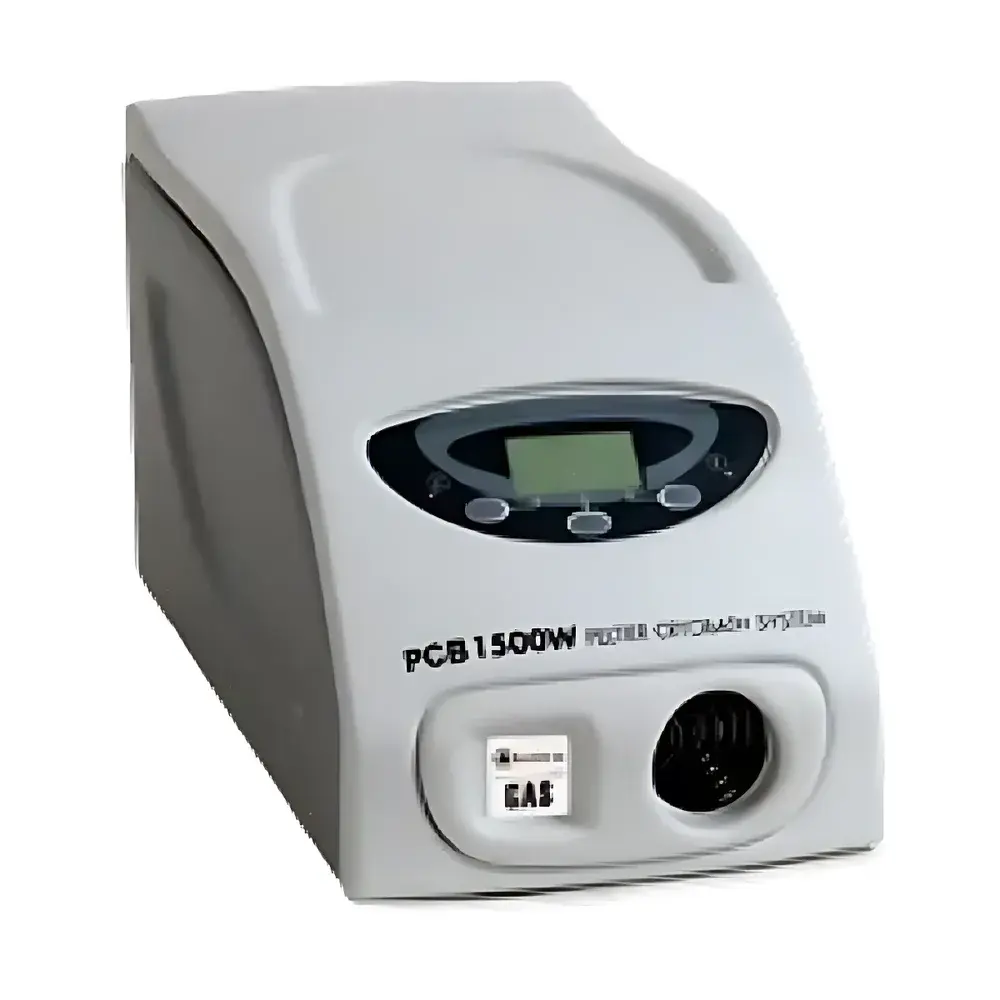
ChemTron PCB 1500 Plus Semiconductor Temperature Controller
| Brand | ChemTron |
|---|---|
| Origin | Germany |
| Model | PCB 1500 Plus |
| Temperature Range | 0–110 °C |
| Temperature Accuracy | ±0.1 °C |
| Temperature Repeatability | ±0.5 °C |
| Semiconductor-Based Heating/Cooling | Yes |
| RS232 Interface | Yes |
| USB Interface | Yes |
| Display | Graphical LCD |
| Certifications | CE, CSA |
| Voltage Options | 110 V / 220 V AC |
Overview
The ChemTron PCB 1500 Plus is a precision semiconductor-based temperature controller designed for external thermal regulation of analytical instruments, sample chambers, and laboratory reactors. Unlike conventional compressor-driven chillers or resistive-heating circulators, this system employs solid-state Peltier elements to achieve bidirectional thermal control—enabling both heating and cooling of circulating fluid without mechanical refrigeration cycles or oil-based heat transfer media. Its operational principle relies on the thermoelectric effect: precise current modulation across semiconductor junctions allows dynamic, stepless adjustment of heat flux into or out of the recirculating water loop. This architecture eliminates vibration, electromagnetic interference, and acoustic noise—critical advantages when integrated with sensitive instrumentation such as FTIR spectrometers, XRD goniometers, or optical microscopy stages where micro-vibrational coupling or EMI-induced signal drift must be avoided. The device operates within a continuous temperature range of 0 °C to 110 °C, with stability maintained at ±0.1 °C under steady-state conditions and repeatability of ±0.5 °C across sequential thermal cycles.
Key Features
- Solid-state semiconductor (Peltier) thermal management—no compressors, refrigerants, or moving parts in the thermal path
- Zero EMI and ultra-low mechanical vibration output—engineered for integration with high-sensitivity optical and electronic measurement systems
- Graphical LCD interface with real-time temperature trend display and intuitive menu navigation
- Dual-voltage compatibility (110 V / 220 V AC) for global deployment without hardware modification
- Integrated RS232 and USB communication ports supporting ASCII command protocol for OEM integration and automated lab workflows
- Compliance with CE and CSA safety standards—fully documented conformity assessment per IEC 61010-1:2010
Sample Compatibility & Compliance
The PCB 1500 Plus is intended for use with externally circulated water-glycol or deionized water loops connected to third-party equipment—including spectrophotometer sample compartments, rheometer jackets, calorimeter baths, and environmental test chambers. It does not directly contact samples; rather, it regulates fluid temperature upstream of the application point. All wetted components are constructed from chemically resistant stainless steel (AISI 316) and EPDM-sealed polymers, ensuring compatibility with pH-neutral aqueous solutions. The unit meets the electrical safety requirements of EN 61010-1 and UL 61010-1, and its electromagnetic compatibility conforms to EN 61326-1 (industrial environment class). While not intrinsically rated for hazardous locations, its low-power semiconductor architecture inherently limits energy discharge risk. For regulated environments, audit-ready operation logs can be exported via USB for GLP/GMP traceability.
Software & Data Management
The controller supports native ASCII command sets over RS232 or USB virtual COM port, enabling direct integration with LabVIEW, Python (pySerial), MATLAB, or custom SCADA platforms. No proprietary software installation is required. Users may configure ramp/soak profiles, setpoint scheduling, and alarm thresholds remotely. Temperature data—including setpoint, actual reading, and deviation—are timestamped and exportable as CSV files. Firmware updates are performed via USB mass-storage mode. The graphical display retains up to 72 hours of historical temperature traces with zoomable axis scaling. All configuration changes are non-volatile and persist through power cycling. While FDA 21 CFR Part 11 compliance is not embedded by default, the system supports external electronic signature and audit trail implementation when deployed within validated instrument networks.
Applications
- Thermal stabilization of optical cells in UV-Vis and fluorescence spectrophotometers
- Precise temperature ramping during DSC calibration and polymer crystallization studies
- Controlled-temperature jacketing for capillary electrophoresis and HPLC column ovens
- Environmental conditioning of semiconductor wafer probing stations and MEMS testing fixtures
- Calibration reference source for thermocouple and RTD verification against NIST-traceable standards
FAQ
Does the PCB 1500 Plus require refrigerant servicing or compressor maintenance?
No—its thermoelectric architecture contains no refrigerant, oil, or rotating mechanical components.
Can it cool below ambient temperature without an external chiller?
Yes, down to 0 °C, provided ambient conditions remain ≤25 °C and heat rejection is adequately managed via convection or optional fan kit.
Is the circulating fluid path compatible with 50% ethylene glycol solutions?
Yes—wetted materials are rated for glycol-water mixtures up to 60% concentration at temperatures ≤90 °C.
What is the maximum recommended flow rate and pressure drop across the unit?
Rated for 1.2 L/min at ≤1.5 bar pressure drop; consult technical manual for pump curve integration guidelines.
How is temperature calibration verified and documented?
Factory calibration uses dual-reference platinum RTDs traceable to DKD/DAkkS accredited laboratories; certificate included with shipment.



