
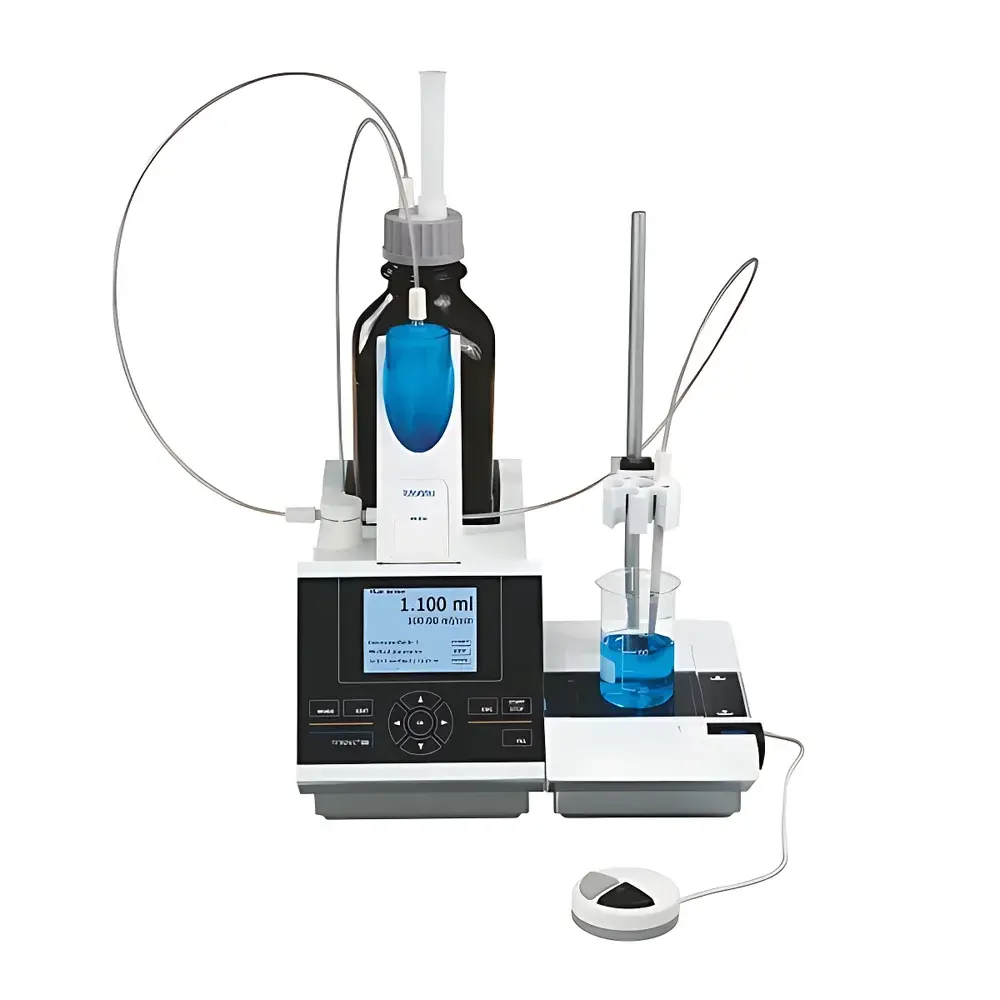
ChemTron T500 Manual Titration System & Precision Dispenser
| Brand | ChemTron |
|---|---|
| Origin | Germany |
| Model | T500 |
| Display | 3.5″ 1/4 VGA TFT color LCD |
| Pipetting Volume Range | 5–50 mL (interchangeable syringe modules) |
| Accuracy | System error ≤0.15%, random error 0.05–0.07% |
| Compliance | DIN EN ISO 8655-6 Part 3 |
| Communication | 2× USB-A, 1× USB-B, 2× RS-232-C |
| Power Supply | 90–240 V AC, 50/60 Hz |
| Dimensions (W×D×H) | 153 × 450 × 296 mm |
| Weight | 3.5 kg (with module) |
| Wetted Materials | PTFE and borosilicate glass |
| Software Compatibility | TitriSoft 3.0 |
| Daisy-chain Capacity | Up to 16 units |
| Stirring Module Options | M1 (base), M2 (includes 20 mL smart module) |
| Volume Resolution | 0.005–0.025 mL (dependent on syringe size) |
| Viscosity Limit | <10 mm²/s |
| Operating Control | Standard mouse (included), optional mini keyboard |
Overview
The ChemTron T500 Manual Titration System & Precision Dispenser is a modular, benchtop liquid handling platform engineered for reproducible manual titrations and high-accuracy volumetric dispensing in regulated and research laboratory environments. Unlike fully automated titrators reliant on potentiometric or photometric endpoint detection, the T500 operates as a human-in-the-loop precision delivery system—designed specifically for applications where standardized wet-chemistry protocols (e.g., ASTM D97, ISO 3675, USP ) mandate operator-controlled reagent addition under visual, colorimetric, or pH-indicated endpoints. Its core architecture integrates a microstepping motor-driven syringe pump (20,000 steps per revolution), interchangeable borosilicate glass/PTFE fluidic modules, and real-time volume feedback calibrated per ISO 8655-6 Part 3. This ensures traceable, auditable delivery across the full 5–50 mL range while maintaining mechanical stability during extended manual titration sequences.
Key Features
- Interchangeable Smart Syringe Modules: Select from 5 mL, 10 mL, 20 mL, or 50 mL borosilicate glass syringes with integrated PTFE seals—each pre-calibrated and auto-recognized upon insertion.
- Dual-Mode Operation: Seamlessly switch between Manual Titration Mode (mouse-triggered incremental dispensing with adjustable step volume) and Auto Dispense Mode (pre-programmed target volume delivery with configurable fill/dispense speed profiles).
- Regulatory-Ready Connectivity: Dual RS-232 ports support direct integration with analytical balances (e.g., Mettler Toledo XS series) for gravimetric sample preparation; USB interfaces enable printer output and TitriSoft 3.0 software synchronization.
- Daisy-Chain Scalability: Up to 16 T500 units can be networked via RS-232 to execute synchronized multi-step protocols under centralized software control—ideal for parallel sample processing in QC labs.
- GLP-Compliant Data Handling: Built-in formula editor supports customizable calculation templates (e.g., % w/w, molarity, titer conversion); all results include timestamp, operator ID, module serial number, and raw volume logs exportable via USB flash drive.
- Self-Diagnostic Fluid Path Integrity Check: Prior to each dispensing cycle, the system verifies syringe plunger position, seal integrity, and motor responsiveness—preventing air ingestion or under-delivery errors.
Sample Compatibility & Compliance
The T500 is validated for use with aqueous solutions, alcohols, acetone, and other low-viscosity solvents (<10 mm²/s at 20 °C). All fluid-contact surfaces consist exclusively of Class VI-certified PTFE and DIN 8552-compliant borosilicate glass (3.3), eliminating metal ion leaching and ensuring compatibility with trace-metal analysis and pharmaceutical excipient testing. Performance meets DIN EN ISO 8655-6 Part 3 for piston-type dispensers, with systematic error ≤0.15% and repeatability (CV) ≤0.07% across the operational range. The device supports 21 CFR Part 11 compliance when used with TitriSoft 3.0’s audit-trail-enabled workflow—capturing electronic signatures, parameter change history, and data integrity metadata.
Software & Data Management
TitriSoft 3.0 serves as the central configuration, execution, and reporting interface for the T500. It enables method library management (up to 15 stored protocols), real-time graphical display of delivered volume vs. time, and automated report generation compliant with ISO/IEC 17025 documentation requirements. Raw datasets are saved in CSV and XML formats with embedded calibration certificates and environmental metadata (ambient temperature, humidity if logged externally). The software supports role-based user access levels (Operator, Supervisor, Administrator) and exports encrypted PDF reports with digital signatures for regulatory submission.
Applications
- Standardized manual titrations per AOAC 965.23 (acid value), ASTM D4739 (TBN), or EN 14104 (biodiesel ester content)
- Gravimetric standard solution preparation using balance-linked mass-to-volume conversion
- QC release testing of raw materials requiring visual endpoint detection (e.g., chloride by Mohr method)
- Calibration standard dilution series for ICP-OES and HPLC mobile phase preparation
- Multi-step sample derivatization workflows in environmental testing labs (e.g., EPA 300.0 anion analysis)
FAQ
Does the T500 support GLP/GMP-compliant electronic record keeping?
Yes—when paired with TitriSoft 3.0 and configured with user authentication, audit trails, and electronic signatures, the system satisfies ALCOA+ principles and FDA 21 CFR Part 11 requirements.
Can the T500 be used with viscous samples such as glycerol or polymer solutions?
No—the instrument is rated for liquids with kinematic viscosity below 10 mm²/s at 20 °C; higher viscosities risk incomplete plunger actuation and volumetric deviation.
Is calibration certificate included with each syringe module?
Yes—each factory-calibrated smart module ships with a traceable calibration report referencing DKD/DAkkS-accredited standards.
What maintenance is required to ensure long-term accuracy?
Annual verification against certified reference volumes is recommended; routine cleaning of PTFE seals and glass barrels with ethanol or IPA is sufficient for daily operation.
How does the T500 handle endpoint detection during manual titration?
It does not perform automatic endpoint detection—it provides precise, repeatable reagent delivery while the operator determines endpoint visually, potentiometrically, or via external pH/conductivity meter input.
Related Products



