
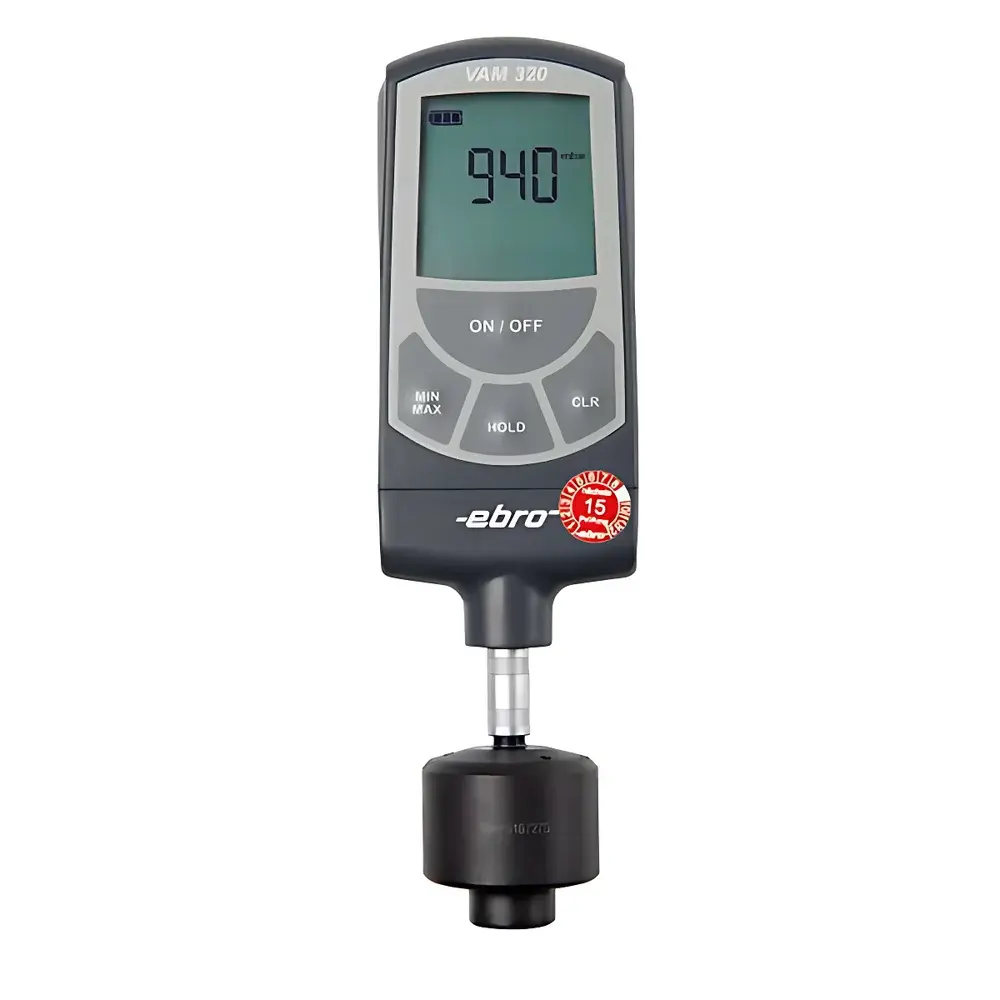
ChemTron VAM 320 / VAM 320-EX Precision Pressure Monitor
| Brand | ChemTron |
|---|---|
| Origin | Germany |
| Model | VAM 320 / VAM 320-EX |
| Measurement Range | 0 to 2000 mbar |
| Max. Overpressure | 3200 mbar |
| Resolution | 1 mbar (0.1 kPa, 0.01 psi, 1 torr) |
| Accuracy | ±0.4 % of full scale or ±1 digit, whichever is greater |
| Sampling Interval | Adjustable from 0.25 s to 15 s |
| Sensor Interface | LEMO 0, 4-pole |
| Power Supply | Integrated rechargeable lithium battery |
| Operating Temperature | 0 °C to +50 °C (max. 85 % RH) |
| Storage Temperature | −5 °C to +50 °C |
| Dimensions (main unit) | 170 × 45 × 24 mm (polyamide 6.6) |
| Sensor Dimensions | 30 × 40 mm (PEEK) |
| Protection Rating | IP50 (unit only, without sensor) |
| Weight | approx. 150 g |
| Calibration | Factory two-point calibration with certificate |
| ATEX Certification | BVS 03 ATEX E 068 (VAM 320-EX models only) |
Overview
The ChemTron VAM 320 and VAM 320-EX are compact, high-precision digital pressure monitors engineered for reliable, real-time pressure measurement in demanding chemical and electrochemical laboratory environments. Unlike general-purpose gauges, these instruments employ a solid-state, insertion-type sensor based on piezoresistive transduction technology—optimized for acid- and alkali-resistant operation via inert PEEK housing and chemically stable sensing elements. Designed for direct integration into gas-handling systems, reaction vessels, and electrolytic cell manifolds, the VAM series delivers traceable, low-drift readings across a 0–2000 mbar absolute or differential range, with overload tolerance up to 3200 mbar. The VAM 320-EX variant complies with ATEX Directive 2014/34/EU for use in potentially explosive atmospheres (Zone 2 / IIC T4), certified by BVS under certificate number BVS 03 ATEX E 068. Its embedded lithium battery enables fully portable, cable-free operation—critical for field validation, mobile reactor monitoring, and confined-space instrumentation.
Key Features
- Piezoresistive pressure sensor with PEEK (polyether ether ketone) wetted parts—resistant to aggressive acids, bases, and organic solvents commonly encountered in electrochemical synthesis and corrosion studies.
- High-resolution digital display with selectable units: mbar, kPa, psi, and torr—ensuring seamless alignment with international lab reporting standards (ISO 80000-4, ASTM E2586).
- Adjustable sampling interval (0.25–15 s) supports both rapid transient capture (e.g., gas evolution during cyclic voltammetry) and long-term stability logging (e.g., headspace pressure in sealed electrolysis cells).
- Integrated rechargeable lithium battery provides >100 hours of continuous operation; charging kit (AG 200, order no. 1340-5050) enables benchtop recharging without disassembly.
- LEMO 0, 4-pole connector ensures robust, low-noise signal transmission and mechanical retention—compatible with standard ChemTron tubing adapters (VMF, VMGL, VMS) for leak-tight integration into glass and PTFE-based manifolds.
- Factory two-point calibration traceable to national standards, supplied with individual certificate—meets GLP documentation requirements for audit-ready instrument qualification.
Sample Compatibility & Compliance
The VAM 320 series is validated for contact with non-corrosive and mildly aggressive process media typical in electrochemical research: aqueous electrolytes (e.g., 1 M H2SO4, KOH, LiPF6 in EC/DMC), inert carrier gases (N2, Ar), and evolved reaction gases (H2, O2, CO2). The VAM 320-EX model extends compatibility to Zone 2 hazardous areas per EN 60079-0 and EN 60079-11, with intrinsic safety design eliminating ignition risk during battery-powered operation. All units conform to EMC Directive 2014/30/EU (EN 61326-1) and RoHS 2011/65/EU. No user recalibration is required under normal operating conditions; periodic verification against a reference standard (e.g., Fluke 754) is recommended every 12 months per ISO/IEC 17025 guidelines.
Software & Data Management
While the VAM 320 operates as a standalone indicator, its analog/digital hybrid architecture supports optional data logging via third-party DAQ systems interfaced through the LEMO output. Raw sensor voltage (0–5 V) correlates linearly with pressure across the full scale, enabling custom integration with LabVIEW, Python (PySerial), or MATLAB for time-series analysis. The device does not include onboard memory or wireless connectivity—intentionally minimizing firmware attack surface and maximizing electromagnetic robustness in high-noise electrochemical setups. Audit trails, electronic signatures, and 21 CFR Part 11 compliance are maintained externally via validated laboratory information management systems (LIMS) that ingest timestamped CSV exports generated from connected acquisition hardware.
Applications
- Real-time monitoring of headspace pressure in sealed electrochemical cells during gas-evolving reactions (e.g., water splitting, CO2 reduction).
- Leak testing and integrity verification of vacuum-tight glovebox feedthroughs and Schlenk line manifolds.
- Calibration reference for differential pressure controllers in controlled-atmosphere reactors.
- In-situ pressure profiling during potentiostatic/galvanostatic aging of batteries and fuel cells.
- Hazardous-area verification of purge gas flow stability in ATEX-certified analytical enclosures (e.g., XRD/XPS sample transfer modules).
FAQ
Is the VAM 320 suitable for measuring vacuum conditions?
Yes—the 0–2000 mbar range includes sub-atmospheric pressures down to 0 mbar absolute (full vacuum), making it appropriate for rough vacuum monitoring in electrochemical deposition chambers and degassing systems.
Can the sensor be sterilized or autoclaved?
No—PEEK construction withstands chemical exposure but is not rated for steam sterilization (>121 °C). For bio-electrochemical applications requiring sterility, use disposable sensor housings or validate alternative cleaning protocols (e.g., 70 % ethanol immersion).
What is the expected service life of the integrated battery?
Under typical usage (1 reading/sec, 20 °C ambient), the lithium battery maintains ≥80 % capacity for ≥500 charge cycles—approximately 2–3 years of daily lab operation.
Does the VAM 320-EX require special installation procedures in hazardous areas?
Yes—per ATEX requirements, the unit must be installed using certified barriers or isolated power supplies if connected to external electronics; standalone battery operation eliminates this constraint.
How often should factory calibration be repeated?
ChemTron recommends recalibration every 12 months or after any mechanical shock exceeding 50 g, consistent with ISO/IEC 17025 Clause 6.5.2 for measurement traceability maintenance.




