
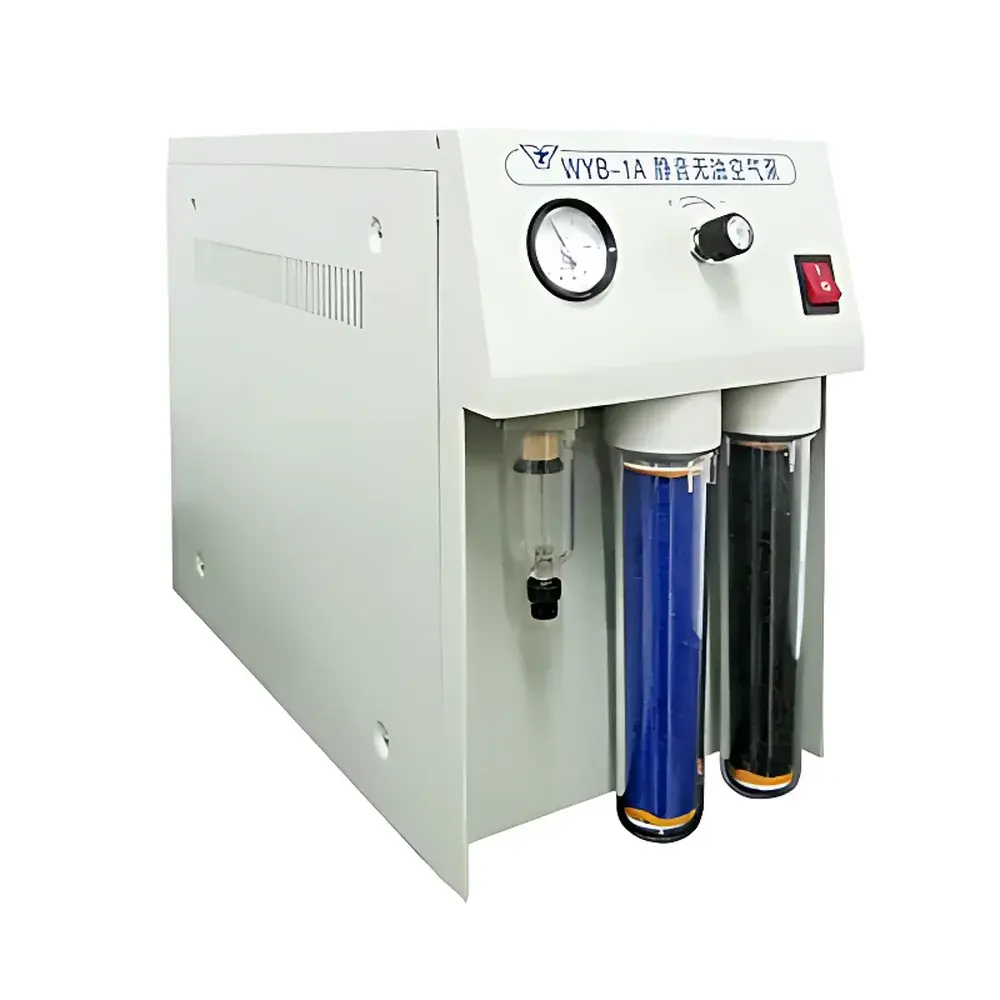
ZhongYa WYB-1A Silent Oil-Free Air Generator
| Brand | ZhongYa |
|---|---|
| Origin | Beijing, China |
| Manufacturer Type | Authorized Distributor |
| Country of Origin | China |
| Model | WYB-1A |
| Price | Upon Request |
| Output Flow Rate | 0–1000 mL/min |
| Output Pressure | 0–0.4 MPa (adjustable) |
| Pressure Stability | ±0.003 MPa |
| Dimensions (L×W×H) | 470×230×340 mm |
| Net Weight | 15 kg |
| Max. Power Consumption | 150 W |
| Ambient Operating Temperature | 10–40 °C |
| Ambient Humidity Limit | ≤85% RH |
Overview
The ZhongYa WYB-1A Silent Oil-Free Air Generator is an engineered solution for laboratories requiring a continuous, reliable, and contamination-free source of compressed air for analytical instrumentation—including gas chromatographs (GC), GC-MS systems, nitrogen generators, flame ionization detectors (FID), thermal conductivity detectors (TCD), and other pneumatic-driven laboratory equipment. Unlike conventional high-pressure gas cylinders, this system utilizes a positive-displacement diaphragm compressor coupled with a three-stage purification architecture to deliver clean, dry, oil-free air without lubricant carryover or hydrocarbon contamination. The core process involves sequential filtration—coalescing removal of bulk moisture and particulates, activated carbon adsorption of residual hydrocarbons and odors, and fine particulate filtration down to 0.01 µm—followed by precision pressure regulation to ensure stable output within ±0.003 MPa. Designed for ISO 8573-1 Class 1:4:1 compressed air quality (solid particles ≤0.1 µm, dew point ≤−40 °C, oil content <0.01 mg/m³), the WYB-1A meets critical prerequisites for trace-level analytical applications where background interference must be minimized.
Key Features
- Silent operation with noise level ≤42 dB(A) at 1 m—optimized for shared lab environments and open-plan facilities
- Oil-free diaphragm compression technology eliminates risk of oil vapor contamination in downstream instruments
- Three-stage integrated purification: pre-filter + activated carbon + ultra-fine particulate filter (0.01 µm retention)
- Microprocessor-controlled pressure regulation with real-time feedback loop ensuring ±0.003 MPa stability under variable demand
- No-load start-up circuit prevents inrush current; built-in dual protection against overpressure and overcurrent
- Compact footprint (470 × 230 × 340 mm) and lightweight design (15 kg) enable benchtop deployment or integration into instrument carts
- Energy-efficient operation (max. 150 W) with thermal overload protection and automatic shutdown on fault detection
- Compatible with continuous-duty cycles up to 24/7 operation without performance degradation in flow rate or purity
Sample Compatibility & Compliance
The WYB-1A delivers air compliant with ASTM D6299 (standard practice for laboratory quality control), ISO 8573-1:2010 Class 1:4:1, and USP requirements for instrument-grade air in pharmaceutical QC labs. It supports all common gas-powered analytical platforms requiring clean, low-particulate, low-hydrocarbon air—particularly GC carrier gas auxiliary supply, detector fuel/air mixtures, and purge gas for autosamplers. No external desiccant or oil traps are required. Units are CE-marked and conform to IEC 61000-6-3 (EMC emission standards) and IEC 61000-6-2 (immunity). Documentation includes factory calibration certificate, material compliance statement (RoHS, REACH), and full traceability of filter media specifications.
Software & Data Management
While the WYB-1A operates as a standalone analog-controlled unit without embedded firmware or network interface, it supports full integration into laboratory infrastructure via optional analog 0–5 V or 4–20 mA pressure/flow monitoring outputs (available upon request). All operational parameters—including inlet/outlet pressure, motor temperature, and runtime hours—are accessible via front-panel LED indicators and mechanical gauges. For GLP/GMP-regulated environments, users may log operational data manually or integrate the unit into centralized building management systems (BMS) using standard analog signal inputs. Audit trails for maintenance intervals (filter replacement every 6–12 months depending on ambient conditions) are recommended per ISO/IEC 17025 Clause 6.4.10.
Applications
- Carrier and make-up gas supply for gas chromatography systems
- Fuel/oxidant air for FID, NPD, and ECD detectors
- Purge and trap systems requiring consistent low-particulate airflow
- Instrument air for automated sample handling, valve actuators, and pneumatic controllers
- Lab-wide centralized air distribution when deployed in parallel configurations
- Research settings requiring long-term stability in environmental simulation chambers or controlled-atmosphere reactors
FAQ
What is the expected service life of the WYB-1A under continuous operation?
With proper ambient conditions (≤85% RH, 10–40 °C) and scheduled filter replacements every 6–12 months, the compressor module maintains rated performance for ≥10,000 operating hours.
Can the WYB-1A be used as a primary air source for mass spectrometry systems?
It is suitable for auxiliary air functions (e.g., collision gas, curtain gas, or detector cooling); however, for high-sensitivity MS applications requiring ultra-high-purity air (<0.001 mg/m³ oil), supplemental polishing filters or dedicated zero-air generators are advised.
Is the output pressure adjustable during operation?
Yes—the integrated pressure regulator allows smooth, tool-free adjustment from 0 to 0.4 MPa while the unit is running, with digital pressure readout available via optional add-on gauge kit.
Does the unit require periodic oil changes or lubrication?
No—diaphragm-based compression eliminates all internal lubricants; only consumable filters require replacement per maintenance schedule.
How does the WYB-1A compare to cylinder-based air sources in terms of total cost of ownership?
Over a 5-year lifecycle, the WYB-1A reduces recurring costs associated with cylinder rental, delivery logistics, safety inspections, and regulatory compliance documentation—while improving workflow continuity and reducing lab footprint.



