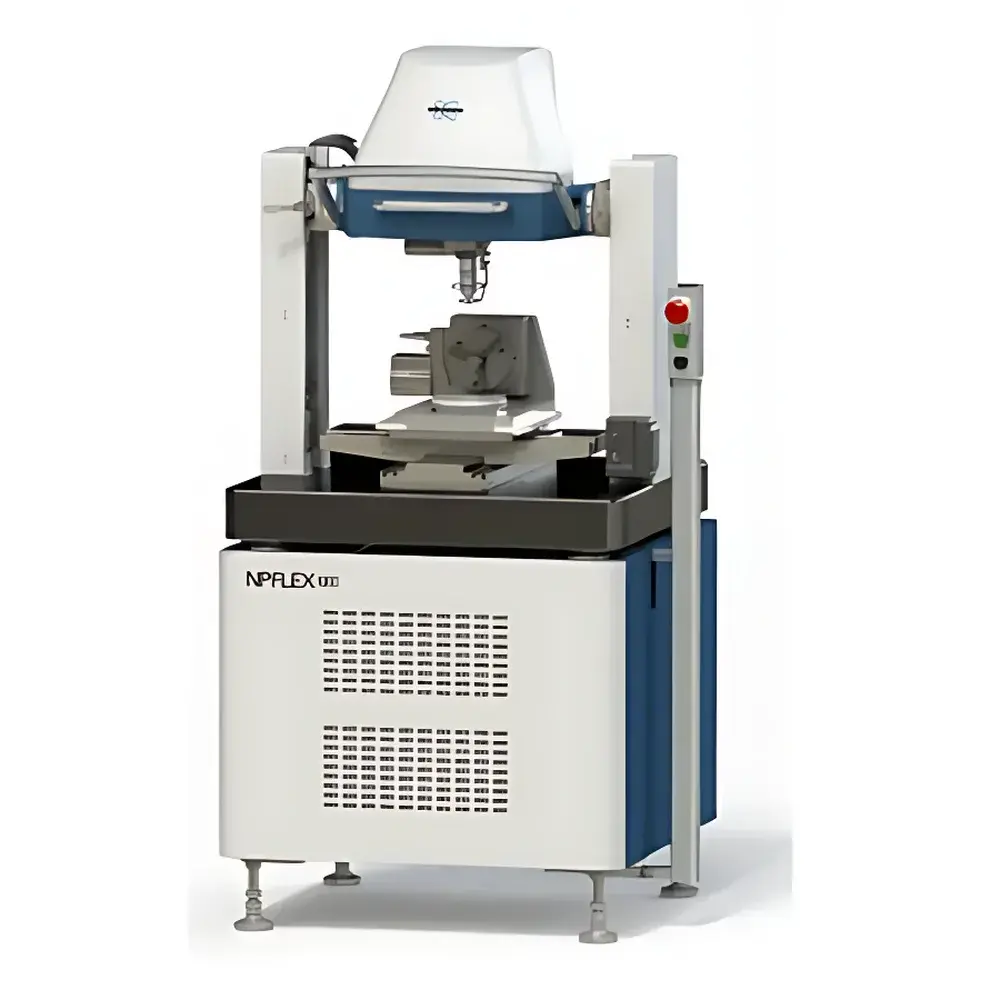
Bruker NPFLEX-1000 White Light Interferometric 3D Optical Profilometer
| Brand | Bruker |
|---|---|
| Origin | USA |
| Model | NPFLEX-1000 |
| Measurement Principle | White Light Interferometry (WLI) |
| Type | Non-contact 3D Surface Profilometer / Roughness Analyzer |
| Sample Stage Travel | 300 mm X-Y |
| Design | Floor-standing Open-bridge Configuration |
| Software Platform | VisionXpress™ with Adaptive USI Mode and One-click Advanced Surface Find™ |
| Compliance | Designed for ISO 25178, ISO 4287, ASTM E1392, and USP <1058> analytical instrument qualification frameworks |
Overview
The Bruker NPFLEX-1000 is a floor-standing, white light interferometric (WLI) 3D optical profilometer engineered for high-precision, non-contact surface topography measurement in demanding industrial metrology environments. Leveraging the physical principle of coherence scanning interferometry—where broadband white light is split into reference and measurement beams, and interference fringes are analyzed as the objective scans vertically—the system delivers sub-nanometer vertical resolution and nanometer-level repeatability across macro- to micro-scale surface features. Unlike stylus-based or confocal profilers, WLI enables rapid, damage-free characterization of delicate, reflective, transparent, or multi-layered surfaces without sample contact or vacuum requirements. The NPFLEX-1000 is purpose-built for production-integrated quality control, process development, and failure analysis in regulated sectors including automotive powertrain components, implant-grade orthopedic devices, and additively manufactured aerospace parts.
Key Features
- Open-bridge gantry architecture with 300 mm clearance between stage and objective lens—enabling unobstructed access to tall, irregular, or oversized components (e.g., turbine blades, stents, injection-molded housings).
- One-click Advanced Surface Find™ technology—automatically identifies optimal focus position and illumination intensity per field-of-view using real-time contrast and fringe signal optimization, eliminating manual focus calibration.
- Adaptive USI (Universal Scanning Interferometry) mode—dynamically selects scan range, sampling density, and fringe analysis algorithm based on local surface slope, reflectivity, and roughness, ensuring robust data capture across heterogeneous regions (e.g., polished lands adjacent to textured flanks).
- Integrated passive air-isolation platform and rigid granite bridge structure—minimizes environmental vibration coupling and thermal drift, supporting long-term stability under factory-floor conditions (per ISO 10360-2 mechanical environmental classification).
- VisionXpress™ software interface—graphical workflow builder with guided measurement setup, parameter presets aligned with ISO/ASTM standards, and one-click report generation compliant with GLP/GMP documentation requirements.
Sample Compatibility & Compliance
The NPFLEX-1000 accommodates samples ranging from 10 mm × 10 mm wafers to 300 mm × 300 mm substrates and heights up to 250 mm. It supports optically diverse materials—including silicon wafers, sapphire optics, PEEK polymer implants, nickel-alloy turbine vanes, and coated glass—without requiring conductive coating or vacuum pumping. Surface slope tolerance exceeds ±70°, enabling accurate profiling of steep sidewalls and deep trenches. All measurement algorithms adhere to ISO 25178-2 (areal surface texture parameters), ISO 4287 (profile-based roughness), and ASTM E1392 (interferometric profilometer verification). System validation documentation supports IQ/OQ/PQ protocols and satisfies FDA 21 CFR Part 11 audit trail requirements when configured with secure user roles and electronic signatures.
Software & Data Management
VisionXpress™ provides traceable, version-controlled measurement workflows with embedded metadata (operator ID, timestamp, instrument serial number, environmental logs). Raw interferogram stacks are stored in vendor-neutral HDF5 format, enabling third-party analysis via Python or MATLAB. Batch processing supports automated parameter mapping across multiple fields-of-view, with statistical process control (SPC) outputs exportable to JMP or Minitab. Audit trails record all parameter changes, data exports, and report modifications—fully compliant with GLP and GMP data integrity principles. Optional Bruker NanoScope Analysis™ extension enables advanced filtering (Gaussian, spline, robust polynomial), defect detection (height thresholding, curvature anomaly mapping), and cross-platform correlation with SEM or AFM datasets.
Applications
- Automotive: Quantifying wear scars on piston rings, measuring coating thickness uniformity on brake calipers, validating surface finish of cylinder head gasket interfaces.
- Medical Devices: Verifying Ra/Rz values on titanium spinal cages per ISO 14644-1 cleanroom particulate limits; assessing edge rounding on laser-cut stents to prevent endothelial damage.
- Additive Manufacturing: Characterizing as-built surface roughness (Sa, Sq) of Inconel 718 lattice structures; detecting powder fusion defects (lack-of-fusion pores, spatter adhesion) via height deviation mapping.
- Semiconductors & Optics: Measuring step heights of thin-film photomasks; evaluating polish-induced subsurface damage on fused silica lenses.
- Research & Development: Correlating tribological performance with 3D texture parameters (Sdq, Sdr); quantifying thermal deformation of MEMS actuators under controlled temperature cycling.
FAQ
What vertical resolution can the NPFLEX-1000 achieve under standard operating conditions?
Typical vertical resolution is ≤0.1 nm RMS (measured on calibrated step standards), dependent on integration time, surface reflectivity, and environmental stability.
Does the system support automated stage navigation for multi-site measurements?
Yes—programmable XYZ stage with encoder feedback enables repeatable coordinate-based positioning and stitching of >100 FOVs per sample.
Can VisionXpress™ generate reports compliant with ISO/IEC 17025 accreditation requirements?
Yes—templates include uncertainty budgets calculated per GUM (Guide to the Expression of Uncertainty in Measurement) and traceability to NIST-traceable artifacts.
Is remote diagnostics and software update capability available?
Bruker Remote Support (BRS) provides encrypted, firewall-compliant access for firmware updates, calibration verification, and troubleshooting—subject to customer-configured IT policies.
How does the system handle highly reflective or low-contrast surfaces?
Adaptive USI mode automatically modulates illumination intensity, adjusts camera gain, and selects optimal coherence envelope width to maximize fringe contrast and minimize phase noise.