
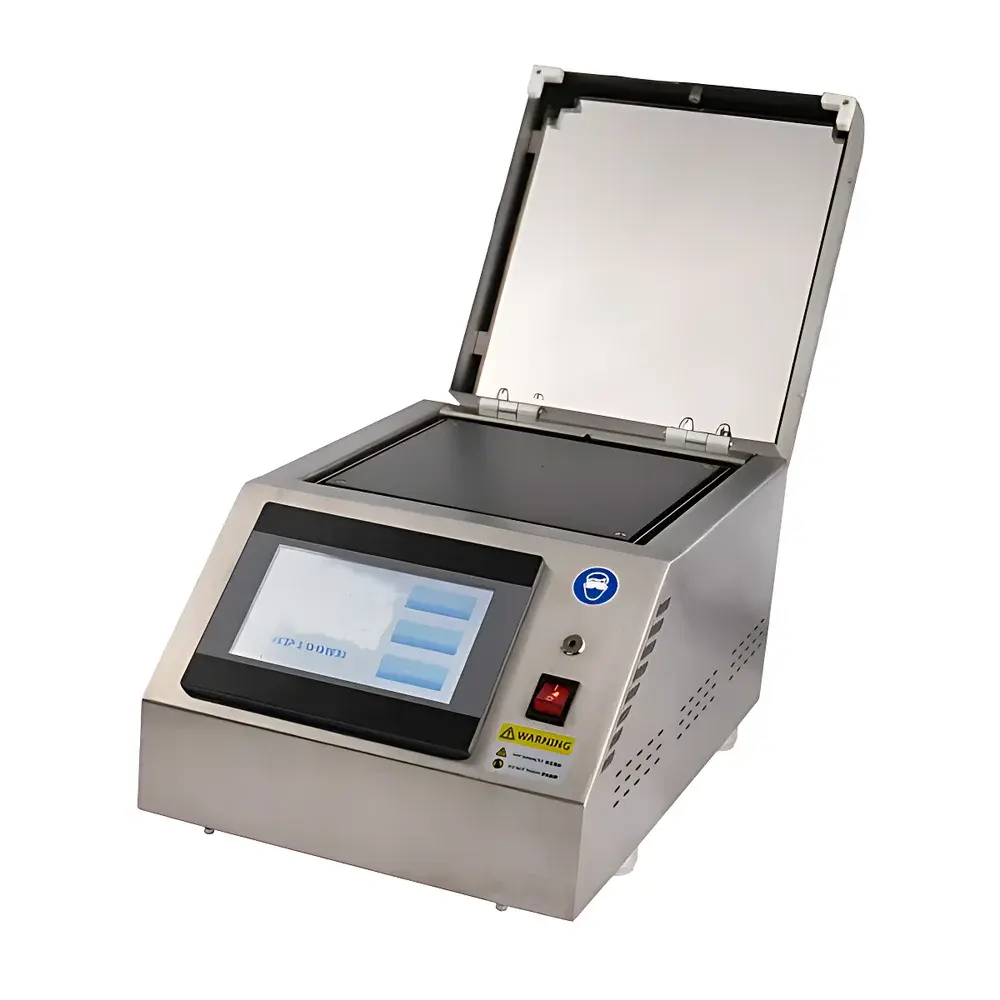
Best Tools HP100 Precision Programmable Hot Plate
| Origin | Beijing, China |
|---|---|
| Manufacturer Type | Authorized Distributor |
| Origin Category | Domestic (PRC) |
| Model | HP100 |
| Price Range | USD 700–1,400 |
| Heating Power | 1000 W |
| Max Operating Temperature | 300 °C |
| Display | 7-inch Full-Color TFT Touchscreen |
| Heating Surface Dimensions | 203 mm × 203 mm (8 inch × 8 inch) |
| Temperature Control Resolution | 0.1 °C |
| Temperature Stability | ±0.5 °C |
| Programmable Lift Mechanism | 5-step, 0–30 mm travel (0.1 mm resolution) |
| Timer Range | 0.1 s to 100,000 s |
| Program Storage | 100 user-defined recipes (5 steps each) |
| Construction | Corrosion-resistant hard-anodized aluminum top plate |
Overview
The Best Tools HP100 Precision Programmable Hot Plate is an engineered thermal platform designed for high-fidelity, repeatable thermal processing in microfabrication and materials science laboratories. Unlike standard electric heating plates, the HP100 integrates closed-loop PID temperature control with a motorized lift mechanism—enabling proximity-based heating protocols essential for photolithography, soft lithography (e.g., PDMS curing), and MEMS device fabrication. Its operational principle relies on resistive heating elements embedded beneath a monolithic anodized aluminum plate, coupled with dual-point RTD sensing and real-time feedback compensation. The system delivers stable thermal output across its full 203 mm × 203 mm active zone, supporting substrate-level heat transfer optimization without forced convection or ambient air interference. With a maximum operating temperature of 300 °C and sub-degree thermal stability (±0.5 °C), the HP100 meets critical requirements for solvent evaporation, pre-bake, post-exposure bake (PEB), and polymer crosslinking processes where thermal gradient minimization directly impacts pattern fidelity and film uniformity.
Key Features
- 7-inch full-color capacitive touchscreen interface with intuitive icon-driven navigation and multi-language support (English, German, Japanese, simplified Chinese)
- Programmable lift mechanism with 0.1 mm resolution and five independent positional steps per recipe—enabling precise gap control between substrate and heating surface for proximity bake applications
- High-stability temperature regulation: ±0.5 °C accuracy over full range (room temperature to 300 °C), achieved via dual-sensor RTD feedback and adaptive PID tuning
- 100 user-storable thermal programs, each configurable with up to five sequential stages (temperature setpoint, dwell time, lift position, ramp rate)
- Corrosion-resistant hard-anodized aluminum top plate (6061-T6 grade) rated for repeated exposure to solvents including acetone, IPA, and developer solutions
- Integrated safety architecture: over-temperature cutoff (320 °C hardware limit), auto-shutdown on lid open detection (if equipped with optional enclosure), and thermal fuse redundancy
Sample Compatibility & Compliance
The HP100 accommodates substrates up to 203 mm (8-inch) diameter—including silicon wafers, glass slides, quartz masks, and flexible polymer films. Its flatness tolerance (<±5 µm over heated area) and low thermal mass design ensure rapid equilibration and minimal edge-to-center deviation (<1% at 200 °C). The unit complies with IEC 61010-1:2010 for laboratory electrical equipment safety and meets EMC requirements per CISPR 11 Class B. While not certified for cleanroom ISO Class 5 environments out-of-box, its sealed electronics and non-particulating surface finish support integration into controlled fabrication spaces when used with appropriate enclosures. For regulated environments, audit trails and electronic signatures can be enabled via optional firmware upgrade aligned with FDA 21 CFR Part 11 data integrity guidelines.
Software & Data Management
The HP100 operates autonomously via its onboard embedded controller but supports optional USB-host connectivity for firmware updates and program backup/restore. All thermal profiles—including timestamps, actual vs. setpoint temperature logs, lift actuation events, and error codes—are recorded internally with 1-second resolution and exportable as CSV files. No proprietary software installation is required; exported logs are compatible with common analysis platforms (MATLAB, Python pandas, JMP). Audit trail functionality—tracking user login, program modification history, and execution records—is available in GxP-compliant firmware versions, supporting GLP/GMP documentation workflows and internal quality audits.
Applications
- Photolithography: Pre-bake, post-exposure bake (PEB), and hard bake of positive/negative photoresists (e.g., AZ series, SU-8, PMMA)
- Soft lithography: Controlled PDMS curing and demolding preparation
- MEMS packaging: Eutectic bonding preheat, adhesive curing, and wafer-level encapsulation
- Thin-film processing: Solvent annealing of organic semiconductors, perovskite precursor drying, and metal oxide nanoparticle sintering
- Sample preparation: Acid digestion support heating (when paired with PTFE-coated vessels), catalyst activation, and moisture removal prior to XRD/TGA analysis
FAQ
What is the maximum recommended substrate thickness for lift-mode operation?
The lift mechanism supports substrates up to 25 mm thick when fully retracted; clearance between plate and lifted substrate remains ≥1 mm at all positions.
Can the HP100 be integrated into a semi-automated process line?
Yes—RS-232 and optional Ethernet (Modbus TCP) interfaces enable external PLC coordination for start/stop commands, status polling, and real-time temperature readback.
Is calibration traceable to NIST standards?
Factory calibration uses NIST-traceable RTD references; users may perform field verification using calibrated secondary standards per ASTM E220.
Does the unit support ramp-and-soak temperature profiles?
Yes—each of the five programmable steps supports independent ramp rates (0.1–50 °C/min), soak durations, and lift positioning.
What maintenance is required for long-term thermal accuracy?
Annual verification of sensor drift and heater uniformity is recommended; no consumables or routine servicing is required under normal lab use conditions.



