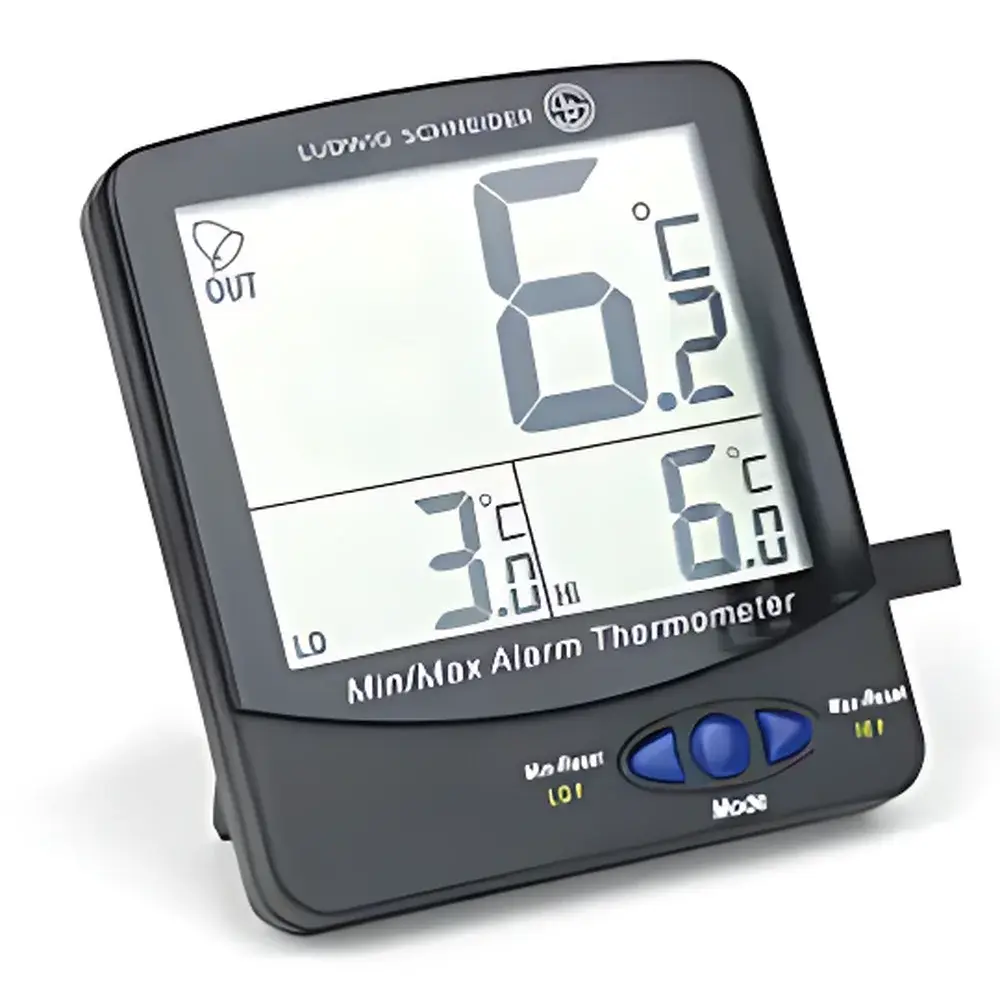
ChemTron 13100 Digital Temperature Measurement System
| Brand | ChemTron |
|---|---|
| Origin | Germany |
| Model | 13100 |
| Internal Sensor Range | 0 °C to +50 °C (32 °F to 122 °F) |
| External Sensor Range | −50 °C to +70 °C (−58 °F to 158 °F) |
| Accuracy | ±1 °C (±2 °F) |
| Resolution | 0.1 °C |
| Response Time (T₉₀) | 10 s |
| Memory Function | Min/Max Recording |
| Alarm | High/Low Temperature Threshold Alert |
| Calibration Points | −20 °C, +4 °C, +37 °C |
| Filling Fluid | Ethylene Glycol-Based Mixture |
| Accessories | 30 mL Plastic Storage Vial |
Overview
The ChemTron 13100 Digital Temperature Measurement System is a precision-engineered, dual-sensor temperature monitoring instrument designed for continuous, traceable thermal validation in regulated laboratory and industrial environments. Built upon a robust digital microprocessor architecture, the system employs high-stability thermistor-based sensing elements—internally integrated for ambient or probe-housing temperature reference, and externally connected via shielded cable for direct immersion or surface contact measurement. Its operational principle relies on resistance-to-digital conversion with linearized output, calibrated against NIST-traceable reference standards at three critical biomedical and cold-chain verification points: −20 °C (ultra-low freezer storage), +4 °C (refrigerated sample holding), and +37 °C (incubation and physiological simulation). The device complies with fundamental metrological requirements outlined in ISO/IEC 17025 for calibration laboratories and supports routine verification per ASTM E2879 (Standard Practice for Validation of Thermal Sensors in Biomedical Applications) and EU GMP Annex 15 (Qualification and Validation).
Key Features
- Dual-range capability: Internal sensor optimized for 0 °C to +50 °C; external probe extends validated operation to −50 °C to +70 °C—covering cryogenic storage, refrigerated transport, and incubator monitoring.
- ±1 °C accuracy across full range with 0.1 °C digital resolution, enabling compliance with USP and environmental monitoring thresholds for sterile compounding and hazardous drug handling.
- T₉₀ response time of 10 seconds ensures rapid stabilization during dynamic thermal transitions—critical for mapping temperature excursions in freeze-thaw cycles or refrigerator door-open events.
- Non-volatile min/max memory logs extreme values without external power, supporting retrospective audit of thermal deviations during unattended operation.
- Configurable high/low alarm thresholds with visual LED indicators and audible alerts facilitate immediate operator intervention—integral to CAPA workflows under FDA 21 CFR Part 11–aligned quality systems.
- Pre-filled ethylene glycol-based thermal fluid in the external probe eliminates user handling of hazardous calibration media while ensuring consistent thermal conductivity and freeze-point depression below −50 °C.
Sample Compatibility & Compliance
The ChemTron 13100 is compatible with a broad spectrum of sample containment systems and environmental enclosures—including upright and chest-style ultra-low temperature freezers (−80 °C nominal), pharmaceutical-grade refrigerators (2–8 °C), CO₂ incubators (36–37 °C), stability chambers (25 °C/60% RH, 40 °C/75% RH), and liquid nitrogen vapor-phase storage units. Its external probe’s chemically inert stainless-steel sheath and IP67-rated connector ensure resilience against condensation, solvent exposure, and repeated cleaning with ethanol or quaternary ammonium disinfectants. All calibration data—including date, technician ID, reference standard ID, and deviation values—is retained in device memory, satisfying GLP documentation requirements for instrument qualification (IQ/OQ/PQ) and supporting audit readiness for MHRA, ANVISA, and PMDA inspections.
Software & Data Management
While the 13100 operates as a standalone, self-contained unit, its digital output interface (RS-232 optional module, sold separately) enables integration into centralized environmental monitoring systems (EMS) compliant with FDA 21 CFR Part 11. When connected, timestamped readings—including real-time temperature, min/max extremes, and alarm status—are transmitted with electronic signature support, audit trail logging, and role-based access control. Raw data exports as CSV or PDF reports include metadata such as instrument serial number, calibration due date, and firmware version—ensuring full data integrity and ALCOA+ principles (Attributable, Legible, Contemporaneous, Original, Accurate).
Applications
- Validation and routine monitoring of cold chain logistics: vaccine transport containers, dry ice shippers, and active temperature-controlled pallet shippers.
- Environmental qualification of cleanrooms, isolators, and laminar flow hoods per ISO 14644-3.
- Thermal mapping studies for stability testing chambers per ICH Q5C guidelines.
- Temperature uniformity verification in laboratory ovens, water baths, and heating blocks used in analytical method development.
- Continuous monitoring during lyophilization cycle development—tracking shelf temperature gradients and condenser performance.
FAQ
Is the external probe suitable for direct immersion in aqueous biological samples?
Yes—the probe’s hermetically sealed 316 stainless-steel tip and ethylene glycol fill are biocompatibility-tested per ISO 10993-5 and approved for non-invasive, short-term contact with cell culture media, serum, and buffer solutions.
Can the device be recalibrated in-house?
Recalibration requires traceable reference sources at −20 °C, +4 °C, and +37 °C; users may perform field verification using certified dry-block calibrators or precision baths, but full recalibration must be conducted by an ISO/IEC 17025-accredited service laboratory.
What is the battery life under continuous logging mode?
With alkaline AA batteries, the unit maintains >12 months of operation at 1-minute sampling intervals; low-battery indication activates 72 hours prior to shutdown to prevent data loss.
Does the system support multi-point probe daisy-chaining?
No—the 13100 is designed for single external probe operation; however, multiple units can be deployed in parallel and synchronized via external time-server protocols for spatial thermal profiling.