
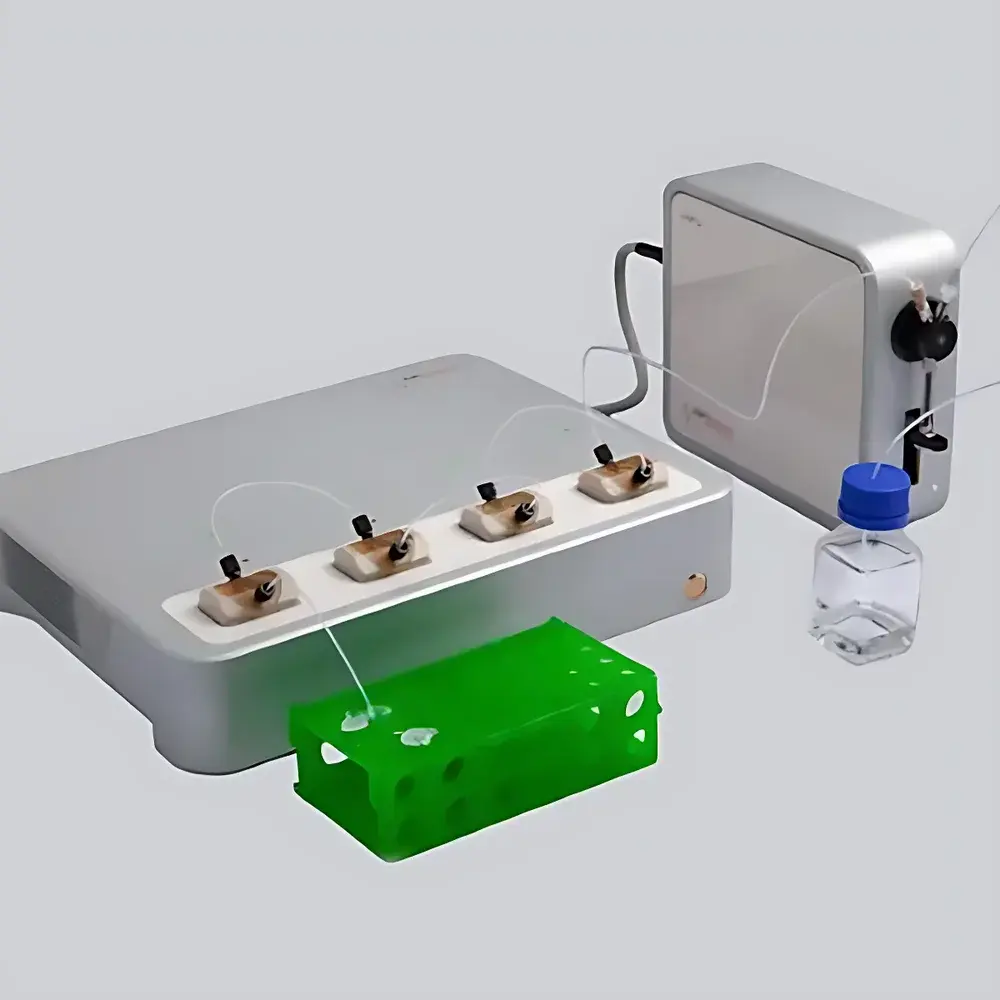
AWSensors QCM-D Quartz Crystal Microbalance with Dissipation Monitoring
| Brand | AWSensors |
|---|---|
| Origin | Spain |
| Model | QCM-D |
| Channel Options | 1-channel or 4-channel modular system |
| Sensor Interface | AT-cut quartz crystals with Cr/Au/Ti electrodes |
| Cell Design | Patented quick-lock mechanism with FFKM or PDMS sealing |
| Measurement Modes | Static (Batch) and dynamic flow-through (Flow) |
| Software Platform | AWSensors Control & Analysis Suite |
| Compliance Framework | Designed for GLP-compliant data integrity |
| Optional Modules | Temperature control unit (±0.1 °C stability), precision flow control unit (integrated dual-position, six-port valve with degassing module), potentiostat integration for electrochemical QCM (EQCM) |
Overview
The AWSensors QCM-D Quartz Crystal Microbalance with Dissipation Monitoring is a high-precision, label-free analytical platform engineered for real-time, in situ characterization of interfacial phenomena at solid–liquid and solid–gas boundaries. Based on the piezoelectric resonance principle of AT-cut quartz crystals, the system simultaneously measures frequency shift (Δf, proportional to adsorbed mass via the Sauerbrey relation) and energy dissipation (ΔD), enabling quantitative differentiation between rigid, viscoelastic, and hydrated thin films. Unlike conventional mass-sensing techniques, QCM-D resolves not only nanogram-level mass changes but also structural softness—critical for studying protein conformational transitions, polymer swelling, lipid bilayer formation, or electrode/electrolyte interphases in battery research. The instrument operates across fundamental resonance frequencies (e.g., 5 MHz standard sensors; optional 10 MHz HFF-QCM for enhanced mass resolution), delivering sub-monolayer sensitivity without optical labels or surface derivatization.
Key Features
- Modular architecture supporting 1-channel or 4-channel parallel operation—each channel independently configurable for temperature, flow rate, and electrochemical bias
- Patented quick-lock cell design ensures rapid sensor exchange (<30 s) while maintaining mechanical stability and measurement reproducibility (RSD < 0.8% for repeated Sauerbrey mass calibration)
- Sealing options include chemically resistant FFKM O-rings or biocompatible PDMS gaskets, enabling compatibility with aggressive solvents, biological buffers, and low-volatility gases
- Minimal sample volume requirements: as low as 5.5 µL for HFF-QCM chips (10 MHz), 44 µL for standard 14-mm-diameter sensors—optimized for precious biomolecules or scarce catalyst samples
- Dual operational modes: static (batch) mode for equilibrium adsorption studies; continuous flow mode with integrated degassing and precise volumetric injection (via dual-position, six-port valve) for kinetic profiling under controlled hydrodynamic conditions
- Native support for electrochemical integration: synchronized potentiostat control allows simultaneous EQCM measurements for redox-coupled interfacial processes in battery or corrosion research
Sample Compatibility & Compliance
The AWSensors QCM-D accommodates a broad range of substrate materials—including gold, platinum, silicon oxide, ITO, carbon, and functionalized polymers—enabling direct immobilization of antibodies, DNA, enzymes, nanoparticles, or battery electrode coatings. Sensor electrodes are fabricated using electron-beam evaporation of Cr/Au or Ti/Au stacks, ensuring adhesion robustness and low ohmic resistance. All hardware and software components comply with CE marking directives. When deployed in regulated environments (e.g., pharmaceutical QC labs), the system can be validated per ASTM E2500 and ISO/IEC 17025 guidelines. Audit-trail-enabled software configuration meets FDA 21 CFR Part 11 requirements for electronic records and signatures, including user role-based access, immutable log files, and timestamped metadata for every measurement event.
Software & Data Management
The AWSensors Control & Analysis Suite provides an intuitive, scriptable interface for experiment design, real-time monitoring, and advanced modeling. It includes built-in fitting engines for Voigt-based viscoelastic modeling, Sauerbrey and Kanazawa corrections, and custom algorithm import via Python API. Raw Δf/ΔD time series are stored in HDF5 format with embedded metadata (sensor ID, temperature setpoint, flow rate, applied potential), ensuring FAIR (Findable, Accessible, Interoperable, Reusable) data principles. Export options include CSV, MATLAB .mat, and standardized MIQE-compliant reports for publication-ready figures. Data backups and remote access are supported through secure SSH or TLS-enabled network deployment.
Applications
- Biomedical Surface Science: Real-time quantification of antibody–antigen binding kinetics, cell adhesion mechanics, and extracellular matrix remodeling under physiological flow
- Energy Materials: In operando monitoring of SEI layer growth on Li-ion battery anodes, catalyst degradation in PEM fuel cells, and ion intercalation dynamics in supercapacitors
- Soft Matter Physics: Hydration-dependent viscoelastic mapping of hydrogels, polyelectrolyte multilayers, and responsive polymer brushes
- Environmental & Food Safety: Label-free immunosensing of pesticides (e.g., carbaryl detection using HFF-QCM platforms), pathogen capture on functionalized surfaces, and membrane fouling analysis
- Electrochemical Interfaces: Coupled EQCM studies of electropolymerization, metal electrodeposition, and corrosion inhibition mechanisms in chloride-containing electrolytes
FAQ
How is the measurement cell sealed?
The cell employs either FFKM (perfluoroelastomer) O-rings or PDMS gaskets—selected based on chemical compatibility and temperature range—to ensure leak-tight sealing under both static and flow conditions.
What is the minimum liquid volume required for measurement?
It depends on the sensor geometry: 5.5 µL for high-frequency HFF-QCM chips (10 MHz); 44 µL for standard 14-mm-diameter sensors.
What is the difference between Batch and Flow measurement modes?
Batch mode maintains a static liquid environment for equilibrium adsorption studies; Flow mode delivers continuous, laminar fluid delivery with programmable flow rates (0.01–1 mL/min), enabling shear-controlled kinetic analysis and surface regeneration.
Can the system be integrated with external instrumentation?
Yes—native drivers support synchronization with commercial potentiostats, syringe pumps, environmental chambers, and Raman spectrometers via TTL triggers or TCP/IP protocols.
Is temperature control available as a standard feature?
Temperature regulation is an optional module offering ±0.1 °C stability over 15–60 °C, with Peltier-based heating/cooling and real-time feedback from embedded Pt100 sensors.
Related Products




