
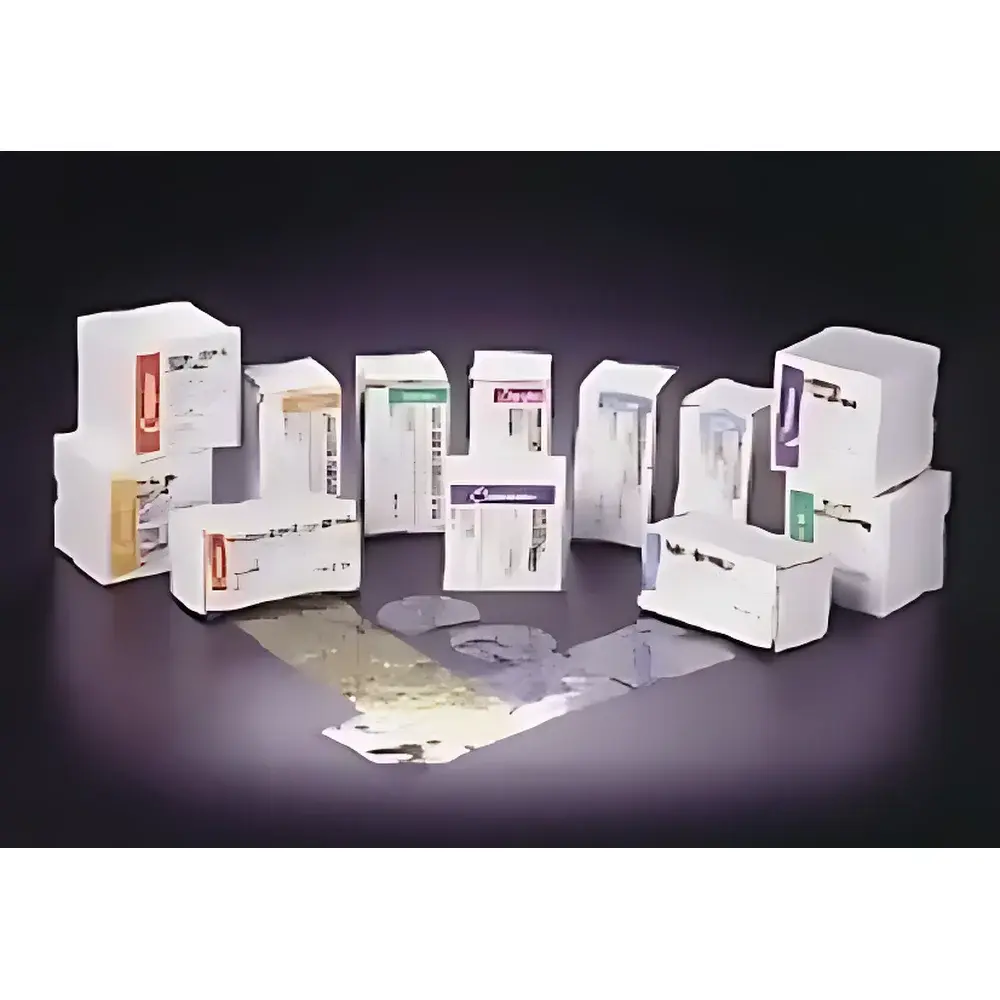
Chemplex 106 Mylar® Sample Film for XRF and EDX Analysis
| Brand | Chemplex |
|---|---|
| Origin | USA |
| Product Type | Imported Mylar® Polyester Film |
| Model | 106 |
| Thickness | 6.0 µm (0.24 mil) |
| Format | Pre-cut Circular Discs, Ø63.5 mm (2.5"), 500 pcs/box |
| Compliance | ASTM D882, ISO 527-3, USP <661.1>, RoHS-compliant |
| Application | X-ray Fluorescence (XRF), Energy-Dispersive X-ray Spectroscopy (EDX), Elemental Analysis Sample Support |
Overview
Chemplex 106 Mylar® Sample Film is a precision-engineered, ultra-thin biaxially oriented polyethylene terephthalate (PET) film specifically formulated for use as a low-background, mechanically stable support membrane in elemental analysis instrumentation. Designed to meet the stringent demands of wavelength-dispersive (WDXRF) and energy-dispersive (EDXRF) X-ray fluorescence spectrometers—as well as scanning electron microscopes equipped with EDX detectors—the film provides optimal X-ray transmission across the 0.1–20 keV range while minimizing spectral interference from matrix absorption and scatter. Its consistent 6.0 µm thickness ensures reproducible attenuation correction during quantitative calibration, and its high tensile strength (≥150 MPa) and dimensional stability (<0.1% moisture-induced expansion) prevent sagging or wrinkling under vacuum or helium purge conditions common in high-sensitivity XRF chambers.
Key Features
- Ultra-low elemental background: Certified trace-metal-free manufacturing process; verified by ICP-MS to contain <10 ppb Na, Mg, Al, Si, P, S, Cl, K, Ca, Ti, Cr, Mn, Fe, Ni, Cu, Zn, As, Se, Sr, Y, Zr, Mo, Ag, Cd, Sn, Sb, Ba, La, Ce, Pr, Nd, Sm, Eu, Gd, Tb, Dy, Ho, Er, Tm, Yb, Lu, Hf, Ta, W, Re, Os, Ir, Pt, Au, Pb, Bi
- Precision pre-cut geometry: Circular discs with nominal diameter of 63.5 mm (2.5 inches), laser-trimmed to ±0.1 mm tolerance, ensuring repeatable placement in sample cups and autosampler trays
- Controlled surface roughness: Ra < 0.02 µm, minimizing diffraction artifacts and beam scattering in micro-XRF mapping applications
- Thermal stability: Withstands continuous operation at temperatures up to 120 °C without shrinkage or haze formation—critical for hot-stage XRF or fused-bead preparation workflows
- Chemical resistance: Inert to aqueous solutions, dilute acids/bases (pH 2–12), and common organic solvents (e.g., acetone, ethanol, chloroform), enabling compatibility with liquid sample encapsulation and solvent-based homogenization protocols
Sample Compatibility & Compliance
Chemplex 106 Mylar® Film is validated for direct contact with solid powders, pressed pellets, filter-collected aerosols, slurries, and thin-film standards. It complies with ASTM D882 (tensile properties of plastic films), ISO 527-3 (mechanical testing of plastics—film and sheet), and USP (plastic packaging systems for pharmaceuticals), confirming suitability for regulated analytical environments. The material meets RoHS Directive 2011/65/EU requirements and carries full traceability documentation—including lot-specific Certificate of Conformance, elemental impurity test reports, and ISO 9001-certified manufacturing records—supporting GLP and GMP audit readiness. It is routinely specified by instrument OEMs including Thermo Fisher Scientific (ARL, Quant’X), PerkinElmer (PinAAcle, Avio), Agilent (4200 Micro XRF), Bruker (S2 PUMA, M4 Tornado), Shimadzu (EDX-7000), Rigaku (NEX CG), and PANalytical (Epsilon 4).
Software & Data Management
While Chemplex 106 Mylar® Film is a passive consumable, its performance directly impacts data integrity in instrument software platforms such as Thermo Fisher’s UniQuant, Bruker’s ESPRIT, PANalytical’s SuperQ, and Spectro’s WinFTM. Users are advised to include film lot numbers in sample metadata fields to enable retrospective correction of minor batch-to-batch variations in carbon/oxygen scatter contribution. All Chemplex lot documentation is digitally archived and accessible via secure client portal with 21 CFR Part 11–compliant electronic signatures and audit trails. Batch-specific XRF transmission spectra (measured using NIST SRM 1832/1833 reference materials) are available upon request for integration into custom calibration models.
Applications
- Support membrane for loose powder analysis in benchtop and handheld XRF analyzers
- Vacuum-compatible window for environmental SEM-EDX analysis of airborne particulates (PM2.5, PM10)
- Substrate for thin-film standard deposition (e.g., metal evaporates, electroplated layers)
- Encapsulation medium for liquid samples in sealed XRF cells (e.g., lubricating oils, coolants, electrolytes)
- Backing layer in multi-layer sample holders for layered material depth profiling
- Reference substrate in interlaboratory proficiency testing programs accredited to ISO/IEC 17043
FAQ
Is Chemplex 106 Mylar® Film suitable for helium-flushed XRF analysis?
Yes—its low helium permeability (≤0.5 cm³·mil/m²·day·atm at 23 °C) ensures stable chamber conditions over typical acquisition times (≤300 s).
Can it be sterilized for biological sample analysis?
Autoclaving is not recommended due to thermal deformation risk; however, gamma irradiation (25 kGy) is validated and does not affect X-ray transmission or mechanical integrity.
What is the shelf life under controlled storage?
When stored unopened at 20–25 °C and 30–50% RH in original aluminum-laminated packaging, shelf life is 36 months from date of manufacture.
Are custom sizes or thicknesses available?
Yes—Chemplex offers OEM-specific formats including square sheets (25 × 25 mm to 100 × 100 mm), slit rolls (10–50 mm width), and thickness variants (3.5 µm, 7.5 µm, 12.5 µm) under CAT.NO 150, 250, 256, 416, and 426.
Does the film require preconditioning before use?
No preconditioning is required; however, equilibration to lab ambient (23 °C, 50% RH) for ≥2 hours prior to mounting is recommended to minimize static charge and improve adhesion uniformity.



