
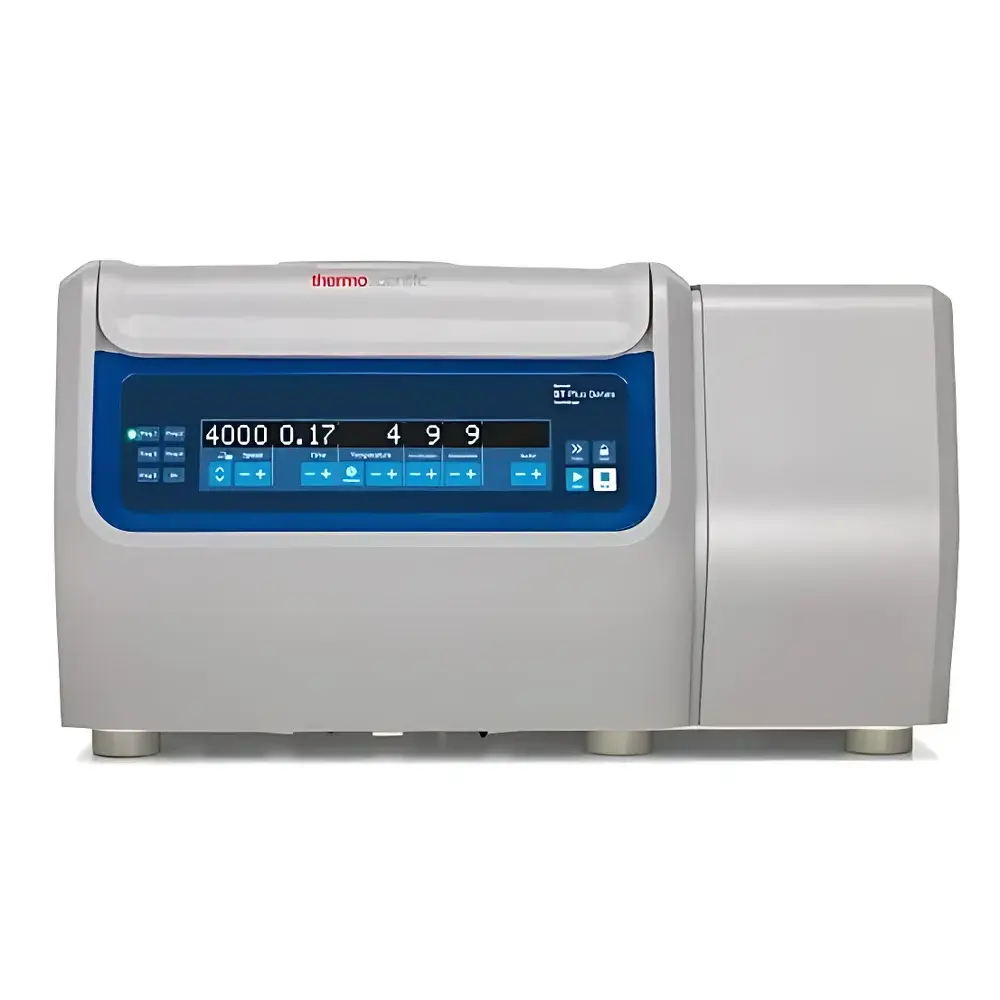
Thermo Scientific Sorvall ST1/ST1R Plus Benchtop Centrifuge
| Brand | Thermo Fisher |
|---|---|
| Origin | Germany |
| Manufacturer | Thermo Fisher Scientific |
| Product Type | Benchtop Centrifuge |
| Model | ST1/ST1R Plus |
| Speed Range | Up to 15,200 rpm |
| Max RCF | 25,830 × g |
| Max Capacity | 4 × 400 mL (with TX-400 rotor) |
| Dimensions | 36.2 × 56.6 × 66 cm |
| Rotor Options | 15 interchangeable rotors including horizontal, fixed-angle, and microcentrifuge configurations |
| Compliance | CAMR-certified ClickSeal™ biocontainment system |
| Safety | Auto-Lock™ III rotor auto-engagement, electric lid latch, SMARTSpin™ imbalance compensation |
| Energy Efficiency | Up to 40% lower energy consumption vs. conventional benchtop centrifuges for standard blood and conical tube protocols |
Overview
The Thermo Scientific Sorvall ST1/ST1R Plus is a high-performance benchtop centrifuge engineered for routine separation tasks in clinical, diagnostic, and research laboratories. Utilizing fixed-angle and swinging-bucket rotor architectures, it operates on the principle of sedimentation under controlled centrifugal force—enabling efficient separation of biological components such as whole blood, plasma, serum, cellular suspensions, and particulate matter based on density and size differentials. The ST1R variant incorporates a refrigerated cooling system (operating range: –9 °C to +40 °C), while the ST1 model provides ambient-temperature operation. Both models are designed for GMP-aligned workflows and support traceable, repeatable processing in regulated environments where reproducibility and operator safety are critical.
Key Features
- Auto-Lock™ III Rotor System: Fully automated rotor engagement ensures precise mechanical alignment and eliminates manual threading or torque calibration—reducing setup time and minimizing user error during rotor changes.
- ClickSeal™ Biocontainment Lid: A one-handed, glove-compatible sealing mechanism certified by the UK Health Security Agency’s Defence Science and Technology Laboratory (DSTL) at Porton Down for containment of BSL-2 agents; eliminates threaded caps and complex latching hardware.
- Fiberlite™ Carbon-Fiber Rotors: Lightweight composite construction reduces inertia, enabling faster acceleration/deceleration profiles and higher sustainable speeds than equivalent aluminum rotors—improving resolution in differential centrifugation protocols.
- SMARTSpin™ Intelligent Rotor Management: Real-time load distribution monitoring dynamically adjusts acceleration and braking profiles to maintain stability under partial or unbalanced loads—enhancing rotor longevity and operational safety.
- Ergonomic Design & Space Optimization: Compact footprint (36.2 × 56.6 × 66 cm) with elevated control panel height facilitates easy loading/unloading at standard bench height; smooth-radius housing enables rapid surface decontamination.
- Electric Lid Latch: Motorized locking mechanism engages with a single button press—even when installed on elevated workstations—ensuring consistent lid closure force and eliminating manual pressure variability.
Sample Compatibility & Compliance
The ST1/ST1R Plus accommodates a broad spectrum of primary sample containers, including 5–7 mL vacutainers (up to 76 tubes per run), 15 mL and 50 mL conical tubes (16 × 50 mL), and microcentrifuge tubes (30 × 2 mL configuration). It supports ISO 22870-compliant point-of-care laboratory requirements and aligns with CLIA, CAP, and JCI accreditation criteria for centrifuge validation. All Fiberlite™ rotors undergo full ASME BPVC Section VIII Div. 1 certification for pressure vessel integrity. The ClickSeal™ system meets EN 14971:2012 risk management standards for medical devices and is validated per ASTM E2993-15 for aerosol containment performance.
Software & Data Management
While the ST1/ST1R Plus features a standalone, non-networked interface, its embedded firmware supports GLP/GMP-relevant operational traceability. Six programmable methods can be stored locally with timestamped start/stop logs, rotor ID recognition, and run history retention (last 100 cycles). Each method includes configurable parameters: speed (rpm or ×g), time, temperature (ST1R only), acceleration/deceleration ramps, and lid lock status. Audit trail data is exportable via USB port in CSV format for integration into LIMS or quality documentation systems. Firmware updates are performed offline using signed binary files compliant with IEC 62304 Class B software lifecycle requirements.
Applications
This centrifuge is routinely deployed in hematology labs for serum/plasma separation from whole blood (e.g., 10 min @ 3,000 rpm, 1,800 × g); in microbiology for pelleting bacterial cultures prior to DNA extraction; in biobanking for cryopreserved PBMC isolation; and in pharmaceutical QC for particle removal from formulation buffers. Its compatibility with TX-400 swing-out rotors (4 × 400 mL capacity) supports large-volume processing in transfusion medicine settings, while the Microliter 30 × 2 rotor enables high-speed pelleting of subcellular organelles at up to 25,830 × g. Routine maintenance intervals follow Thermo Fisher’s recommended 500-hour service schedule, with rotor lifetime tracked via embedded RFID tags.
FAQ
Is the ST1R Plus compatible with third-party rotors?
No—only Thermo Fisher–certified rotors with integrated RFID authentication are recognized by the SMARTSpin™ system. Non-OEM rotors will not initialize.
What regulatory documentation is provided with the instrument?
Each unit ships with a Factory Acceptance Test (FAT) report, CE Declaration of Conformity, ISO 13485 manufacturing certificate, and ClickSeal™ CAMR validation dossier.
Can the centrifuge be integrated into a networked lab environment?
Not natively—the ST1/ST1R Plus lacks Ethernet, Wi-Fi, or RS-232 connectivity. Data export is limited to USB-hosted CSV files.
Does the ST1R model maintain temperature stability during prolonged runs?
Yes—the compressor-based refrigeration system maintains setpoint within ±1.5 °C over 30-minute continuous operation at maximum speed and full load.
How often must the Auto-Lock™ III mechanism be serviced?
The system requires no scheduled maintenance; wear inspection is performed during annual rotor calibration per Thermo Fisher Service Bulletin SB-ST1-2023-04.



