
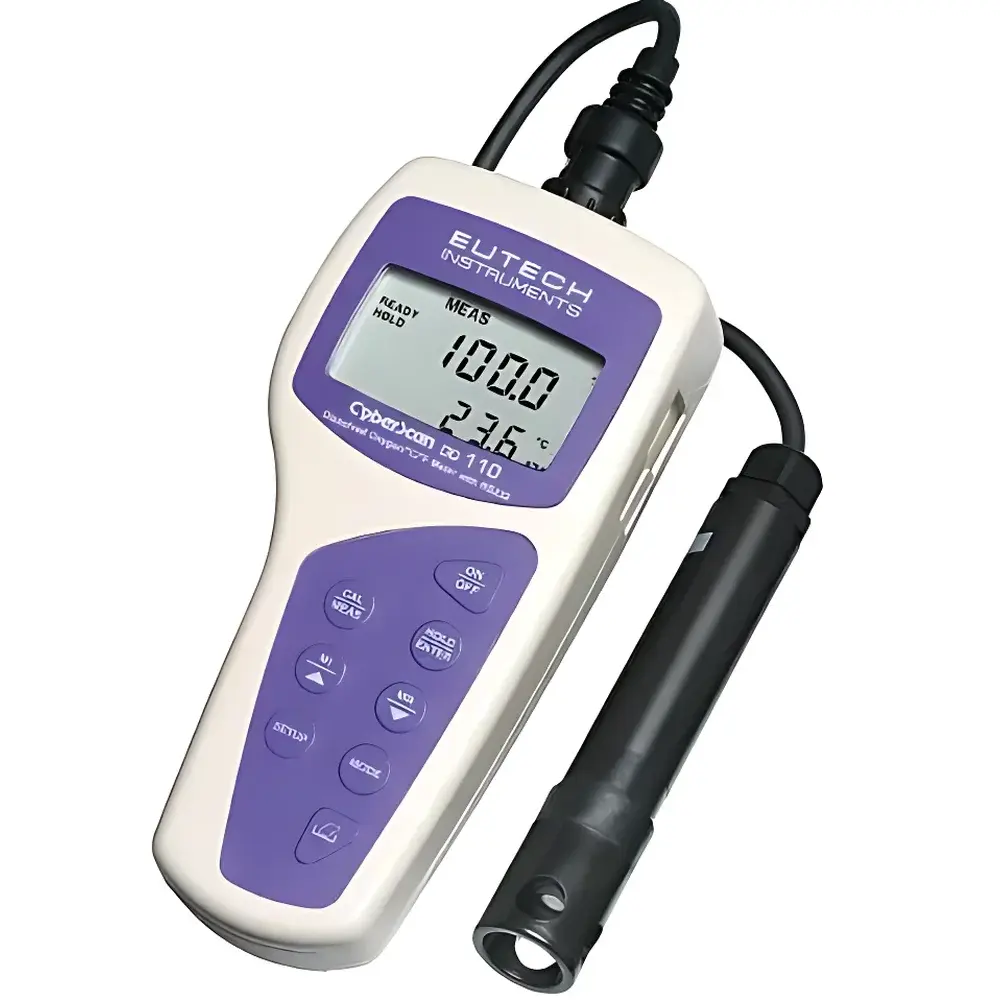
Thermo Fisher Scientific Eutech CyberScan DO110 Portable Dissolved Oxygen Meter
| Brand | Thermo Fisher Scientific |
|---|---|
| Origin | Singapore |
| Manufacturer | Thermo Fisher Scientific |
| Country of Origin | Imported |
| Model | DO110 |
| Instrument Type | Portable |
| Electrode Type | Galvanic Cell |
| DO Range | 0.00–19.99 mg/L (ppm) |
| DO Resolution | 0.01 mg/L |
| DO Accuracy | ±1.5% of full scale |
| Saturation Range | 0.0–199.9% |
| Saturation Resolution | 0.1% |
| Salinity Compensation | 0.0–50.0 ppt (manual entry, auto-applied) |
| Atmospheric Pressure Compensation | 500–1499 mmHg / 66.6–199.9 kPa (manual entry, auto-applied) |
| Temperature Range | 0.0–50.0 °C |
| Temperature Resolution | 0.1 °C |
| Temperature Accuracy | ±0.3 °C |
| Calibration | Dual-point (% saturation) or single-point (mg/L) |
| Data Storage | 100 measurement sets |
| Display | Dual-line LCD (5.8 × 3.3 cm) |
| IP Rating | IP54 |
| Power | 4 × AA alkaline batteries (typical life >700 h) or 9 V regulated DC adapter (200 mA) |
| Dimensions (instrument) | 18 × 9 × 4 cm |
| Weight (instrument) | 220 g |
Overview
The Thermo Fisher Scientific Eutech CyberScan DO110 Portable Dissolved Oxygen Meter is a field-deployable electrochemical instrument engineered for reliable, on-site quantification of dissolved oxygen (DO) concentration and temperature in aqueous environmental samples. It employs a galvanic cell oxygen sensor—requiring no external polarization voltage—which delivers stable, low-maintenance operation across diverse freshwater, estuarine, and wastewater matrices. The DO110 operates on the principle of oxygen diffusion through a gas-permeable membrane into an internal electrolyte, where electrochemical reduction at the cathode generates a current linearly proportional to partial pressure of O₂. This analog signal is digitized and compensated in real time for temperature, salinity, and atmospheric pressure—critical variables governing oxygen solubility per Henry’s law. Designed for compliance with standard methods including APHA 4500-O G and ISO 5814, the DO110 supports regulatory monitoring workflows in municipal water utilities, environmental consulting firms, academic field programs, and industrial effluent discharge verification.
Key Features
- Galvanic cell-based DO sensor with integrated temperature thermistor for simultaneous dual-parameter measurement
- One-touch unit toggle between mg/L (ppm) and % saturation—enabling rapid interpretation across regulatory reporting formats
- Real-time compensation algorithms for salinity (0.0–50.0 ppt) and barometric pressure (500–1499 mmHg), both manually entered and automatically applied to raw sensor output
- IP54-rated enclosure providing protection against dust ingress and water splashes—validated for outdoor use in rain, high humidity, or near-surface aquatic environments
- Dual-line LCD display (5.8 × 3.3 cm) concurrently showing DO value, temperature, electrode status indicator, and active compensation parameters
- Non-volatile memory retaining up to 100 measurement records—including timestamp, DO, temperature, salinity, and pressure settings—even after power loss
- Auto-power-off after 20 minutes of inactivity; battery life exceeds 700 hours using standard AA alkaline cells
Sample Compatibility & Compliance
The DO110 is validated for use with natural waters (rivers, lakes, groundwater), treated drinking water, activated sludge systems, aquaculture ponds, and industrial process streams. Its galvanic electrode exhibits minimal response drift in turbid or organically rich samples and does not require stirring correction under moderate flow conditions (≥10 cm/s). The instrument conforms to IEC 60529 for IP54 ingress protection and meets electromagnetic compatibility requirements per EN 61326-1 for laboratory and field instrumentation. While not certified for hazardous locations, its design aligns with GLP documentation practices: all stored data include metadata (date/time, operator ID via optional software), and calibration events are logged with reference values and deviation metrics. For audit readiness, users may export datasets via RS232C interface to compliant LIMS or spreadsheet applications.
Software & Data Management
Data transfer is supported via standard RS232C serial protocol (6-pin DC socket), enabling direct connection to PCs running terminal emulation software or custom scripts for batch logging. Though the DO110 lacks onboard Bluetooth or USB, its ASCII-formatted output includes header lines identifying instrument model, firmware version, and measurement mode—facilitating automated parsing in Python, MATLAB, or LabVIEW environments. The 100-entry memory implements circular overwrite logic with timestamping compliant with ISO/IEC 17025 clause 7.7 on record retention. No proprietary drivers or cloud dependencies are required; exported files meet FDA 21 CFR Part 11 readiness when paired with validated third-party acquisition software featuring electronic signature and audit trail capabilities.
Applications
- Regulatory compliance monitoring per EPA Method 360.1 and EU Directive 2000/60/EC for surface water DO thresholds
- Biochemical oxygen demand (BOD) incubation setup verification and endpoint confirmation
- Aquaculture system health assessment—tracking diurnal DO fluctuations in recirculating tanks or raceways
- Wastewater treatment plant aeration basin optimization and nitrification/denitrification control
- Field validation of online DO analyzers during routine QA/QC checks
- Academic limnology studies requiring lightweight, battery-operated instrumentation for remote sampling campaigns
FAQ
Does the DO110 require membrane replacement or electrolyte refilling?
Yes—the galvanic sensor uses a replaceable Teflon membrane and consumable electrolyte solution. Membrane replacement is recommended every 3–6 months depending on sample fouling; electrolyte should be renewed with each membrane change.
Can the instrument compensate for altitude-induced pressure changes during mountain stream surveys?
Yes—users manually input local barometric pressure (in mmHg or kPa), and the meter applies standardized solubility corrections per USGS Water-Supply Paper 2254 and ASTM D888 Annex A1.
Is calibration traceable to NIST standards?
While the DO110 itself is not NIST-certified, its two-point calibration (0% in sodium sulfite solution and 100% in air-saturated water) follows procedures documented in APHA Standard Methods, and reference materials used must be NIST-traceable per laboratory quality system requirements.
What is the minimum sample volume required for accurate measurement?
No minimum volume is specified; however, consistent immersion depth ≥2 cm and gentle stirring (if static conditions prevail) ensure representative diffusion equilibrium at the membrane surface.
How does the DO110 handle temperature gradients during rapid profiling?
The integrated thermistor provides continuous temperature feedback at 0.1 °C resolution, and DO compensation updates dynamically—no user intervention is needed during vertical or horizontal transects.







