
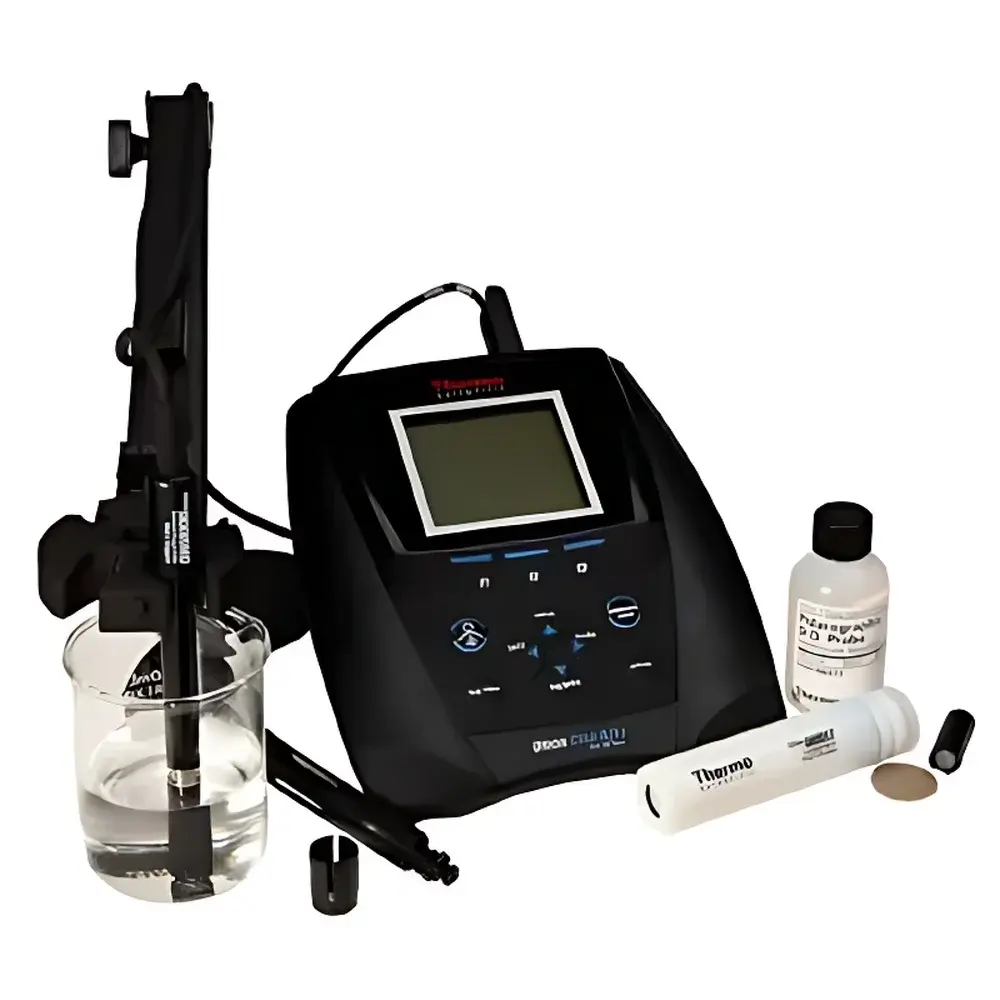
Thermo Fisher Scientific Orion Star A216 and A326 Benchtop/Portable pH and Dissolved Oxygen Meters
| Brand | Thermo Fisher Scientific |
|---|---|
| Origin | Singapore |
| Manufacturer | Thermo Fisher Scientific |
| Product Type | Imported |
| Model | A216 (Benchtop), A326 (Portable) |
| Instrument Category | Benchtop |
| Parameter Count | Dual (pH & DO) |
| pH Accuracy | ±0.001 |
| pH Measurement Range | −2.000 to 20.000 |
| pH Resolution | 0.1 / 0.01 / 0.001 |
| mV Range | ±2000.0 mV |
| mV Resolution | 0.1 mV |
| mV Accuracy | ±0.1 mV |
| Polarographic DO Range | 0–90 mg/L |
| RDO Fluorescence DO Range | 0–50 mg/L |
| RDO DO Accuracy | ±0.1 mg/L (0–8 mg/L), ±0.2 mg/L (8–20 mg/L), ±10% of reading (20–50 mg/L) |
| DO Saturation Range | 0–600% (polarographic), 0–500% (RDO) |
| DO Saturation Accuracy | ±2% |
| Atmospheric Pressure Compensation | 450.0–850.0 mmHg |
| Salinity Correction | 0–45 ppt |
| Temperature Range | 0–50 °C |
| Temperature Accuracy | ±0.1 °C |
| Data Storage | 2000 entries (A216), 5000 entries (A326), with timestamp, date, sample ID, user ID, calibration data |
| Compliance | GLP-compliant data logging |
| Connectivity | RS232, USB |
| Power | 4 × AA batteries or AC adapter |
| IP Rating | IP54 (A216), IP67 (A326) |
Overview
The Thermo Fisher Scientific Orion Star A216 (benchtop) and A326 (portable) pH and dissolved oxygen (DO) meters are precision electrochemical instruments engineered for rigorous laboratory, field, and quality control environments. These dual-parameter analyzers integrate potentiometric pH measurement with either polarographic or luminescence-based (RDO) dissolved oxygen detection—enabling simultaneous, traceable quantification of two critical water quality and process parameters. The instruments operate on established electrochemical principles: pH is determined via Nernstian response of a glass electrode against a stable reference, while DO is measured either by oxygen reduction current at a Clark-type cathode (polarographic mode) or by phase-shift analysis of fluorescent lifetime quenching (RDO mode). Designed for compliance-driven workflows, both models support full GLP data integrity requirements—including user authentication, audit-trail-capable calibration logging, and time-stamped measurement records—making them suitable for regulated applications in pharmaceutical manufacturing, environmental monitoring, wastewater treatment, and academic research.
Key Features
- Intuitive multi-language interface (English, Chinese, Spanish, French, German, Italian) with large backlit LCD supporting simultaneous dual-channel display (e.g., pH + DO saturation %, or mV + temperature)
- AUTO-READ™ intelligent stabilization algorithm locks readings automatically upon signal convergence, indicated by a dedicated status icon
- Programmable timed data acquisition (manual, auto-hold, or interval-based) with configurable sampling intervals from 1 second to 24 hours
- Smart buffer recognition for USA, NIST, and DIN pH standards; editable calibration curves to optimize slope and offset without re-calibration
- Automatic probe identification for both polarographic and RDO DO sensors—eliminating manual sensor-type configuration errors
- Integrated temperature compensation using built-in thermistor (0–50 °C); optional external temperature probe support for enhanced accuracy in non-isothermal samples
- Dual power architecture: operates continuously on AC adapter (100–240 V AC) or up to 2000 hours on four AA alkaline batteries (A326 rated IP67 for dust/water immersion resistance)
Sample Compatibility & Compliance
The Star A series accommodates a broad range of aqueous matrices—from ultrapure water and buffered standards to high-ionic-strength industrial effluents and seawater (with salinity correction up to 45 ppt). Electrode compatibility includes standard BNC pH electrodes, refillable or gel-filled reference junctions, and both 9-pin mini-DIN polarographic and RDO probes. All measurements adhere to internationally recognized methodologies: pH determinations align with ASTM D1293 and ISO 10523; DO measurements conform to ASTM D888 (for polarographic) and ASTM D5420 (for optical RDO), with atmospheric pressure compensation ensuring validity across altitudes (450–850 mmHg). Data storage meets GLP requirements per 21 CFR Part 11 when used with Orion™ software and enabled user access controls—supporting full traceability of operator identity, calibration history, and raw measurement metadata.
Software & Data Management
Data export and instrument management are performed via Thermo Fisher’s free Orion™ CombiStat Software (Windows-compatible), which enables secure bidirectional communication over RS232 or USB. The software supports batch export of CSV- or Excel-formatted datasets—including pH, DO concentration/saturation, temperature, atmospheric pressure, salinity, calibration coefficients, and timestamps—with optional digital signature and electronic lab notebook (ELN) integration. Audit trails record all configuration changes, calibration events, and data deletions with immutable timestamps and user IDs. Firmware updates are delivered through the same interface, ensuring long-term regulatory alignment and feature enhancements without hardware replacement.
Applications
- Pharmaceutical water system validation (PW, WFI) per USP and EP 2.2.42
- Environmental surface water and groundwater monitoring under EPA Method 360.1 and ISO 5814
- Bioreactor and fermentation process control requiring real-time pH and DO feedback
- Drinking water treatment compliance testing (e.g., WHO Guidelines, EU Directive 98/83/EC)
- Academic teaching labs emphasizing electrochemical fundamentals, sensor kinetics, and error propagation analysis
- Food and beverage QC for product stability, shelf-life studies, and microbial growth correlation
FAQ
Can the A216 and A326 be used interchangeably for regulatory submissions?
Yes—both models generate GLP-compliant data with identical metadata structures, calibration traceability, and audit-log capabilities when configured with user authentication and electronic signatures via Orion CombiStat Software.
Does the instrument support automatic temperature compensation for DO measurements?
Yes—temperature is measured in real time and applied dynamically to both polarographic and RDO DO calculations using built-in algorithms compliant with ISO 5814 and ASTM D5420.
Is sensor calibration stored per probe or per instrument?
Calibration data is stored per probe ID (via embedded EEPROM in compatible Orion sensors), enabling seamless probe swapping without recalibration—provided the probe type and serial number are registered in the instrument memory.
What happens if the battery dies during a timed measurement sequence?
The A326 retains all active settings and unsaved data in non-volatile memory; upon power restoration, it resumes operation and logs a power-interruption event with timestamp in the audit trail.
Are third-party pH or DO probes compatible?
Only Thermo Fisher-certified Orion probes are fully supported for automated recognition, diagnostic self-tests, and RDO-specific firmware features; generic BNC pH electrodes may function but lack calibration history synchronization and advanced diagnostics.





