
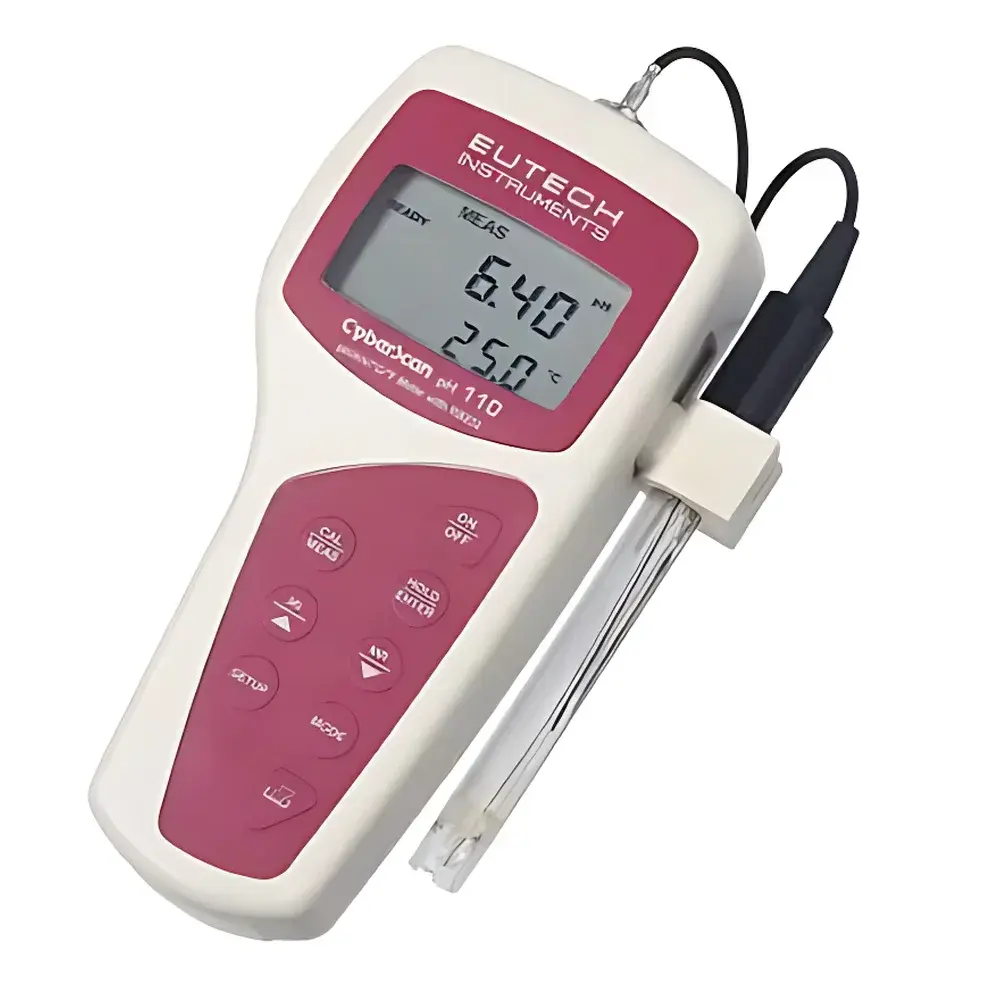
Eutech CyberScan pH110 Portable pH/ORP/Temperature Meter
| Brand | Thermo Fisher Scientific |
|---|---|
| Origin | Singapore |
| Manufacturer | Eutech Instruments (a Thermo Fisher brand) |
| Model | pH110 |
| pH Range | -2.00 to 16.00 |
| pH Resolution | 0.01 pH |
| pH Accuracy | ±0.01 pH |
| Calibration Points | Up to 6-point, auto-buffer recognition (USA, NIST, DIN, PWB) |
| ORP Range | ±1999.0 mV |
| ORP Resolution | 0.1 mV (±199.9 mV), 1 mV (>±199.9 mV) |
| ORP Accuracy | ±0.2 mV / ±2 mV ±1 LSD |
| Temperature Range | -10.0 to 110.0 °C |
| Temperature Resolution | 0.1 °C |
| Temperature Accuracy | ±0.5 °C |
| Temperature Compensation | Auto/manual (0.0–100.0 °C) |
| Data Storage | 100 measurement sets + calibration records |
| Display | Dual-line LCD (5.8 × 3.3 cm) |
| Interface | BNC, 2.5 mm phono, DC socket, RS232C |
| Power | 4 × 1.5 V AA alkaline batteries (life >700 h) or 9 V regulated adapter (200 mA) |
| Dimensions (instrument) | 18 × 9 × 4 cm |
| Weight (instrument) | 220 g |
Overview
The Eutech CyberScan pH110 Portable pH/ORP/Temperature Meter is a field-deployable, microprocessor-controlled electrochemical analyzer engineered for precision and reliability in routine laboratory, environmental monitoring, aquaculture, wastewater treatment, and educational applications. Built upon a robust analog front-end architecture with high-impedance input circuitry (>1012 Ω), the pH110 employs potentiometric measurement principles compliant with ASTM D1293 and ISO 10523 standards for pH determination in aqueous media. Its dual-channel capability simultaneously acquires pH, redox potential (ORP), and temperature—enabling real-time temperature-compensated measurements per IUPAC-recommended Nernst equation implementation. Designed for operational continuity in variable ambient conditions (0–50 °C), the instrument features non-volatile memory with power-loss protection, ensuring integrity of calibration coefficients and up to 100 timestamped measurement records without external power.
Key Features
- True multi-parameter operation: simultaneous pH, ORP (mV), and temperature measurement with automatic or manual temperature compensation (0.0–100.0 °C)
- Intelligent 6-point calibration with auto-buffer recognition across four international standard sets (USA, NIST, DIN, PWB), reducing operator error and improving traceability
- High-resolution dual-line LCD display (5.8 × 3.3 cm) with dedicated parameter indicators and status icons for rapid visual verification
- RS232C serial interface supporting bidirectional communication with PCs or thermal printers; compatible with Eutech DAS (Data Acquisition Software) for GLP-compliant data export, graphing, and audit trail generation
- Low-power design delivering >700 hours of continuous operation on standard AA alkaline batteries; optional 9 V regulated DC adapter for benchtop use
- Compact, ergonomic housing (18 × 9 × 4 cm; 220 g) with IP67-rated ingress protection against dust and incidental water exposure during field deployment
Sample Compatibility & Compliance
The pH110 is optimized for aqueous and semi-aqueous samples with conductivity ≥50 µS/cm, including drinking water, surface water, effluent streams, nutrient solutions, buffer standards, and biological media. It supports glass-body and epoxy-bodied combination pH electrodes (BNC connector), as well as ORP electrodes with platinum or gold sensing elements (2.5 mm phono). All measurements adhere to ISO/IEC 17025 documentation requirements when used with certified reference materials and validated procedures. The device’s firmware and data handling architecture support alignment with FDA 21 CFR Part 11 expectations for electronic records—particularly when paired with DAS software enabling user authentication, electronic signatures, and immutable audit logs.
Software & Data Management
The included Eutech DAS (Data Acquisition Software) provides a Windows-based platform for configuring instrument parameters, scheduling automated readings, exporting CSV/Excel-formatted datasets, and generating compliance-ready reports. Data transfer occurs via RS232C at 9600 baud, with full support for time-stamped entries, electrode diagnostics (slope/offset), and calibration history. All stored measurements retain metadata including date/time stamp, temperature reading, electrode ID (if entered manually), and calibration status—facilitating retrospective review under GLP or GMP quality systems. Firmware updates are delivered through the same interface, ensuring long-term regulatory adaptability.
Applications
- Environmental field testing: pH and ORP profiling of rivers, lakes, and groundwater per EPA Method 150.1 and APHA Standard Methods 4500-H+
- Water treatment process control: real-time monitoring of coagulation, disinfection, and neutralization stages
- Aquaculture and hydroponics: maintenance of optimal pH ranges for species-specific growth (e.g., tilapia: 6.5–8.5; lettuce: 5.5–6.5)
- Academic teaching labs: hands-on instruction in electrochemical fundamentals, calibration theory, and Nernstian behavior
- Pharmaceutical QC: verification of buffer preparation consistency and stability testing per USP
FAQ
Does the pH110 support automatic temperature compensation (ATC) with all electrode types?
Yes—ATC is enabled when a compatible thermistor-equipped pH or ORP electrode (e.g., Eutech ECN-211, ECN-221) is connected via BNC; manual compensation remains available for fixed-temperature protocols.
Can calibration data be exported separately from measurement records?
Yes—DAS software allows selective export of calibration logs (including slope, offset, buffer IDs, and timestamps) as standalone CSV files for internal audit or regulatory submission.
Is the instrument suitable for use in humid or outdoor environments?
The pH110’s sealed enclosure meets IP67 specifications for temporary immersion (up to 1 m for 30 min) and dust-tight operation, making it appropriate for rain-exposed fieldwork when used with appropriate electrode housings.
What validation documentation is provided with the instrument?
Each unit ships with a factory calibration certificate traceable to NIST standards, a declaration of conformity (CE, RoHS), and software validation documentation for DAS under ISO 13485-aligned processes.
How is battery life affected by RS232 communication frequency?
Continuous data streaming reduces battery life by approximately 15% versus intermittent logging; however, the instrument enters low-power sleep mode between transmissions to preserve longevity.



