
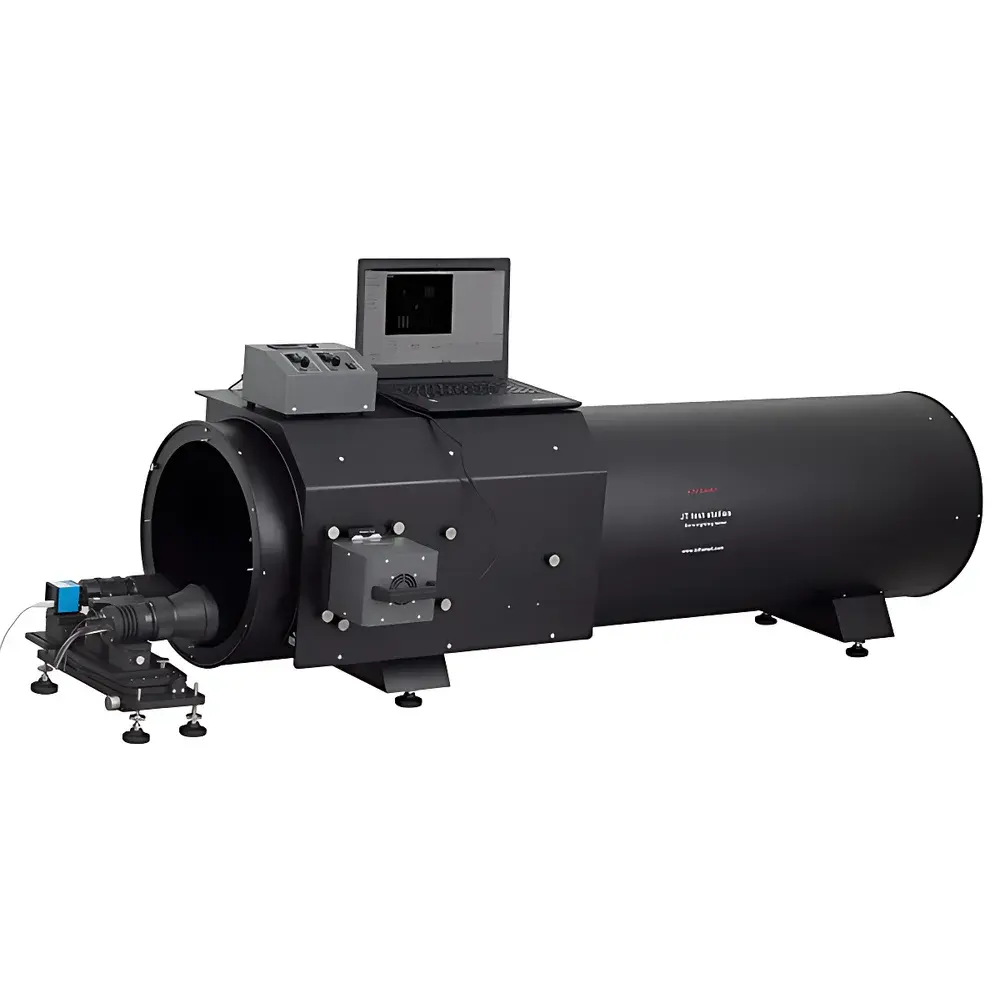
Inframet JT Series Multi-Sensor Boresight Test System
| Brand | Inframet |
|---|---|
| Origin | Poland |
| Model | JT Series (JT150 to JT600, JT-EX) |
| Optical Tube Aperture | 150–600 mm |
| Effective Output Aperture | 46–125 mm |
| Central Obstruction (Dead Zone) | 27–96 mm |
| Dimensions (L×W×H) | 270×340×740 mm (JT150) to 750×820×2750 mm (JT600) |
| Configuration Options | X1–X3 (manual), Y1–Y5 (computer-controlled), +S (SWIR-capable), +Borex (precision mounting platform) |
| Compliance | Designed for MIL-STD-3009, ISO 12233, ASTM E1242, and GLP-aligned test workflows |
Overview
The Inframet JT Series Multi-Sensor Boresight Test System is a precision optical metrology platform engineered for the quantitative alignment verification and parametric characterization of electro-optical (EO) multi-sensor systems. It operates on the principle of collimated beam projection and high-resolution target imaging, enabling traceable boresight error measurement between independent optical axes — including visible/NIR cameras, thermal imagers (MWIR/LWIR), laser rangefinders (single- and multi-pulse), and laser designators. Unlike generalized optical benches, the JT system integrates calibrated parallel optical tubes (CJT series), dual-band collimated sources (DNSB), and standardized resolution targets (USAF 1951, IR-USAF 1951) into a mechanically stable, thermally compensated architecture. Its modular design supports both manual (X-series) and fully computerized (Y-series) operation modes, with optional SWIR extension (+S) and Borex precision mounting platform integration for mission-critical EO/IR system qualification in defense, aerospace, and R&D environments.
Key Features
- Modular configuration scalability: Select from eight standard aperture variants (JT150 to JT600) with effective output apertures ranging from 46 mm to 125 mm and central obstructions minimized to ensure unobstructed wavefront delivery.
- Dual-band collimation capability: DNSB dual-spectrum source enables simultaneous or sequential calibration of visible/NIR and thermal channels using spectrally matched targets (USAF 1951 for VIS/NIR; IR-USAF 1951 for MWIR/LWIR).
- Multi-sensor axis alignment validation: Quantifies boresight error between up to six co-mounted sensors — including camera-to-camera, camera-to-thermal imager, laser rangefinder-to-camera, laser rangefinder-to-thermal imager, and laser designator-to-hybrid sensor pairs.
- Comprehensive parametric testing: Measures spatial resolution (MTF-based), minimum resolvable temperature difference (MRTD), laser divergence (full-angle, ±0.1 mrad repeatability), and mechanical-to-optical axis misalignment (reference plane registration via AH1 adapter).
- Computer-integrated automation (Y-series): Equipped with BOR software suite, frame-grabber acquisition cards, and programmable controllers (CDNSB) for repeatable test sequencing, data logging, and export-compliant reporting (CSV, XML, PDF).
- Optional SWIR extension (+S): Enables alignment and resolution testing of short-wave infrared (SWIR) imagers (0.9–1.7 µm) using calibrated SWIR-specific targets and spectral filters.
- Borex precision mounting platform: A motorized, kinematic, and vibration-damped stage that ensures sub-arcminute angular stability and repeatable mechanical reference plane registration across thermal and mechanical cycling.
Sample Compatibility & Compliance
The JT system accommodates EO payloads with apertures up to 300 mm and focal lengths from 10 mm to 1200 mm. It supports C-mount, F-mount, M42, and custom flange interfaces via AH1 and Borex adapters. All configurations comply with metrological traceability requirements per ISO/IEC 17025:2017 for calibration laboratories. Target-based resolution measurements align with ASTM E1242 (infrared imaging systems) and ISO 12233 (still camera resolution). Laser divergence tests conform to MIL-STD-3009 Annex D (laser rangefinder performance verification). The Y-series software includes audit trail functionality, user access controls, and electronic signature support compliant with FDA 21 CFR Part 11 for regulated environments.
Software & Data Management
BOR (Boresight Optimization & Reporting) software provides full control of CJT tube focus, DNSB source intensity/wavelength selection, target positioning, image capture, and automated boresight calculation. Each test session generates timestamped metadata including environmental conditions (ambient temperature, humidity), sensor identification, operator ID, and calibration certificate references. Data exports include raw images, MTF curves, boresight error vectors (azimuth/elevation), divergence profiles, and pass/fail flags against user-defined thresholds. Version Y5 adds BRES receiver alignment module and CBRES control program for closed-loop laser receiver axis optimization. All software modules are validated per GAMP 5 guidelines and support integration into enterprise LIMS or QMS platforms via RESTful API.
Applications
- Defense system integration: Final acceptance testing of gunner’s primary sights (GPS), targeting pods (e.g., AN/AAQ-33 Sniper ATP), and multi-spectral surveillance turrets prior to field deployment.
- Aerospace EO payload qualification: Verification of sensor co-alignment in UAV gimbal systems, satellite-borne Earth observation suites, and helicopter-mounted FLIR systems.
- R&D laboratory metrology: Development and validation of novel multi-spectral fusion algorithms requiring precise inter-sensor geometric registration.
- Manufacturing QA/QC: Batch verification of production-line EO assemblies, including automatic boresight drift monitoring over thermal soak cycles (−40°C to +70°C).
- Calibration laboratory accreditation: Serving as a primary reference system for accredited labs performing ISO/IEC 17025-compliant EO instrument calibration services.
FAQ
What is the smallest measurable boresight error achievable with the JT system?
Under controlled lab conditions (vibration-isolated bench, thermal stabilization ≥2 hours), the Y-series achieves angular resolution of ≤3 arcseconds for visible/NIR channels and ≤10 arcseconds for thermal channels, limited primarily by target pixel sampling and collimator wavefront quality.
Can the JT system verify dynamic boresight stability during thermal cycling?
Yes — when integrated with environmental chambers and Borex platform, the system supports automated boresight mapping across temperature ramps (e.g., −40°C → +70°C at 1°C/min), with real-time error vector trending and hysteresis analysis.
Is third-party software integration supported?
All Y-series configurations provide documented DLL libraries and TCP/IP command protocols for integration with MATLAB, LabVIEW, Python (via PySerial), and custom test executive frameworks.
Does Inframet provide NIST-traceable calibration certificates?
Yes — each CJT collimator and DNSB source ships with individual NIST-traceable calibration reports (wavelength accuracy ±0.5 nm, collimation error <λ/10 PV), updated annually upon recalibration.
What training and documentation is included with system delivery?
Standard delivery includes on-site installation, 3-day operator certification, comprehensive technical manual (PDF + hardcopy), BOR software license with 12 months maintenance, and access to Inframet’s secure customer portal with firmware updates and application notes.




