
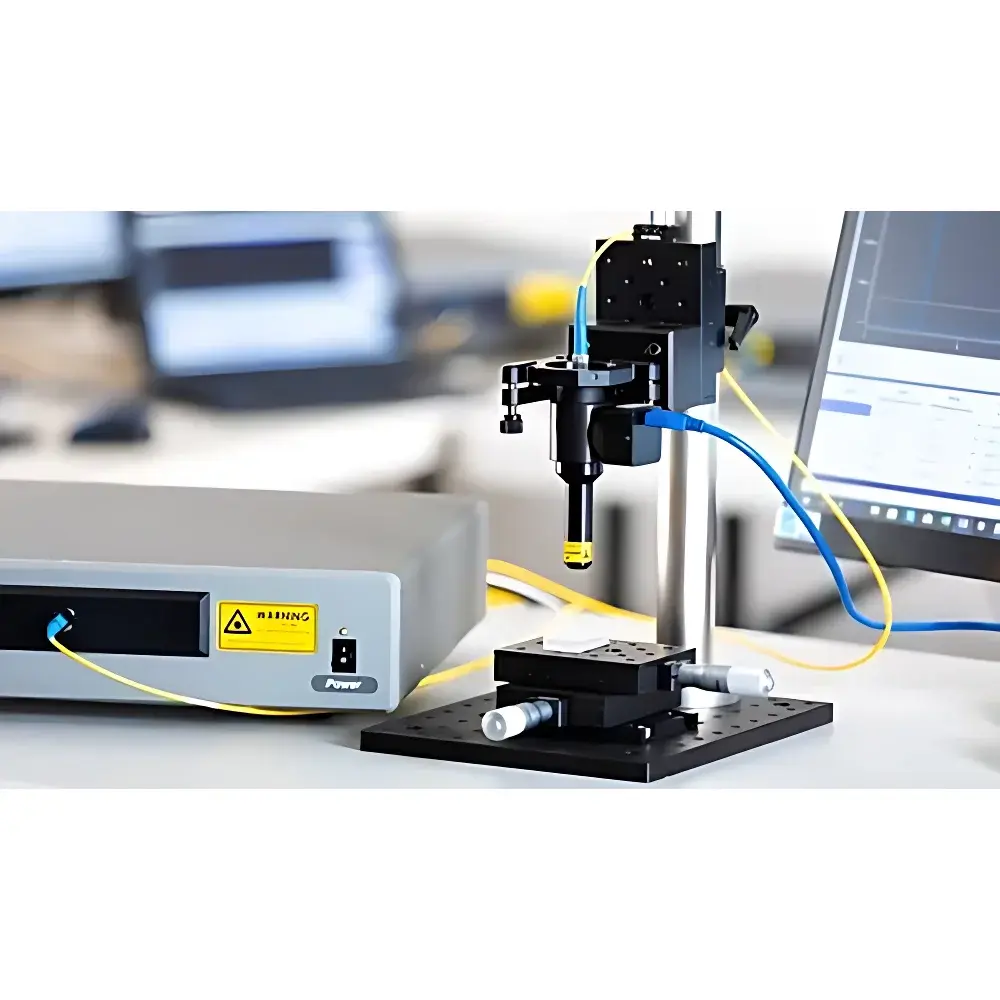
Bristol Non-Contact Optical Thickness Gauge
| Brand | Bristol |
|---|---|
| Origin | USA |
| Manufacturer Type | Authorized Distributor |
| Origin Category | Imported |
| Model | Bristol |
| Price Range | USD 42,000 – 113,000 (based on configuration) |
| Measurement Principle | White-Light Interferometry (WLI) with Coherence Scanning |
| Max. Layers Measured | 31 |
| Measurement Accuracy | ±0.1 µm (for high-precision configurations) / ±1 µm (standard) |
| Measurement Confidence Level | ≥99.7% (3σ) |
| Calibration Standard | NIST-traceable intrinsic length reference |
| Measurement Frequency | Up to 20 Hz |
| Optical Path Length Options | 12 mm / 40 mm / 80 mm |
| Interface | USB 3.0 and Gigabit Ethernet |
| Software Platform | Windows-based proprietary optical metrology suite with LabVIEW/.NET API support |
| Optional Automation Interfaces | TCP/IP real-time data streaming |
Overview
The Bristol Non-Contact Optical Thickness Gauge is an industrial-grade white-light interferometric (WLI) metrology system engineered for high-precision, non-destructive thickness measurement of transparent and semi-transparent multi-layer structures. Unlike contact-based or eddy-current methods, this gauge operates on the principle of coherence scanning interferometry—where broadband light is split into reference and sample arms; interference fringes generated at each interface within a layered stack are resolved spectrally to determine optical path differences. By incorporating material-specific group refractive index (ng) compensation—either preloaded or dynamically calculated using user-provided dispersion coefficients—the system delivers true physical thickness values with traceability to NIST standards. Designed for integration into R&D labs, precision optics manufacturing lines, and regulated medical device production environments, it meets foundational requirements for GLP-compliant documentation and supports audit-ready data logging per FDA 21 CFR Part 11 when deployed with appropriate software configuration.
Key Features
- Non-contact, non-invasive measurement—zero mechanical loading ensures no deformation of soft polymers, hydrogel lenses, or delicate thin-film substrates.
- Simultaneous resolution of up to 31 discrete interfaces—enabling full cross-sectional profiling of complex stacks such as OLED displays (including LOCA layers), multi-element lens assemblies, and coated biomedical tubing.
- Visible aiming beam (635 nm) for intuitive, repeatable positioning—critical for manual alignment during QC sampling or low-volume prototype validation.
- Real-time, continuous self-calibration via built-in intrinsic length standard—eliminates drift-related recalibration downtime and maintains long-term measurement stability.
- Dual-path optical design supporting 12 mm, 40 mm, and 80 mm working distances—optimized for applications ranging from wafer-scale semiconductor substrates to macroscopic optical components.
- High-speed acquisition at 20 Hz frame rate—suitable for inline monitoring in controlled environments where process feedback latency must remain under 50 ms.
Sample Compatibility & Compliance
The system accommodates rigid and compliant materials—including fused silica, BK7, sapphire, silicone hydrogel, PET, ITO-coated glass, and silicon wafers—without requiring surface preparation or coupling media. It complies with ISO 10110-7 (optical element surface form tolerances), ASTM F2457 (ophthalmic lens thickness), and USP (non-invasive thickness testing of parenteral packaging). When configured with optional TCP/IP output and timestamped metadata embedding, the instrument satisfies data integrity requirements under GMP Annex 11 and EU GMP Chapter 4 for automated quality control systems. All calibration records—including NIST certificate numbers and uncertainty budgets—are exportable in CSV/JSON format for internal QA audits.
Software & Data Management
The included Windows-native MetroSuite software provides full parameter configuration, live fringe visualization, and layer-by-layer thickness reporting. It supports automatic peak detection using operator-defined design files specifying up to 32 expected reflection positions—enabling rapid pass/fail evaluation against geometric tolerances (out-of-spec results highlighted in red). Refractive index calculation utilizes Cauchy or Sellmeier dispersion models; coefficients may be imported or refined empirically. For automation integration, native LabVIEW drivers, .NET SDKs, and RESTful API endpoints are provided. Raw interferogram data and processed thickness arrays are stored in HDF5 format—ensuring compatibility with MATLAB, Python (h5py), and statistical process control (SPC) platforms. Audit trails record user actions, parameter changes, and calibration events with immutable timestamps.
Applications
- Optical Components: Center thickness, sag height, and group refractive index of single lenses, cemented doublets, and air-spaced multi-lens assemblies.
- Ophthalmic Devices: Thickness profiling of soft contact lenses and intraocular lenses (IOLs), including edge geometry and hydration-state-dependent swelling analysis.
- Medical Tubing: Concurrent measurement of outer diameter, inner diameter, and wall thickness—including tapered sections and neck transitions—in fluoroscopic catheters and endoscopic sheaths.
- Flat Panel Displays: Total stack thickness, individual layer thicknesses (e.g., TFT array, encapsulation, polarizer), and LOCA bond-line uniformity in AMOLED and microLED modules.
- Semiconductor & Precision Glass: Pre- and post-CMP thickness verification of Si/GaAs wafers; thickness mapping of polished borosilicate substrates used in MEMS packaging.
FAQ
Does the system require periodic recalibration by an external service provider?
No—continuous self-calibration against its NIST-traceable intrinsic reference eliminates scheduled third-party recalibration. Annual verification using certified step-height standards is recommended for ISO/IEC 17025 compliance.
Can the gauge measure opaque or highly scattering materials?
It is optimized for transparent and semi-transparent dielectrics. Opaque metals, carbon composites, or heavily pigmented polymers fall outside its operational envelope due to insufficient back-surface reflectivity.
Is TCP/IP data streaming compatible with PLC-based factory networks?
Yes—real-time thickness values, confidence metrics, and status flags are transmitted via configurable UDP/TCP packets with sub-100 ms latency, supporting direct ingestion into Siemens TIA Portal, Rockwell FactoryTalk, or custom MES architectures.
How is group refractive index handled for novel polymer formulations?
Users input dispersion coefficients (A–F for Sellmeier or A–C for Cauchy); the software computes ng across the measurement bandwidth and applies correction automatically—no empirical lookup tables required.
What environmental conditions affect measurement stability?
Ambient temperature fluctuations >±0.5°C/hour or vibration exceeding ISO 23828 Class 2 may degrade fringe contrast. Installation on pneumatic isolation tables and within climate-controlled zones (20 ± 1°C, 40–60% RH) is advised for metrology-grade repeatability.



