
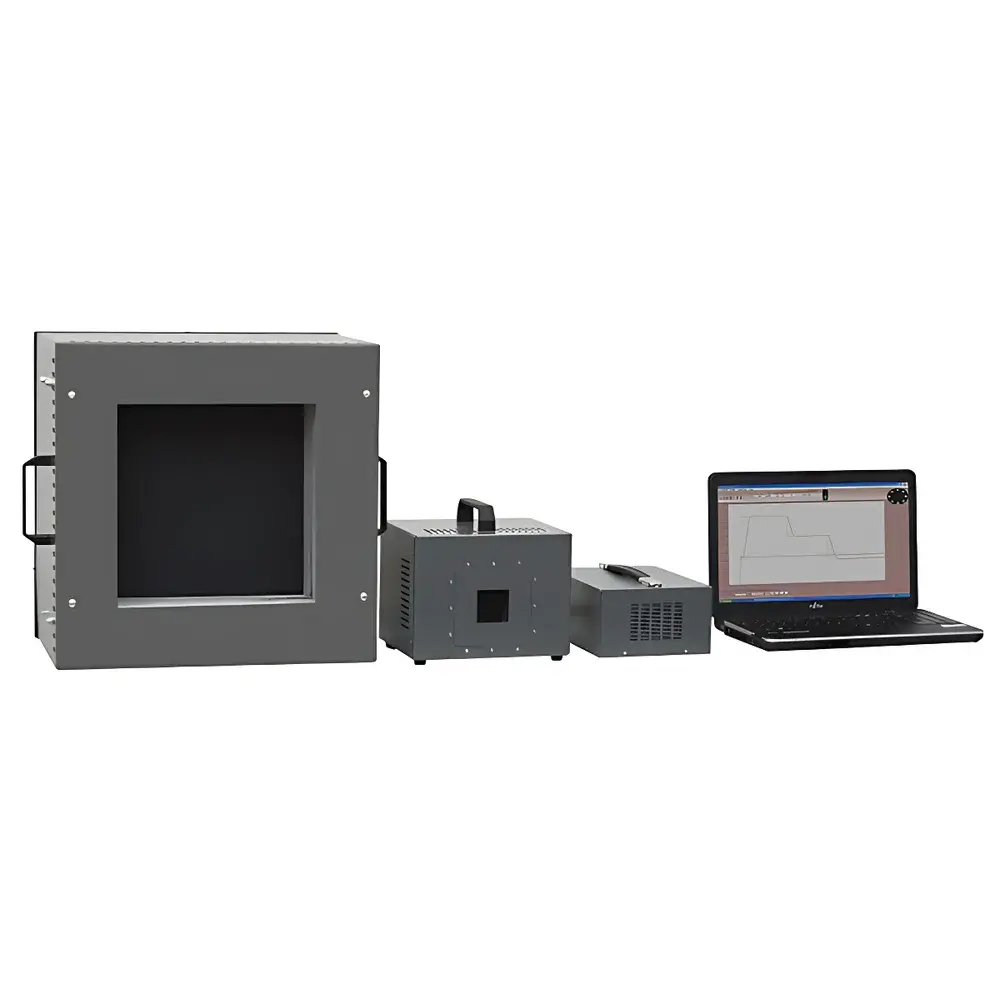
Inframet MTB Series High-Precision Medium-Temperature Extended-Area Blackbody
| Brand | Inframet |
|---|---|
| Origin | Poland |
| Model | MTB |
| Temperature Range | Ambient +5°C to 550°C |
| Aperture Options | 50×50 mm to 300×300 mm |
| Emissivity | 0.96 ± 0.01 |
| Temperature Resolution | 0.01°C |
| Temperature Uncertainty | 0.07°C or 0.002×(T−25)°C |
| Spatial Uniformity | ≤0.002×(T−25)°C (MTB-2D) to ≤0.01×(T−25)°C (MTB-12D) |
| Stabilization Time | <10 min to <25 min (model-dependent) |
| Control Interface | RS-232 / USB 2.0 |
| Power Supply | 115–230 VAC, 50/60 Hz (single-phase) up to 400–6200 W (model-dependent) |
| Operating Temperature | +5°C to +45°C |
| Storage Temperature | −10°C to +60°C |
| Weight | 12 kg to 67 kg |
Overview
The Inframet MTB Series High-Precision Medium-Temperature Extended-Area Blackbody is a laboratory-grade calibration source engineered for radiometric and thermographic system validation across the mid-infrared spectral band (typically 3–14 µm). Designed on the principle of Planckian radiation emission from a temperature-controlled, high-emissivity cavity surface, the MTB delivers traceable, spatially uniform thermal radiation ideal for calibrating infrared cameras, thermal imagers, radiation thermometers, and spectral radiometers. Its core architecture integrates a thin-film resistive heating element directly bonded to a precision-machined, oxidized aluminum or Inconel radiation plate—ensuring rapid thermal response, minimal thermal gradients, and long-term stability under repeated thermal cycling. Unlike point-source or cavity-type blackbodies, the MTB functions as an extended-area source with defined aperture geometry, enabling full-field calibration of imaging systems without vignetting or field-of-view mismatch.
Key Features
- Extended-area radiation source with four standardized aperture sizes (50×50 mm, 100×100 mm, 150×150 mm, 300×300 mm) to match diverse optical system f/# and working distance requirements.
- Temperature control range from ambient +5°C to 550°C, with recommended operational range of 100°C–550°C for optimal stability and uniformity performance.
- High-resolution digital temperature regulation with 0.01°C setpoint resolution and closed-loop PID feedback using calibrated Pt100 sensors embedded in the radiation plate substrate.
- Emissivity certified at 0.96 ± 0.01 (measured per ASTM E1933-19 and ISO 18434-1), verified via reflectance-limited cavity geometry and spectrally neutral surface oxidation.
- Temperature uncertainty specified as max(0.07°C, 0.002×(T−25)°C), traceable to NIST-traceable reference standards and validated under ISO/IEC 17025-accredited calibration protocols.
- Thermal uniformity characterized per ISO 12717:2021 — defined as peak-to-peak spatial variation across the active aperture — achieving ≤0.002×(T−25)°C for MTB-2D at 300°C and maintaining ≤0.01×(T−25)°C even for the largest MTB-12D model.
- Dual-mounting configuration support (vertical or horizontal), with documented improvement in uniformity (up to 30%) when operated horizontally due to reduced convective asymmetry.
Sample Compatibility & Compliance
The MTB series is compatible with all IR imaging platforms requiring NIST-traceable, spatially resolved calibration sources—including cooled and uncooled microbolometer arrays, InSb and MCT focal plane arrays, and scanning radiometers. Its physical design conforms to standard optical bench integration practices: front-panel aperture flanges comply with ANSI/ISA-77.41 mechanical interface specifications, and mounting holes accommodate standard kinematic optical rails (e.g., Thorlabs TR series). All models meet CE marking requirements for electromagnetic compatibility (EN 61326-1) and low-voltage safety (EN 61010-1). Calibration certificates include full uncertainty budgets compliant with ISO/IEC 17025:2017 and are issued by Inframet’s in-house DKD-accredited calibration laboratory (DAkkS Reg. No. D-K-18049-01-00). For regulated environments, optional audit-ready documentation packages support FDA 21 CFR Part 11 compliance (electronic signature, change control, and data integrity logs) when paired with Inframet’s MTB-Control v3.x software.
Software & Data Management
Each MTB unit ships with MTB-Control v3.x — a Windows-based application supporting both RS-232 (via included DB9-to-USB adapter) and native USB 2.0 communication. The software provides real-time temperature monitoring, multi-point ramp/soak profiling, automated stabilization verification (per user-defined ΔT and dwell time), and export of time-stamped measurement logs in CSV and XML formats. All parameter changes are logged with timestamp, operator ID (if configured), and pre-/post-value deltas—enabling full GLP/GMP traceability. Raw sensor readings, control loop diagnostics, and thermal history plots are accessible for root-cause analysis during instrument qualification (IQ/OQ/PQ). Optional Python and LabVIEW drivers allow integration into custom test automation frameworks (e.g., NI TestStand, Keysight PathWave).
Applications
- Factory and field calibration of thermal imaging systems used in predictive maintenance, aerospace NDT, and electrical substation monitoring.
- Validation of radiometric accuracy and non-uniformity correction (NUC) algorithms in OEM IR camera development labs.
- Reference source for ISO 18434-1-compliant condition monitoring programs in rotating machinery and process industries.
- Performance testing of infrared thermometers per ASTM E2847 and IEC 62942-2 standards.
- Research applications in emissivity modeling, atmospheric transmission studies, and hyperspectral IR sensor characterization.
FAQ
What is the recommended operating orientation for optimal temperature uniformity?
Horizontal mounting is recommended for highest spatial uniformity; vertical operation increases convective asymmetry and may degrade uniformity by up to 30% at temperatures above 300°C.
Can the MTB be used below 100°C, and how does it affect stabilization time?
Yes, but stabilization time increases significantly below 100°C — e.g., MTB-4D requires >25 minutes to stabilize within ±0.5°C at 50°C versus <15 minutes at 200°C.
Is the emissivity value wavelength-dependent, and over what spectral range is it guaranteed?
Emissivity remains stable within ±0.005 across 3–14 µm, as verified by FTIR reflectance measurements per ASTM E1933 Annex A2.
Does the MTB require periodic recalibration, and what is the recommended interval?
Annual recalibration is recommended for ISO/IEC 17025 traceability; however, in-house verification using a reference thermometer (e.g., Fluke 1523 with 0.02°C uncertainty) is advised before critical calibration campaigns.
Are custom apertures or temperature ranges available?
Yes — Inframet offers OEM configurations including elliptical apertures, extended ranges up to 700°C (MTB-HX variant), and vacuum-compatible versions (MTB-VAC) upon request.



