
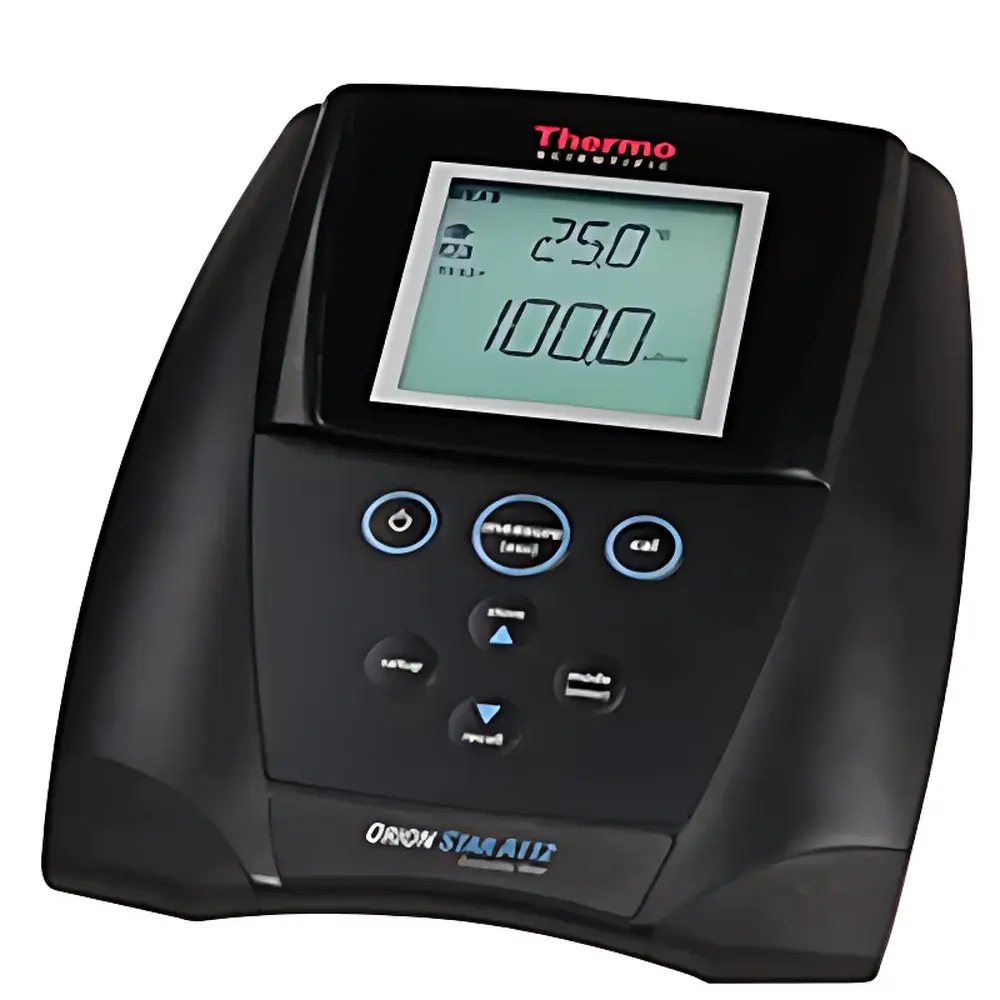
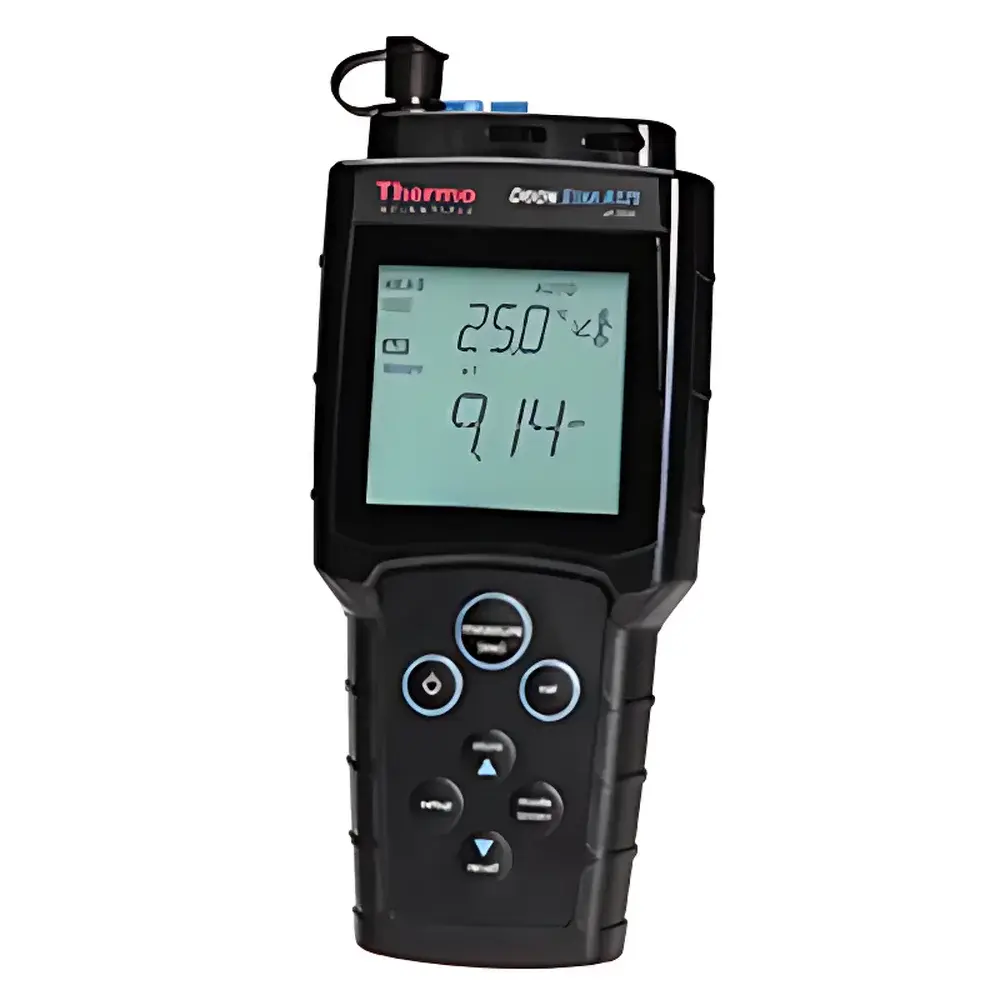
Thermo Scientific Orion Star A112 / A122 Benchtop & Portable Conductivity Meter
| Brand | Thermo Scientific Orion |
|---|---|
| Model | 110C-01A (Benchtop) / 120C-01A (Portable) |
| Measurement Principle | Four-electrode or two-electrode AC conductivity measurement |
| Conductivity Range | 0.1 µS/cm to 200 mS/cm |
| Resolution | 0.01 µS/cm or 3 significant digits |
| Accuracy | ±0.5% of reading |
| Temperature Range | −5 °C to +105 °C |
| Temp. Resolution | 0.1 °C |
| Temp. Accuracy | ±0.1 °C |
| Cell Constant Range | 0.001–10 cm⁻¹ |
| Reference Temp. | 20 °C or 25 °C selectable |
| TDS Range | 1–19,999 mg/L |
| TDS Factor | 0.01–10.00 (default 0.49) |
| Temp. Compensation | Linear, 0–10.0 %/°C |
| Calibration | Single-point conductivity calibration |
| Data Storage | 50 readings (manual or auto-log) |
| Interface | 8-pin mini-DIN for conductivity electrodes |
| Power | 4×AA alkaline batteries or universal AC adapter (100–240 V AC) |
| Benchtop IP Rating | IP54 |
| Portable IP Rating | IP67 |
| Compliance | Designed for GLP-compliant environments |
Overview
The Thermo Scientific Orion Star A112 (benchtop) and Star A122 (portable) Conductivity Meters are precision-engineered instruments for reliable, repeatable measurement of electrical conductivity and total dissolved solids (TDS) in aqueous samples across environmental, municipal, industrial, and academic laboratories. These meters operate on the principle of alternating current (AC) conductivity measurement—applying a low-frequency AC voltage across a conductive cell to minimize polarization effects and electrode fouling—ensuring stable, drift-free readings across wide dynamic ranges. The dual-platform design enables seamless transition between fixed-lab and field-deployed operations without compromising metrological integrity. Built around a microprocessor-controlled analog front end, the system delivers high signal-to-noise ratio performance and temperature-compensated results traceable to NIST-traceable standards. Each unit is factory-calibrated and validated against certified reference materials, supporting ISO/IEC 17025-aligned quality systems.
Key Features
- Simultaneous real-time display of conductivity (or TDS), temperature, battery status, and calibration state on a large backlit LCD screen with intuitive icon-driven interface.
- AUTO-READ™ functionality automatically locks stable measurements and displays a visual confirmation icon—eliminating subjective judgment of endpoint stability.
- Configurable cell constant (0.001–10 cm⁻¹) and user-selectable reference temperature (20 °C or 25 °C) enable compliance with regional regulatory reporting conventions (e.g., US EPA Method 120.1, ASTM D1125).
- Universal power architecture supports both 4×AA alkaline batteries (up to 2,000 hours typical life) and an auto-ranging AC adapter (100–240 V AC), ensuring uninterrupted operation in lab, plant, or remote field settings.
- Rugged mechanical design: benchtop version rated IP54 (dust-protected, splash-resistant); portable version rated IP67 (dust-tight and submersible up to 1 m for 30 min), meeting IEC 60529 specifications.
- Integrated temperature sensor with ±0.1 °C accuracy and linear compensation (0–10.0 %/°C) ensures accurate thermal correction across diverse sample matrices—from glacial meltwater to geothermal brines.
Sample Compatibility & Compliance
The Star A series accommodates standard 2- or 4-electrode conductivity cells via its proprietary 8-pin mini-DIN connector, enabling compatibility with Orion’s full range of certified K=0.1, 1.0, and 10.0 cm⁻¹ sensors—including the included 011050MD cell (K=1.0). It is validated for use with potable water, wastewater effluents, surface water, groundwater, cooling tower fluids, boiler feedwater, and process rinse solutions. Instrument firmware and operational protocols align with Good Laboratory Practice (GLP) and Good Manufacturing Practice (GMP) documentation requirements. While the meter itself does not embed electronic signatures, its data export capability (via optional RS232 or USB cable) supports integration into validated LIMS or ELN platforms compliant with FDA 21 CFR Part 11 when paired with appropriate procedural controls and audit trail configuration.
Software & Data Management
Data storage is implemented in non-volatile memory with capacity for 50 timestamped entries—each containing conductivity/TDS value, temperature, date/time stamp, and electrode ID (if encoded). Logging modes include manual trigger and timed auto-record (user-definable interval). Entries support post-acquisition editing: individual deletion or bulk clear. Export is accomplished via ASCII text output through serial interface, compatible with spreadsheet applications and laboratory informatics systems. No proprietary software is required for basic operation; however, Thermo Fisher’s optional Orion ComConnect software enables advanced report generation, calibration history archiving, and trend analysis—all structured to support internal quality audits and external accreditation reviews (e.g., ISO 17025 Clause 7.7).
Applications
- Regulatory compliance monitoring per US EPA Clean Water Act (CWA) and Safe Drinking Water Act (SDWA) criteria.
- Process control in municipal drinking water treatment plants—tracking coagulation efficiency, disinfection byproduct precursors, and distribution system integrity.
- Environmental field surveys assessing salinity intrusion, acid mine drainage, or agricultural runoff impact on aquatic ecosystems.
- Pharmaceutical water system qualification (Purified Water, Water for Injection) per USP and EP 2.2.38.
- Educational laboratories teaching fundamental electrochemical principles and solution thermodynamics.
- Industrial boiler and chiller water management to prevent scaling, corrosion, and microbial growth.
FAQ
What is the difference between the 110C-01A and 120C-01A models?
The 110C-01A is the benchtop variant (Star A112), supplied with a desktop stand and AC adapter; the 120C-01A is the portable variant (Star A122), shipped with protective carrying case, electrode holster, rinse pouches, and AA batteries.
Can this meter measure resistivity?
No—the instrument calculates and displays conductivity and derived TDS only. Resistivity is the mathematical inverse of conductivity but is not directly reported; users may compute it manually using σ = 1/ρ.
Is multi-point conductivity calibration supported?
No—this is a single-point calibration system optimized for routine verification against a known standard (e.g., 1413 µS/cm KCl). For higher-order characterization, Thermo Scientific recommends the Orion Star A212 or A322 advanced models.
Does the meter support automatic temperature compensation (ATC) for non-linear samples?
It implements linear ATC only, consistent with standard methods for natural waters and dilute electrolytes. Non-linear compensation (e.g., Vogel equation) requires external calculation or higher-tier instrumentation.
How is data integrity ensured during field use?
Timestamped entries are stored in write-protected memory; power loss does not erase logged data. Full audit trail functionality requires integration with compliant third-party software and documented SOPs per 21 CFR Part 11 Subpart B.







