
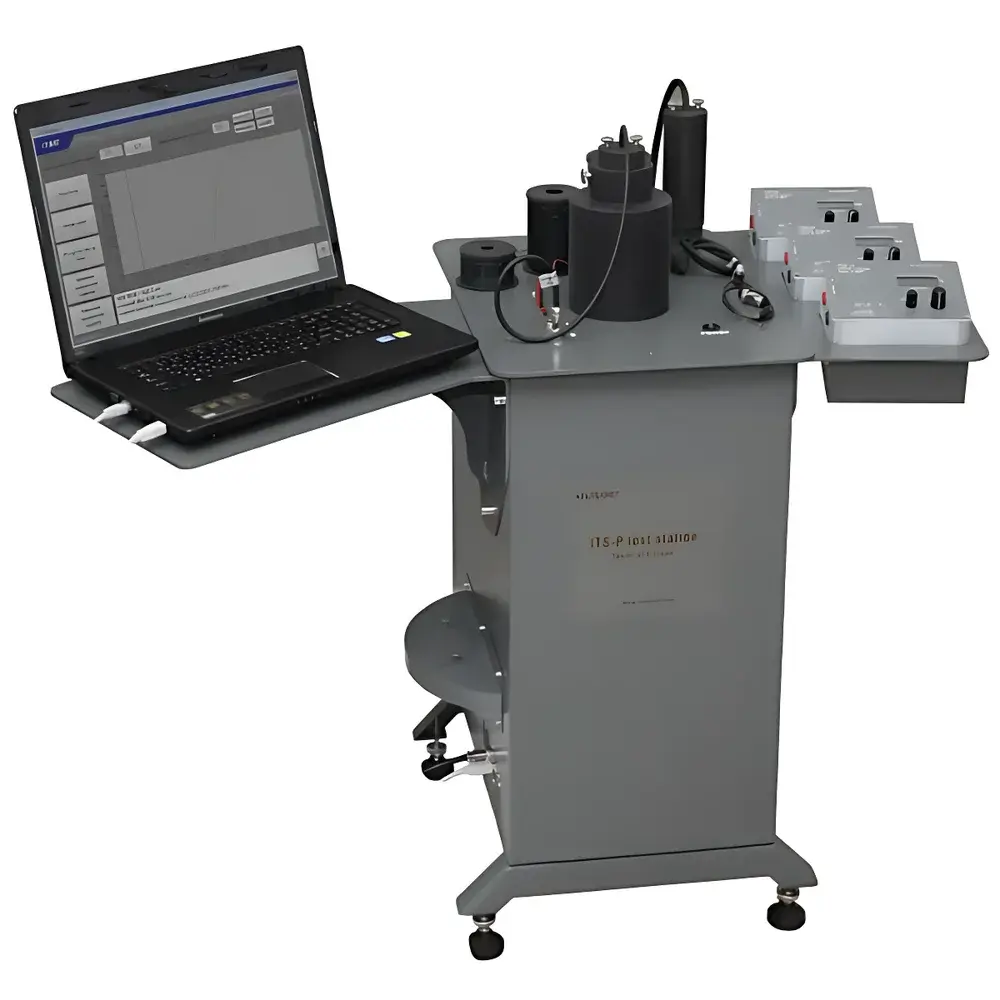
Inframet IRAD Image Intensifier Photometry & Temporal Parameter Test System
| Brand | Inframet |
|---|---|
| Origin | Poland |
| Model | IRAD |
| Spectral Range | 400–1200 nm |
| Maximum Photocathode Diameter | 40 mm |
| Wavelength Selection Points | 12 discrete wavelengths |
| Radiometric Sensitivity Measurement | photocathode spectral radiant sensitivity & radiant luminance gain |
| Photometric Parameters | luminance gain, radiometric gain, saturation, equivalent background input (EBI), photocathode luminous/radiant sensitivity |
| Temporal Parameters | rise time, delay time, decay (afterglow) time, stability |
| Detector Interface | BM-PT main module, LP1/LP2 photometers, RP radiometer, CP current meter, TP real-time probe |
| Software | IRAD control & analysis suite, ITIME temporal analysis module |
| Compliance | Designed for laboratory-based R&D per ISO/IEC 17025-aligned optical metrology practices |
Overview
The Inframet IRAD Image Intensifier Photometry & Temporal Parameter Test System is a precision-engineered metrology platform designed for comprehensive characterization of image intensifier tubes (IITs) in research and development environments. Unlike legacy military-standard test setups, the IRAD system implements a flexible, non-MIL-STD methodology optimized for academic, defense R&D, and industrial photonics laboratories requiring traceable, wavelength-resolved photometric, radiometric, and dynamic temporal measurements. At its core, the system operates on calibrated photoelectric detection principles—integrating spectrally selective illumination, synchronized signal acquisition, and high-fidelity analog-to-digital conversion—to quantify both steady-state and transient optoelectronic responses of IITs across the visible to near-infrared spectrum (400–1200 nm). Its architecture supports full-tube evaluation—including hermetically sealed commercial and military-grade units—as well as bare-tube characterization under controlled vacuum-compatible conditions.
Key Features
- Extended spectral coverage from 400 nm to 1200 nm with programmable selection of 12 discrete calibration wavelengths, enabling precise determination of photocathode spectral radiant sensitivity (A/W) and radiant luminance gain (cd·sr⁻¹·W⁻¹)
- Simultaneous photometric and radiometric measurement capability via dual-channel photometer modules (LP1 and LP2) and a dedicated radiometer (RP), each traceably calibrated against NIST-traceable standards
- Real-time temporal response acquisition using the TP fast-response probe (sub-microsecond resolution) coupled with the BM-PT master timing and control module for accurate quantification of rise time, delay time, and afterglow decay profiles
- Modular mechanical interface system supporting both encapsulated IITs (up to 40 mm diameter) and unpackaged devices, including custom adapters for standard 18 mm, 25 mm, and 40 mm tube formats
- Integrated high-voltage power supply suite (three independent HV channels, up to –15 kV) with programmable ramping, monitoring, and interlock logic compliant with IEC 61010-1 safety requirements
- Dual-software architecture: IRAD software provides instrument orchestration, parameter automation, and compliance-ready reporting; ITIME software delivers advanced temporal waveform analysis, curve fitting, and statistical repeatability assessment (e.g., σ < 0.8% for gain measurements over 50 cycles)
Sample Compatibility & Compliance
The IRAD system accommodates a broad range of image intensifier configurations—including Gen II, Gen II+, and Gen III tubes—with or without microchannel plate (MCP) structures. It supports both fiber-optic and lens-coupled input/output interfaces and enables measurement of critical performance metrics defined in ASTM E2839–22 (Standard Practice for Characterizing Image Intensifier Tubes) and MIL-STD-3009B Annex D (non-mandatory test methodologies). All optical and electrical calibrations are documented per ISO/IEC 17025 requirements, and raw data logs include full metadata (wavelength, HV setting, integration time, ambient temperature/humidity) to support GLP audit trails. The system does not require integration with external vacuum chambers; however, optional vacuum-compatible adapters are available for in-situ testing under low-pressure conditions.
Software & Data Management
IRAD software provides a deterministic, scriptable environment for test sequence definition—including automated wavelength sweeps, gain-vs-voltage sweeps, and EBI drift monitoring over extended durations (up to 24 h). All acquired datasets are stored in HDF5 format with embedded calibration coefficients, timestamped metadata, and user-defined annotation fields. Export options include CSV, MATLAB (.mat), and XML for interoperability with third-party analysis tools. ITIME software implements IEEE 1850-compliant temporal parameter extraction algorithms—including 10%–90% rise time calculation, full-width-at-half-maximum (FWHM) decay analysis, and exponential multi-term fitting for complex afterglow behavior. Both applications enforce role-based access control and support FDA 21 CFR Part 11-compliant electronic signatures when deployed in regulated QA/QC environments.
Applications
- Development and validation of next-generation night vision devices, particularly those incorporating GaAs or InGaAs photocathodes operating beyond 900 nm
- Quantitative comparison of MCP aging effects on temporal fidelity and gain stability under accelerated life testing protocols
- Calibration reference services for national metrology institutes performing inter-laboratory comparisons of IIT performance
- Failure analysis of field-deployed tubes exhibiting anomalous EBI increase or delayed response onset
- Support for EU-funded photonics initiatives requiring full spectral responsivity mapping per CEN/CENELEC standards
FAQ
Does the IRAD system support automated calibration verification between measurement sessions?
Yes—the system includes a built-in reference LED source with NIST-traceable output stability (< ±0.15% over 8 h), enabling daily verification of photometric channel linearity and wavelength registration accuracy.
Can IRAD measure gated image intensifiers with nanosecond-scale gate pulses?
The TP probe and BM-PT timing module support gate widths down to 5 ns with jitter < 120 ps RMS; however, sub-10 ns pulse characterization requires optional external sampling oscilloscope synchronization via SMA trigger output.
Is firmware update capability available remotely?
Firmware updates are delivered via encrypted USB key with SHA-256 signature verification; remote network-based updates are disabled by default to maintain air-gapped security in classified labs.
What documentation is provided for ISO/IEC 17025 accreditation?
A complete metrological file package is supplied—including uncertainty budgets for all primary parameters (e.g., ±1.8% k=2 for luminance gain at 555 nm), calibration certificates for all detectors, and traceability chains to PTB and NPL primary standards.
Are spare parts and service contracts available outside Poland?
Inframet maintains authorized service centers in Germany, the UK, and the USA; extended warranty and annual calibration contracts include on-site technician deployment and spare module loaner programs.



