
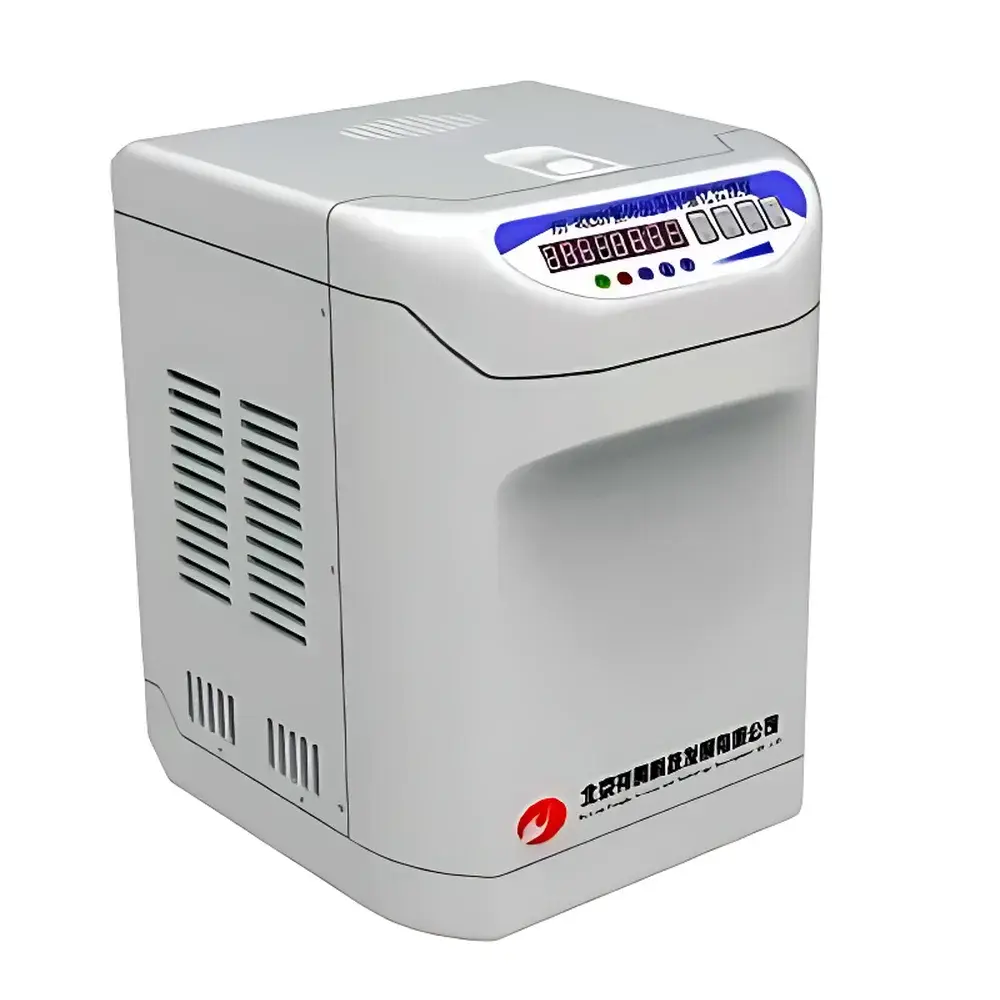
Xianghu XH-400UV UV Photocatalytic Parallel Synthesizer
| Brand | Xianghu |
|---|---|
| Origin | Beijing, China |
| Manufacturer Type | Direct Manufacturer |
| Product Origin | Domestic (China) |
| Model | XH-400UV |
| UV Lamp Power | 400 W (adjustable 100–400 W) |
| UV Wavelength | 365 nm |
| Temperature Sensor | Contact-type corrosion-resistant probe |
| Rotation Speed | 10 rpm |
| Display | LED numeric display for time and real-time temperature |
| Reaction Vessels | Quartz glass test tubes or beakers |
| Parallel Capacity | 20 × 10–30 mL (tubes) or 4 × 50–250 mL (beakers) |
Overview
The Xianghu XH-400UV UV Photocatalytic Parallel Synthesizer is an engineered platform for controlled, high-throughput photochemical reaction screening under ultraviolet irradiation. It operates on the fundamental principle of photolysis and photocatalysis: incident 365 nm UV photons are absorbed by reactant molecules or photocatalysts (e.g., TiO₂, ZnO), promoting electrons from the valence band to the conduction band and generating reactive species—including hydroxyl radicals (•OH), superoxide anions (O₂•⁻), and holes (h⁺)—that drive bond cleavage, oxidation, reduction, or C–C coupling reactions. Unlike conventional thermal synthesis systems, this instrument decouples reaction activation energy from heat input, enabling selective transformations under ambient or precisely regulated temperature conditions. Its parallel architecture supports systematic parameter optimization—wavelength-independent intensity control, uniform irradiation distribution across multiple vessels, and synchronized rotational mixing—making it suitable for reaction mechanism studies, catalyst screening, and kinetic profiling in academic and industrial R&D laboratories.
Key Features
- Adjustable 100–400 W high-pressure mercury lamp with stable 365 nm emission peak—optimized for efficient excitation of common photocatalysts and UV-absorbing substrates.
- Integrated contact-type corrosion-resistant temperature sensor with real-time feedback, ensuring thermal stability during extended irradiation without compromising vessel integrity.
- Precision 10 rpm rotation stage with balanced load distribution—minimizes sedimentation, enhances mass transfer, and ensures homogeneous light exposure across all reaction zones.
- Dual-parameter LED display showing elapsed time and in-situ temperature—enabling precise protocol replication and traceable experimental logging.
- Quartz glass reaction modules (test tubes: 10–30 mL × 20 positions; beakers: 50–250 mL × 4 positions)—selected for >90% UV transmittance at 365 nm and resistance to oxidative degradation under prolonged irradiation.
- Modular mechanical design with accessible lamp housing, removable turntable, and tool-free vessel clamping—facilitating cleaning, maintenance, and rapid configuration changes between tube- and beaker-based workflows.
Sample Compatibility & Compliance
The XH-400UV accommodates a broad range of photoactive systems: heterogeneous suspensions (e.g., nanoparticulate photocatalysts in aqueous media), homogeneous solutions (e.g., Ru(bpy)₃²⁺-mediated redox reactions), and gas–liquid interfaces (e.g., VOC oxidation in aerated reactors). All wetted components—including quartz vessels, PTFE-coated fasteners, and stainless-steel chassis—are chemically inert toward strong oxidants (H₂O₂, O₃), acidic/basic electrolytes, and organic solvents (acetonitrile, DMF, ethanol). While not certified to IEC 61000-6-3 or UL 61010-1 out-of-the-box, the system adheres to foundational electrical safety and UV containment practices consistent with ISO 15265:2018 (safety requirements for UV-emitting laboratory equipment) and supports GLP-compliant documentation when paired with external data loggers meeting FDA 21 CFR Part 11 audit-trail requirements.
Software & Data Management
The XH-400UV operates as a standalone hardware platform with embedded microcontroller logic—no proprietary software or driver installation required. Time and temperature values are displayed locally and can be manually recorded or interfaced via optional RS-232/USB TTL modules (sold separately) for integration into LabArchives, Electronic Lab Notebooks (ELNs), or custom Python- or LabVIEW-based acquisition scripts. Users may define fixed-duration protocols (e.g., “30 min @ 300 W, 25 °C”) or implement stepwise power ramping using external timers. For regulatory environments, timestamped operator logs, lamp usage hours, and thermal deviation reports can be generated externally to satisfy internal QA/QC review cycles or ISO/IEC 17025 method validation documentation.
Applications
- High-throughput screening of photocatalytic materials for hydrogen evolution, CO₂ reduction, or selective organic functionalization.
- Kinetic evaluation of advanced oxidation processes (AOPs) in simulated wastewater matrices—monitoring TOC removal, COD decay, and intermediate speciation via offline HPLC/GC-MS.
- Mechanistic studies of photoinduced electron transfer (PET) in supramolecular systems and coordination complexes.
- Accelerated photostability testing of pharmaceuticals and agrochemicals per ICH Q1B guidelines (optionally coupled with UV-Vis spectrophotometric endpoint analysis).
- Development of solar-driven remediation strategies for emerging contaminants (e.g., PFAS, microplastics-derived leachates) under controlled spectral input.
FAQ
Is the 365 nm output filtered to exclude harmful UVC (<280 nm) radiation?
Yes—the mercury lamp assembly includes a fused quartz envelope with intrinsic cutoff below ~280 nm, and the instrument’s front shielding meets ANSI Z136.1 Class 1 laser product equivalency for UV-A exposure limits.
Can the rotation speed be adjusted beyond 10 rpm?
No—the motor is fixed at 10 rpm to ensure mechanical stability, uniform photon flux distribution, and compatibility with standard quartz vessel geometries.
What is the maximum operating temperature limit for continuous use?
The system is rated for sustained operation up to 60 °C ambient; quartz vessels remain stable to 800 °C, but thermal management is limited by the sensor range (0–100 °C) and cooling capacity of passive airflow.
Are spare lamps and quartz vessels available as consumables?
Yes—original Xianghu OEM 400 W UV mercury lamps (GPH400TQ) and calibrated quartz test tubes (15 mL, 20 mL, 30 mL) are stocked and shipped globally with batch-specific certification of transmittance at 365 nm.
Does the instrument support inert atmosphere operation?
Not natively—the chamber is open-air; however, users routinely integrate it within gloveboxes or fit custom nitrogen-purged acrylic enclosures using the standardized 200 mm turntable diameter and 120 mm lamp-to-sample distance.



