
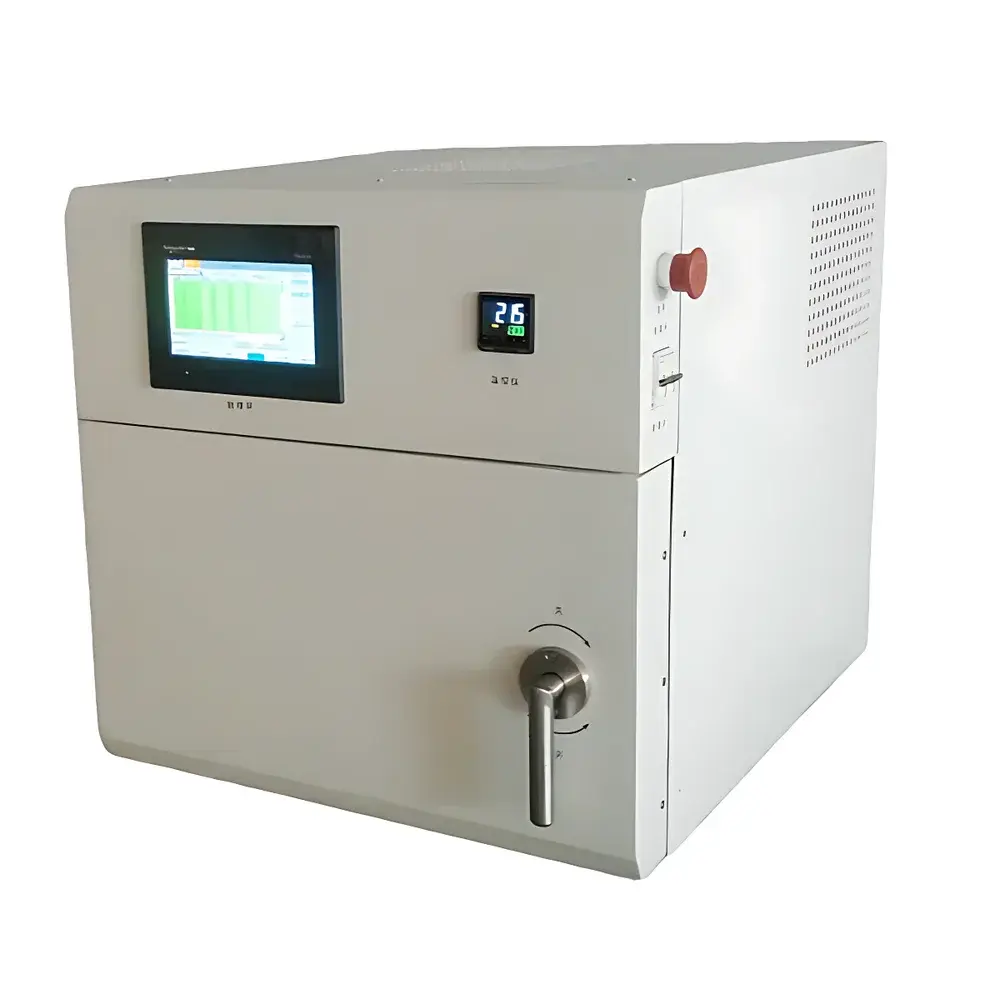
Xianghu UP-600 Microwave Muffle Furnace
| Brand | Xianghu |
|---|---|
| Origin | Beijing, China |
| Manufacturer Type | Direct Manufacturer |
| Product Category | Domestic |
| Model | UP-600 |
| Price Range | USD 7,000–14,000 (FOB) |
| Instrument Type | Box-Type Furnace |
| Maximum Temperature | 1200 °C |
| Temperature Control Accuracy | ±0.1% of reading |
| Rated Power | 3 kW (small variant) / 5 kW (large variant) |
| Average Heating Rate to Max Temp | ≥30 °C/min |
| Heating Method | Microwave (2450 MHz) |
| Internal Cavity Dimensions | 150×110×70 mm or 200×200×100 mm (L×W×H) |
| Microwave Output Power Range | 0.01–1.40 kW (3 kW model) / 0.01–2.80 kW (5 kW model) |
| Continuous Operating Temperature | 1150 °C |
| Temperature Measurement | Type K thermocouple, 0–1300 °C |
| Control System | 40-segment programmable profile, real-time curve display, data logging & export, dynamic screen saver |
| Safety Compliance | Microwave leakage <0.5 mW/cm², over-temperature & over-current protection, interlocked door switch |
| External Dimensions (small) | ~750×550×650 mm |
| (large) | ~850×650×750 mm |
| Loading Volume (small) | 130×80×70 mm |
| (large) | 140×140×100 mm |
Overview
The Xianghu UP-600 Microwave Muffle Furnace is a precision-engineered thermal processing instrument that replaces conventional resistive heating with controlled 2450 MHz microwave energy delivery. Unlike traditional muffle furnaces relying on conduction and convection, this system enables volumetric, selective, and rapid heating of dielectric materials—resulting in significantly reduced thermal inertia, uniform temperature distribution within the cavity, and elimination of thermal gradients across sample cross-sections. Designed for laboratory-scale synthesis, calcination, ashing, and sintering applications, it operates continuously up to 1150 °C with a maximum rated temperature of 1200 °C. Its architecture integrates electromagnetic shielding, closed-loop thermocouple feedback, and programmable power modulation to ensure repeatability and compliance with thermal process validation requirements in materials R&D and quality control environments.
Key Features
- Energy-efficient microwave heating: Achieves >97% time reduction versus conventional furnaces for equivalent thermal treatments—e.g., complete ashing of organic matrices in under 15 minutes.
- Dual-power configuration: Selectable 3 kW (compact) or 5 kW (high-capacity) models, each supporting continuous power adjustment from 0.01 kW to full output for precise thermal ramping and hold control.
- High-fidelity temperature regulation: Type K thermocouple monitoring (0–1300 °C range) coupled with PID algorithm delivers ±0.1% of reading accuracy at steady state—critical for phase transition studies and stoichiometric oxide synthesis.
- 40-segment programmable controller: Enables complex multi-step thermal profiles (ramp/soak/cool cycles), real-time graphical display of temperature vs. time, and timestamped data export via USB for audit-ready documentation.
- Robust safety architecture: Interlocked door mechanism prevents microwave emission during operation; integrated sensors trigger immediate shutdown upon over-temperature or over-current events; measured microwave leakage remains below 0.5 mW/cm² (per IEC 61000-4-3 and GB 4706.21 standards).
Sample Compatibility & Compliance
The UP-600 accommodates ceramic crucibles (alumina, silicon carbide), quartz boats, and graphite susceptors—compatible with powders, pellets, thin films, and pre-sintered compacts. It supports standardized test methods including ASTM E1527 (ash content determination), ISO 1171 (determination of ash in coal and coke), and USP <231> (heavy metals testing requiring high-temperature residue preparation). The furnace’s thermal stability and low thermal mass enable reproducible burnout of polymer binders in MLCC tape casting, consistent calcination of LiCoO₂ precursors per DOE battery manufacturing guidelines, and controlled oxidation of Fe₃O₄ nanoparticles without agglomeration. All operational parameters—including power setpoints, temperature logs, and alarm timestamps—are recorded with GLP-compliant metadata, satisfying traceability requirements under FDA 21 CFR Part 11 when paired with validated software workflows.
Software & Data Management
No proprietary cloud platform is required. The embedded controller stores up to 100 complete experiment records locally, each containing full thermal profile data (time, target temp, actual temp, applied power), event flags (e.g., “door opened”, “alarm triggered”), and user-defined annotations. Data export is performed via standard USB-A interface in CSV format—readily importable into MATLAB, Python (pandas), or LIMS systems. Optional RS485 Modbus RTU interface allows integration into centralized lab automation networks for remote monitoring and scheduled batch execution. Audit trails include operator ID (if configured), firmware version, and calibration date—supporting internal QA reviews and external ISO/IEC 17025 accreditation audits.
Applications
- Synthesis of electronic ceramics: BaTiO₃, SrTiO₃, BST, PZT, and Zr-doped variants under controlled oxidizing atmospheres.
- Cathode material processing: Solid-state synthesis of LiCoO₂, LiMn₂O₄, and Ni-rich NMC precursors with minimized lithium volatilization.
- Functional oxide development: Y₃Al₅O₁₂ (YAG), ZnFe₂O₄, Mn₃O₄, and rare-earth phosphors (e.g., Y₂O₃:Eu³⁺ red phosphor) requiring precise thermal history control.
- Thermal analysis support: Rapid ashing of biological tissues, foodstuffs, and polymers prior to elemental analysis (ICP-OES, AAS); LOI (loss on ignition) measurements per ASTM C114 for cementitious materials.
- Research-grade sintering: Low-temperature densification of nanostructured oxides and microwave-transparent composites where conventional heating induces grain coarsening.
FAQ
What types of crucibles are recommended for use with the UP-600?
Alumina (99.7% Al₂O₃), silicon carbide, and high-purity quartz crucibles are validated for use up to 1150 °C. Graphite crucibles may be employed only with supplemental inert gas purging due to oxidation risk above 600 °C in air.
Can the UP-600 operate under controlled atmosphere conditions?
Yes—optional flanged ports accommodate N₂, Ar, or forming gas (5% H₂/95% N₂) inlet/outlet lines with mass flow controllers. Vacuum operation is not supported.
Is calibration traceable to national standards?
The included Type K thermocouple is supplied with as-delivered calibration certificate (NIST-traceable reference standard); field recalibration using a certified dry-block calibrator is recommended annually.
How does microwave heating affect thermal uniformity compared to resistance furnaces?
Microwave coupling depends on dielectric loss factor (ε″); uniformity is optimized by sample geometry, susceptor placement, and mode-stirring design—typical radial/temporal variation is ±5 °C across the central 70% of the cavity volume at 1000 °C.
What maintenance is required for long-term reliability?
Quarterly inspection of waveguide gasket integrity, annual cleaning of cavity walls with non-abrasive ceramic cleaner, and biannual verification of door interlock function and microwave leakage levels using a calibrated survey meter.



