
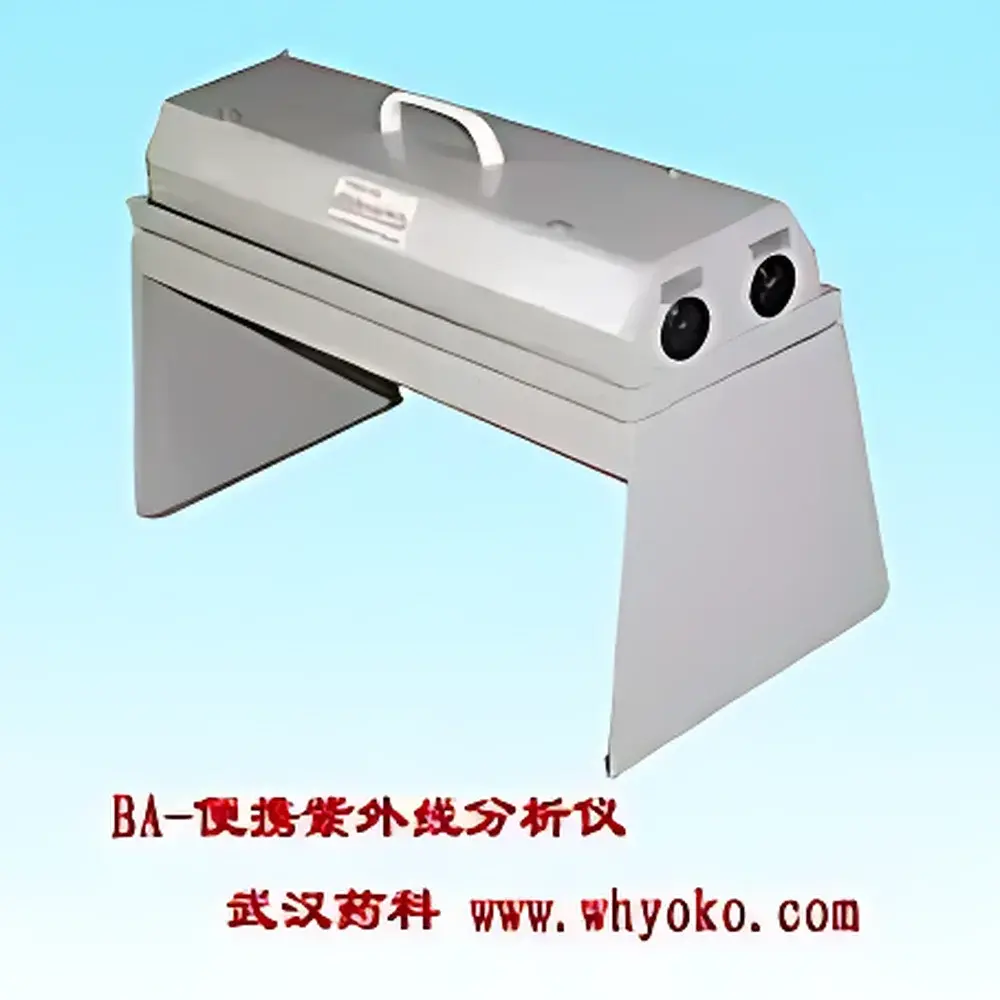
whYOKO YOKO-BA Portable Dual-Wavelength UV Transilluminator for Thin-Layer Chromatography
| Brand | whYOKO |
|---|---|
| Origin | Hubei, China |
| Model | YOKO-BA |
| Wavelengths | 254 nm & 365 nm (dual-band) |
| Lamp Configuration | Two independent UV lamps (one 254 nm, one 365 nm) |
| Filter Dimensions | 50 mm × 200 mm |
| Filter Transmission | ≥68% at 254 nm, ≥86% at 365 nm |
| Power Supply | 220 V ±10%, 50–60 Hz |
| Power Consumption | 12 W |
| Operating Mode | Manual |
| Enclosure Dimensions | 340 mm (L) × 130 mm (W) × 190 mm (H) |
| Sample Viewing Area | 200 mm × 200 mm |
| Maximum Sample Thickness | 5 mm |
| Compliance | CE-marked design principles |
Overview
The whYOKO YOKO-BA Portable Dual-Wavelength UV Transilluminator is an engineered solution for fluorescence-based visualization in thin-layer chromatography (TLC), nucleic acid gel electrophoresis, and protein/enzyme zymogram analysis. Unlike broad-spectrum UV sources, this instrument employs discrete, narrowband ultraviolet emission at two analytically critical wavelengths—254 nm and 365 nm—each generated by dedicated low-pressure mercury vapor lamps. The 254 nm band enables high-sensitivity detection of aromatic compounds, nucleic acids, and many UV-absorbing TLC markers, while the 365 nm band excites a broader range of fluorescent dyes (e.g., ethidium bromide analogues, SYBR dyes, fluorescein derivatives) with reduced photodamage to biological samples. Optical isolation is achieved via precision-cut ultraviolet-transmitting filters with certified transmission efficiencies of ≥68% at 254 nm and ≥86% at 365 nm—ensuring maximum photon flux delivery to the sample plane without visible-light contamination. Its compact, modular architecture supports both upright transmissive viewing (for standard TLC plates and 200 × 200 mm gels) and inverted configuration (for direct contact imaging of vertical or horizontal gels), making it suitable for field-deployable QC labs, teaching laboratories, and mobile analytical units.
Key Features
- Dual-wavelength operation with independently switchable 254 nm and 365 nm UV lamps—enabling method-specific excitation without cross-wavelength interference.
- High-transmission UV filter (50 × 200 mm) fabricated from optical-grade fused silica with certified spectral throughput: ≥68% @ 254 nm, ≥86% @ 365 nm—validated per ISO 9001 manufacturing protocols.
- Low thermal load design: 12 W total power consumption with electronic ballast technology ensures stable arc discharge, instant ignition (<0.5 s), and minimal heat accumulation—critical for prolonged exposure of thermally sensitive biomolecules.
- Modular mechanical layout: lamp housing detaches from base stand for handheld inspection, inverted transillumination, or integration into custom imaging rigs.
- Optical shielding: three-sided opaque enclosure minimizes ambient light leakage during fluorescence observation, improving signal-to-noise ratio in low-light environments.
- Sample compatibility: accommodates TLC plates up to 200 × 200 mm; accepts gel cassettes and slab gels with thickness ≤5 mm via rear access slot.
Sample Compatibility & Compliance
The YOKO-BA supports standard analytical formats including silica gel 60 F254 and aluminum-backed TLC plates, agarose and polyacrylamide gels stained with intercalating dyes (e.g., GelRed, SYBR Safe), and native or denatured protein gels visualized via Coomassie-fluorescent conjugates or enzymatic activity staining. Its wavelength specification aligns with common reference methods in pharmacopeial standards (USP , EP 2.2.46) and food safety testing (AOAC 990.17). While not certified for IVD or clinical diagnostics use, its construction adheres to general electrical safety requirements equivalent to IEC 61010-1:2010 for laboratory equipment. For regulated environments, users may implement procedural controls—including logbook entries, lamp usage tracking, and periodic filter transmission verification—to support GLP or GMP audit readiness.
Software & Data Management
The YOKO-BA operates as a hardware-only transillumination source and does not include embedded firmware or proprietary software. It is fully compatible with third-party digital imaging systems—including DSLR cameras equipped with UV-pass lenses (e.g., Nikon UV-Nikkor 105 mm), scientific CMOS sensors with quantum efficiency >30% in the UVC/UVA range, and document scanners modified for UV excitation. Users may integrate it into existing image acquisition pipelines compliant with FDA 21 CFR Part 11 when paired with validated camera control software (e.g., ImageJ with metadata logging plugins, NIS-Elements, or GeneTools). Audit trail functionality must be implemented externally via file naming conventions, timestamped storage, and version-controlled SOP documentation.
Applications
- Routine TLC plate development monitoring and Rf value determination in synthetic organic chemistry and natural product isolation.
- Post-electrophoretic visualization of DNA/RNA fragments in agarose gels and ss/dsDNA conformational analysis.
- Detection of enzyme isoforms (e.g., lactate dehydrogenase, esterase) in native PAGE zymograms using fluorogenic substrates.
- Field-based adulterant screening in herbal extracts and food matrices where portable, battery-independent UV excitation is required.
- Teaching laboratory demonstrations of fluorescence principles, photochemistry, and separation science fundamentals.
FAQ
Can the YOKO-BA be used for UV crosslinking of nucleic acids?
No. This instrument emits non-ionizing UV-A/UV-C radiation at fixed intensities optimized for fluorescence excitation—not covalent crosslinking. Crosslinking requires higher irradiance (>0.1 J/cm²) and controlled dose delivery, typically provided by dedicated UV stratalinker systems.
Is the 254 nm output safe for direct viewing?
No. Direct ocular exposure to 254 nm UV is hazardous and may cause photokeratitis or cataract formation. Always use certified UV-blocking safety goggles (OD ≥4 at 254 nm) and operate within enclosed or shielded configurations.
Does the unit include a timer or intensity control?
No. The YOKO-BA features manual on/off switching only. Exposure duration and repeatability must be managed externally via stopwatch or integrated camera shutter timing.
How often should the UV lamps and filter be replaced?
Lamp output degrades gradually; replacement is recommended after 1,000 hours of cumulative operation or when observed fluorescence intensity decreases by >20% under standardized test conditions. Filters require cleaning with spectroscopic-grade methanol but are not consumables—replacement is only necessary if scratched or cracked.
Can this transilluminator be powered via USB or external battery pack?
No. It requires a stable 220 V AC supply. No DC conversion module or battery interface is provided. Portable deployment necessitates a compatible AC inverter system.
Related Products





