
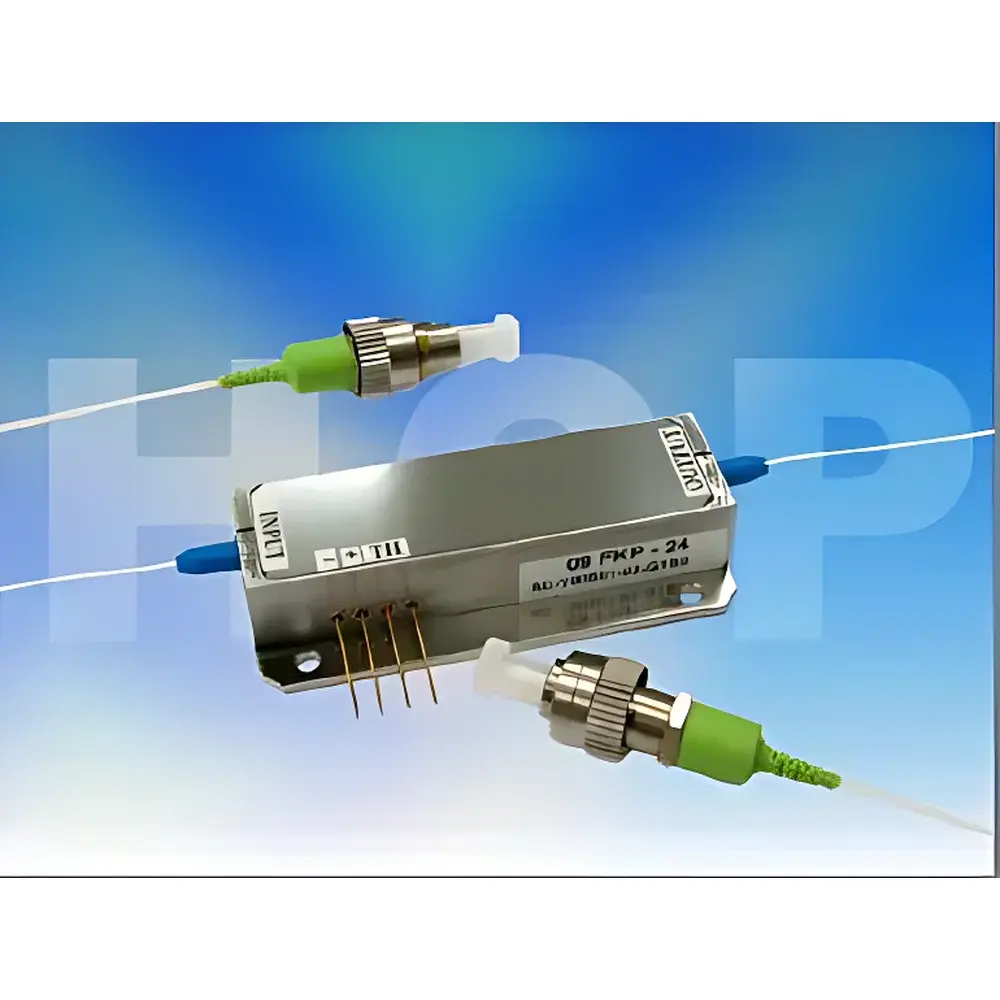
HCP PPLN Waveguide Chip
| Brand | HCP |
|---|---|
| Origin | Taiwan |
| Manufacturer Type | Authorized Distributor |
| Product Category | Domestic (China Market) |
| Model | PPLN-Waveguide |
| Price | USD 4,800 (FOB Taiwan) |
Overview
HCP PPLN Waveguide Chips are monolithic nonlinear optical components fabricated via periodic poling of stoichiometric lithium niobate (LiNbO₃) substrates, followed by waveguide structuring using either proton exchange (PE) or ridge etching processes. These chips operate on the principle of quasi-phase-matching (QPM), enabling highly efficient second-harmonic generation (SHG), sum-frequency generation (SFG), difference-frequency generation (DFG), optical parametric amplification (OPA), optical parametric generation (OPG), and optical parametric oscillation (OPO). Unlike bulk PPLN crystals—which offer robustness for high-power CW or pulsed laser systems—PPLN waveguides provide significantly enhanced nonlinear interaction strength per unit length due to tight optical confinement, resulting in conversion efficiencies up to two orders of magnitude higher than their bulk counterparts at equivalent pump intensities.
Key Features
- Engineered for high-efficiency nonlinear frequency conversion across visible, near-infrared (NIR), mid-infrared (MIR), and extended spectral ranges (UV to THz with custom poling)
- Two waveguide architectures available: low-loss proton-exchanged (PE) waveguides and high-damage-threshold ridge waveguides with superior mode confinement and broader operational bandwidth
- Uniform or chirped QPM grating designs supported for dispersion management and broadband phase matching
- Standardized product series covering common pump–signal–idler combinations, with rapid delivery from stock inventory
- Thermally tunable phase-matching with precise temperature coefficients (e.g., ~8–13 °C/nm depending on design), compatible with standard thermoelectric coolers (TECs) and PID-controlled ovens
- Optimized for integration into compact OEM modules, fiber-pigtailed systems, and laboratory-grade wavelength converters
Sample Compatibility & Compliance
HCP PPLN waveguides are compatible with standard single-mode fiber coupling (SMF-28, PM1550, etc.) and free-space beam input configurations. All devices undergo full optical characterization—including propagation loss, mode field diameter (MFD), numerical aperture (NA), and normalized conversion efficiency—prior to shipment. While not certified to ISO/IEC 17025 or FDA 21 CFR Part 11 by default, the manufacturing process adheres to semiconductor-grade cleanroom protocols (Class 1000), and test reports include traceable calibration data referenced to NIST-traceable power meters and spectrometers. Devices meet RoHS Directive 2011/65/EU and REACH Regulation (EC) No. 1907/2006 requirements for hazardous substances.
Software & Data Management
Each waveguide chip is supplied with a detailed datasheet containing measured performance parameters, including MFD (±10% tolerance), propagation loss (dB/cm), normalized conversion efficiency (%/W·cm², ±20% tolerance), and thermal tuning slope (°C/nm). For system-level integration, HCP provides MATLAB- and Python-compatible configuration files specifying QPM period distribution, effective refractive indices, and temperature-dependent phase-matching curves. These files support simulation of conversion efficiency versus pump wavelength, temperature, and polarization state—enabling predictive modeling prior to experimental deployment. Audit trails for production lot numbers, poling uniformity maps, and end-face inspection images are retained for 5 years and available upon request for GLP/GMP-aligned validation workflows.
Applications
- Compact visible-light sources via SHG of 1064 nm or 1550 nm lasers (e.g., 532 nm green or 775 nm red output)
- Mid-IR generation for spectroscopic gas sensing (e.g., CO, CH₄, NO₂ detection bands between 3–5 µm via DFG)
- Quantum optics applications requiring narrow-linewidth photon pair generation through spontaneous parametric down-conversion (SPDC)
- Frequency comb extension and stabilization in metrology-grade optical clocks
- OEM integration into portable LIDAR transceivers and medical imaging systems requiring wavelength agility
- Terahertz generation via optical rectification in specially designed chirped structures
FAQ
What is the typical damage threshold for ridge vs. proton-exchanged waveguides?
Ridge waveguides exhibit >10× higher peak power damage threshold (≥500 MW/cm² for 10 ps pulses) compared to proton-exchanged equivalents (<50 MW/cm²), owing to reduced ion diffusion-induced lattice disorder and improved thermal dissipation geometry.
Can these waveguides be fiber-pigtailed?
Yes—HCP offers optional fiber coupling services using alignment-optimized V-groove arrays and UV-curable epoxy. Coupling losses range from 1.2–2.5 dB/facet depending on MFD matching and polarization alignment.
Is temperature control mandatory for stable operation?
While room-temperature operation is feasible for fixed-wavelength applications, active thermal stabilization (±0.1 °C) is recommended to maintain phase-matching stability over time and environmental drift, especially in multi-stage cascaded processes.
Do you provide custom QPM period design?
Yes—custom poling patterns (uniform, step-chirped, or aperiodic) can be designed for specific nonlinear interactions, including non-collinear OPOs, ultra-broadband DFG, or dispersion-engineered SPDC sources.
What is the lead time for custom waveguides?
Standard custom orders require 8–12 weeks from final design approval; expedited fabrication (4–6 weeks) is available with priority scheduling and additional engineering review fees.



