
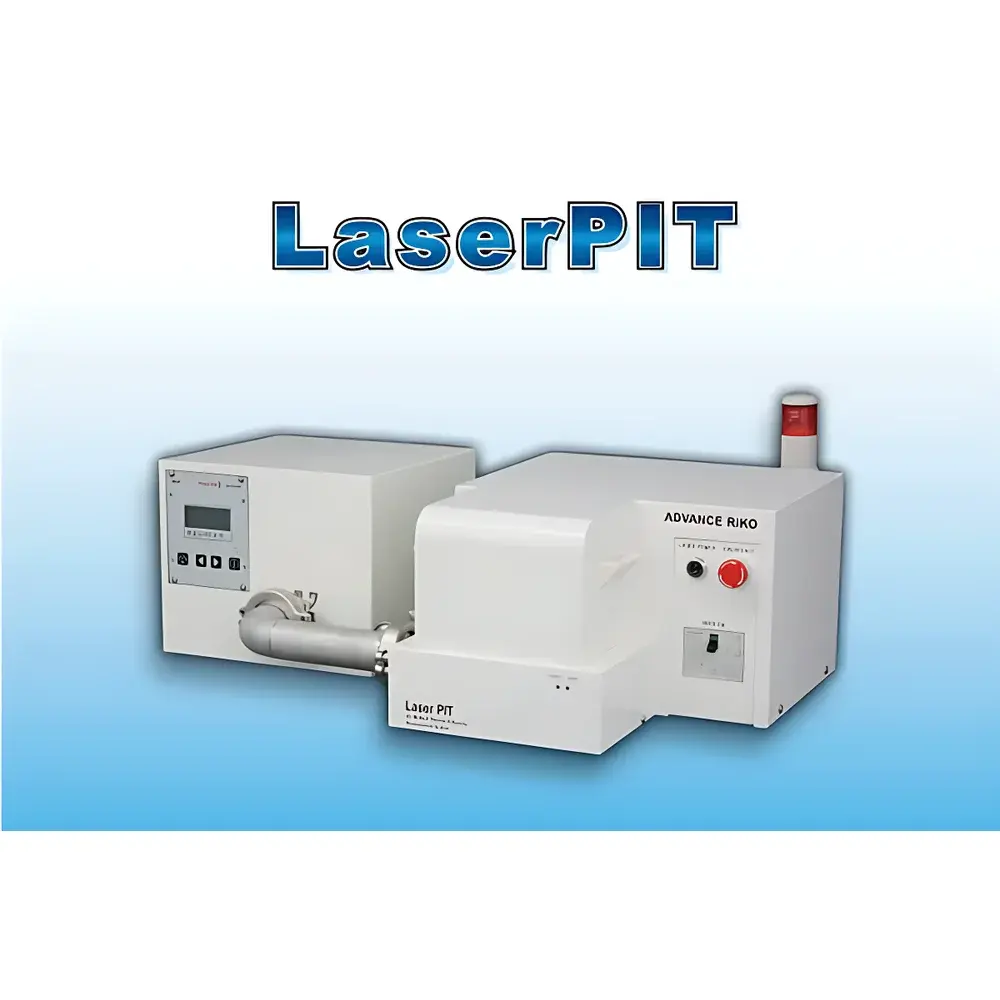
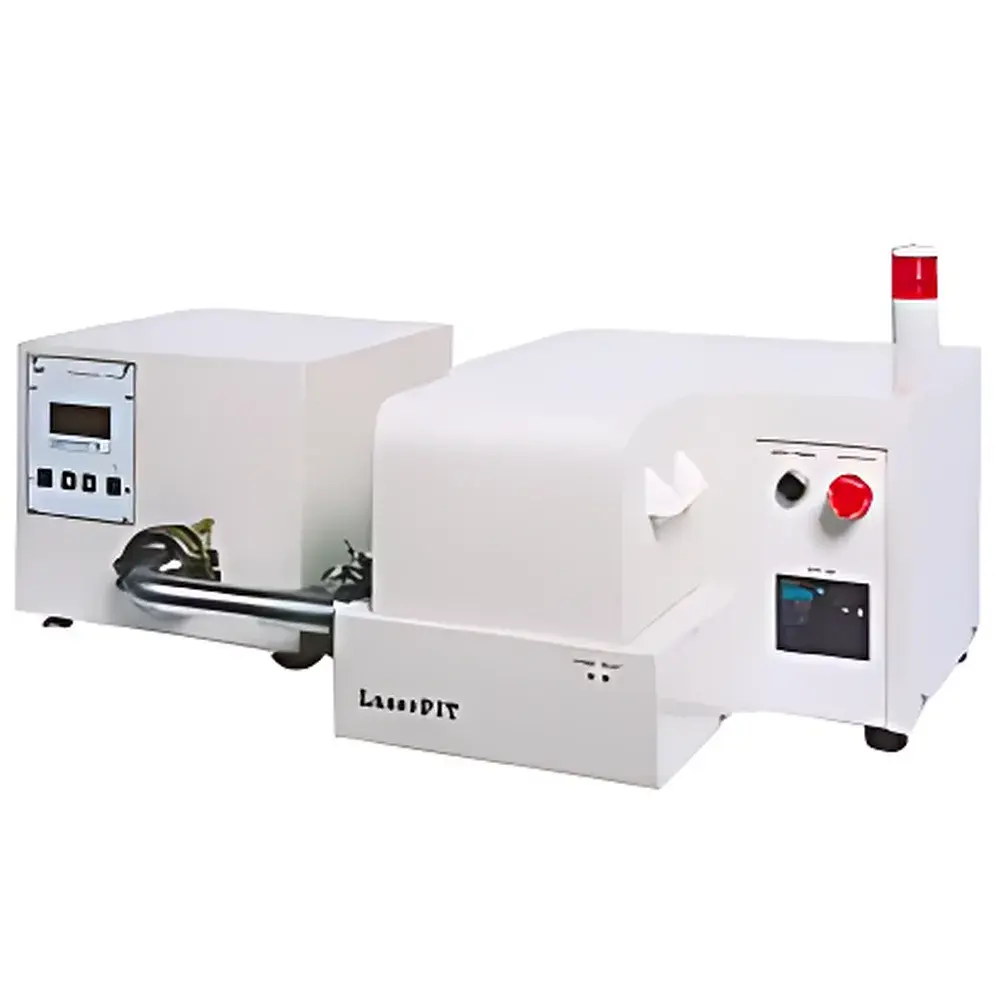
Advance Riko LaserPIT AC-Method Thermal Diffusivity Measurement System
| Origin | Japan |
|---|---|
| Manufacturer Type | Authorized Distributor |
| Origin Category | Imported |
| Model | LaserPIT |
| Instrument Type | Laser Flash Method (AC-mode variant) |
| Temperature Range | Ambient to 200 °C |
| Sample Dimensions (Bulk) | 2.5–5 mm width × 30 mm length × 3–500 µm thickness |
| Sample Dimensions (Thin Films on Substrates) | 2.5–5 mm width × 30 mm length × 100–1000 nm thickness |
| Measurement Atmosphere | Vacuum (< 0.02 Pa) |
| Film Analysis Capability | Differential AC-mode thermal diffusivity extraction for anisotropic and substrate-supported thin films |
Overview
The Advance Riko LaserPIT AC-Method Thermal Diffusivity Measurement System is a high-precision, vacuum-compatible instrument engineered for the quantitative determination of thermal diffusivity (α) in solid materials using a phase-sensitive, modulated laser heating technique—commonly referred to as the AC (alternating current) variant of the laser flash method. Unlike conventional time-domain laser flash analysis (LFA), the LaserPIT employs a sinusoidally modulated laser beam to induce periodic surface temperature oscillations, enabling high-sensitivity detection of thermal wave propagation in both bulk and ultra-thin film geometries. This approach delivers enhanced signal-to-noise ratio for low-diffusivity polymers and high-frequency resolution for nanoscale thermal transport characterization in anisotropic or layered structures. The system operates under high vacuum (< 0.02 Pa) to eliminate convective and radiative interference, ensuring measurement fidelity across a broad thermal conductivity spectrum—from diamond (α ≈ 1.2 cm²/s) to polyimide (α ≈ 0.001 cm²/s).
Key Features
- AC-mode laser excitation with precise frequency sweep (1–100 Hz) for depth-resolved thermal wave analysis;
- Dual configuration support: LaserPIT-R (routine bulk measurements) and LaserPIT-M2 (advanced thin-film metrology with differential signal processing);
- Integrated high-vacuum chamber (< 0.02 Pa) with automated pressure monitoring and interlock safety protocols;
- Modular sample stage accommodating standardized strip geometries (2.5–5 mm × 30 mm) for reproducible edge-effect minimization;
- Substrate-compensated algorithm suite for extracting intrinsic film diffusivity from supported nanostructures (100–1000 nm), including AlN, Al₂O₃, DLC, and organic pigment layers;
- Thermal stability control enabling measurements from ambient to 200 °C with ±0.5 °C uniformity over the sample zone;
- Compliance-ready architecture supporting audit trails, user access levels, and electronic signature workflows per FDA 21 CFR Part 11 requirements.
Sample Compatibility & Compliance
The LaserPIT accommodates a wide range of industrially relevant material classes within strict dimensional constraints: bulk thin plates (3–500 µm thick), including CVD diamond, AlN ceramics, Cu/Ni foils (< 5 µm), glass/resin substrates (< 50 µm), graphite flakes (< 100 µm), and polymer films (e.g., PET, polyimide < 5 µm). For deposited thin films, it supports quantitative thermal diffusivity extraction from layers as thin as 100 nm on thermally contrasting substrates—critical for thermal management R&D in semiconductor packaging, flexible electronics, and advanced coating development. All measurement procedures align with ISO 22007-2 (plastics), ASTM E1461 (metals/ceramics), and JEDEC JESD51-14 (IC package thermal characterization) frameworks. Data integrity is maintained via GLP/GMP-compliant metadata tagging, including environmental logs, calibration timestamps, and operator ID linkage.
Software & Data Management
Control and analysis are performed via LaserPIT ControlSuite v4.x—a Windows-based application featuring real-time thermal waveform visualization, multi-harmonic fitting engines, and automated baseline correction. The software implements proprietary deconvolution algorithms to separate substrate and film thermal responses in composite systems, outputting α-values with uncertainty estimation based on Monte Carlo sensitivity analysis. Export formats include CSV, HDF5, and XML for integration into LIMS or enterprise QA databases. Audit trail functionality records all parameter changes, measurement events, and report generations with immutable timestamps—fully traceable for regulatory submissions. Optional API modules enable programmable batch sequencing and remote monitoring via secure TLS-encrypted HTTP endpoints.
Applications
- Thermal qualification of high-power electronic substrates (AlN, SiC, diamond heat spreaders);
- Process validation of sputtered target materials used in PVD thermal barrier coatings;
- Quality control of roll-to-roll coated polymer films for flexible display backplanes;
- Anisotropy mapping of exfoliated graphite and graphene-enhanced composites;
- Thermal interface material (TIM) layer performance benchmarking on silicon or glass carriers;
- Development of low-κ dielectrics and high-κ gate oxides in next-generation logic nodes;
- Stability assessment of organic photovoltaic (OPV) active layers under thermal cycling;
- Failure analysis of delamination-induced thermal resistance in multilayer MEMS packages.
FAQ
What distinguishes the AC-mode laser flash method from conventional time-domain LFA?
The AC method uses amplitude- and phase-modulated laser excitation to generate steady-state thermal waves, enabling higher signal fidelity for thin films and low-diffusivity materials where transient pulse decay is difficult to resolve.
Can the LaserPIT measure absolute thermal conductivity (λ)?
No—it measures thermal diffusivity (α) directly; λ must be calculated using λ = α·ρ·Cp, where density (ρ) and specific heat (Cp) are obtained separately via pycnometry and DSC, respectively.
Is substrate removal required for film measurements?
No—the system is explicitly designed for non-destructive, in-situ analysis of films on native substrates using differential thermal wave modeling.
Does the system support automated temperature ramping during measurement?
Yes—programmable thermal profiling from ambient to 200 °C enables Arrhenius-type activation energy extraction for phonon scattering analysis.
How is measurement repeatability ensured across different operators?
Through standardized sample mounting fixtures, auto-calibrating IR detector gain control, and SOP-enforced workflow templates embedded in ControlSuite.



