
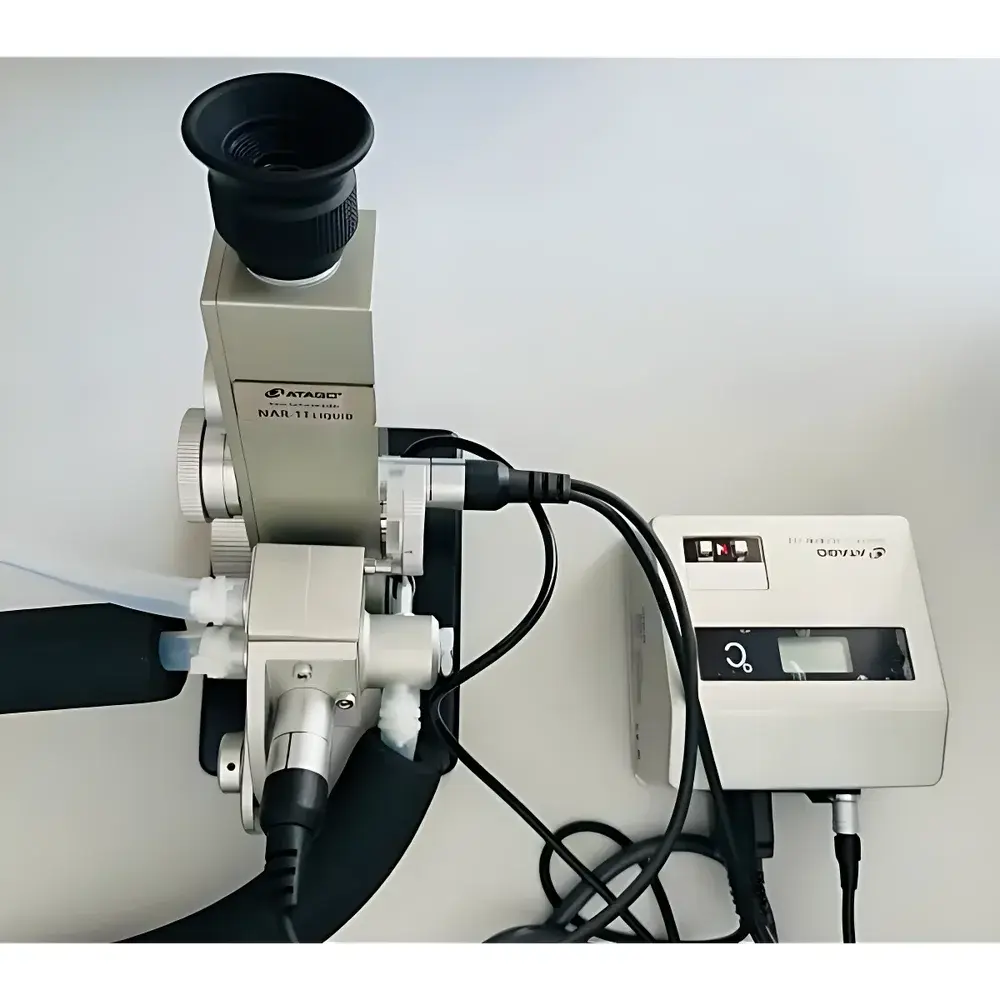
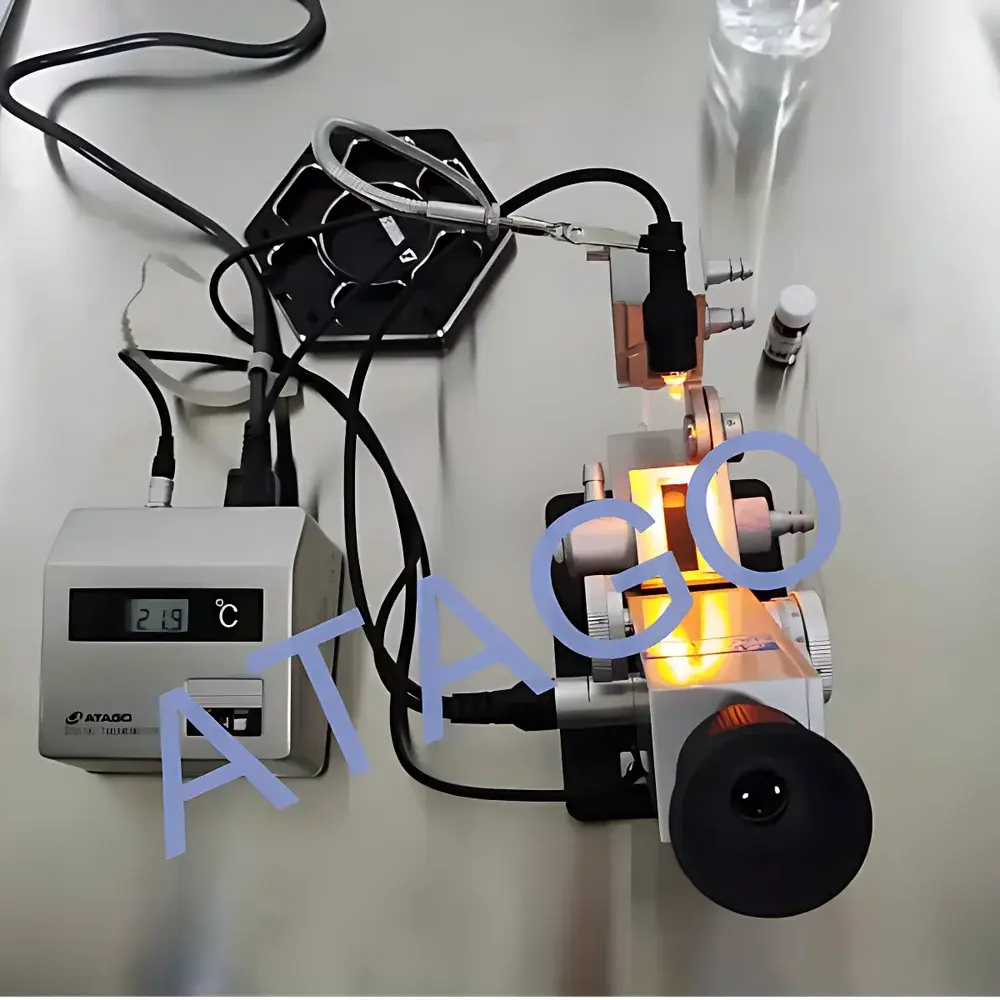
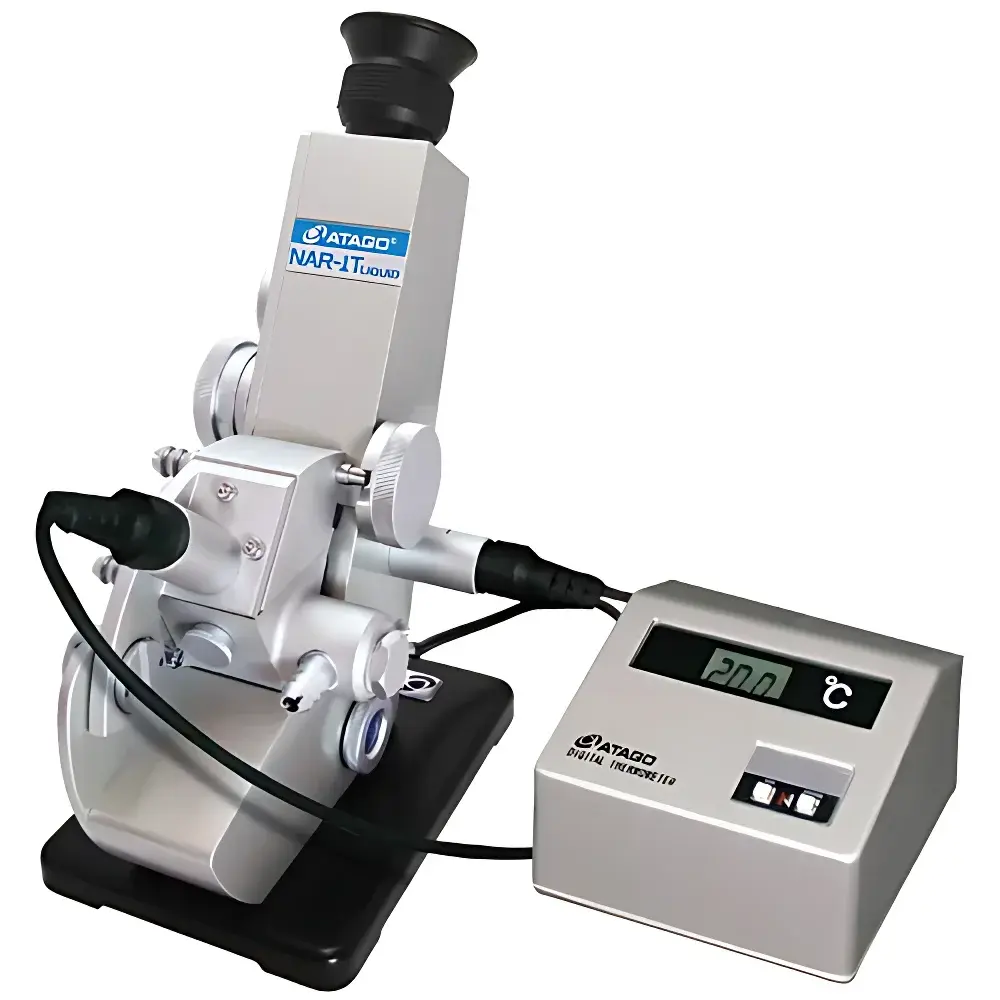
ATAGO NAR-1T LIQUID Abbe Refractometer
| Brand | ATAGO |
|---|---|
| Origin | Japan |
| Model | NAR-1T LIQUID |
| Type | Benchtop Abbe Refractometer |
| Temperature Control | Yes |
| Digital Display | Yes |
| Measurement Range | Refractive Index (nD) 1.3000–1.7000, Brix 0.0–95.0% |
| Accuracy | ±0.0002 (nD), ±0.1% (Brix) |
| Resolution | 0.001 (nD), 0.5% (Brix) |
| Light Source | 589 nm LED (D-line equivalent) |
| Temperature Range | 5–40 °C |
| Temp. Accuracy | ±0.2 °C |
| Power Supply | AC 100–240 V, 50/60 Hz, 5 VA |
| Dimensions (Main Unit) | 13 × 18 × 23 cm, 1.8 kg |
| Dimensions (Temp. Display Unit) | 10 × 11 × 7 cm, 0.5 kg |
Overview
The ATAGO NAR-1T LIQUID Abbe Refractometer is a precision benchtop optical instrument engineered for accurate and repeatable measurement of the refractive index (nD) and related concentration parameters—including Brix, salinity, and solvent concentration—in transparent and semi-transparent liquid samples. Based on the fundamental principle of total internal reflection at the prism-sample interface, the instrument determines the critical angle of incident light (at 589 nm, matching the sodium D-line wavelength) and converts it into a refractive index value via calibrated optical geometry. This Abbe-type design adheres to ISO 21147:2020 and ASTM D1218 standards for refractometric analysis, ensuring metrological traceability and compatibility with international quality assurance frameworks. Unlike handheld or analog models, the NAR-1T LIQUID integrates active temperature monitoring and digital signal processing to compensate for thermal drift—a critical requirement for compliance with GLP and GMP environments where sample temperature control directly impacts nD reproducibility.
Key Features
- High-precision Abbe optical system with double-prism configuration for minimized chromatic aberration and enhanced angular resolution
- Stable 589 nm LED light source—eliminates sodium lamp maintenance while delivering D-line-equivalent spectral output with >50,000-hour lifetime
- Integrated digital temperature sensor (±0.2 °C accuracy) mounted directly on the measuring prism, enabling real-time thermal correction per ISO 21147 Annex B
- Large backlit LCD display showing simultaneous nD, Brix, and sample temperature with 0.001-unit nD and 0.5%-unit Brix resolution
- Robust die-cast aluminum chassis providing mechanical stability under laboratory vibration and thermal cycling conditions
- Low-power operation (5 VA) compliant with IEC 61000-3-2 harmonic emission limits; compatible with global AC mains (100–240 V, 50/60 Hz)
- Front-panel calibration access via precision adjustment screw—no disassembly required for routine nD verification using certified sucrose standards
Sample Compatibility & Compliance
The NAR-1T LIQUID is optimized for homogeneous liquids with low turbidity and minimal suspended solids—such as aqueous sugar solutions, organic solvents, glycols, battery electrolytes, antifreeze formulations, pharmaceutical syrups, and essential oils. It supports measurement of samples within a viscosity range up to 500 mPa·s without flow distortion. The instrument meets CE marking requirements for electrical safety (EN 61010-1) and electromagnetic compatibility (EN 61326-1). Its measurement methodology aligns with USP (Refractometry), AOAC Official Method 932.12 (Brix determination), and ISO 2173 (fruit juice analysis), making it suitable for regulated QC/QA workflows in food, pharma, and chemical manufacturing. Temperature-controlled operation between 5 °C and 40 °C ensures adherence to method-defined thermal conditions specified in ASTM D1218 for hydrocarbon refractometry.
Software & Data Management
While the NAR-1T LIQUID operates as a standalone instrument, its digital output architecture supports optional RS-232 serial interface (available via accessory cable) for integration into laboratory information management systems (LIMS) or electronic lab notebooks (ELN). When connected, the device transmits timestamped nD, Brix, and temperature values in ASCII format, enabling automated data logging and audit-trail generation. All measurements comply with FDA 21 CFR Part 11 requirements when used in conjunction with validated LIMS software that enforces user authentication, electronic signatures, and immutable record retention. Internal memory is not present—data integrity relies on external system capture, reinforcing data governance best practices in regulated environments.
Applications
- Food & Beverage: Brix quantification in fruit juices, soft drinks, honey, jams, and dairy-based concentrates per AOAC and Codex Alimentarius protocols
- Automotive Fluids: Glycol concentration in engine coolants and urea content in diesel exhaust fluid (DEF) per SAE J2547 and ISO 22241
- Pharmaceuticals: Refractive index verification of excipients, syrup bases, and ophthalmic solutions per USP monographs
- Chemical Manufacturing: Solvent purity assessment (e.g., ethanol, acetone, isopropanol) and polymer solution concentration monitoring
- Clinical Diagnostics: Urine specific gravity estimation and serum protein screening via refractometric correlation (CLSI EP15-A3)
- Academic Research: Characterization of nanofluids, ionic liquid mixtures, and temperature-dependent dispersion behavior in optical material studies
FAQ
What calibration standards are recommended for daily verification?
ATAGO recommends NIST-traceable sucrose solutions (e.g., 10%, 30%, and 60% w/w) for Brix mode, and certified mineral oil standards (nD = 1.4700 ± 0.0001) for refractive index verification. Calibration should be performed at ambient temperature prior to each analytical session.
Can the NAR-1T LIQUID measure opaque or highly viscous samples?
No. The instrument requires optical transmission through the sample-prism interface. Suspended particles, air bubbles, or viscosities exceeding 500 mPa·s will distort the critical angle detection and invalidate results. Pre-filtration or dilution may be necessary for turbid or viscous matrices.
Is temperature compensation automatic or manual?
Temperature measurement is automatic and continuous via the integrated prism-mounted sensor. However, nD correction to 20 °C is not applied internally—the operator must apply standard conversion tables (e.g., CRC Handbook or ISO 21147 Annex C) if reference-temperature reporting is required.
Does the unit support multi-language display or firmware updates?
The NAR-1T LIQUID features fixed English-language firmware with no field-upgradable software. Display language is not configurable; all menu prompts and units are presented in English only.
What maintenance intervals are recommended for long-term accuracy?
Prism surface cleaning with lens-grade tissue and reagent-grade ethanol after each use; full optical alignment verification every 12 months by an ATAGO-certified service center; annual temperature sensor recalibration traceable to NPL or PTB standards.




