
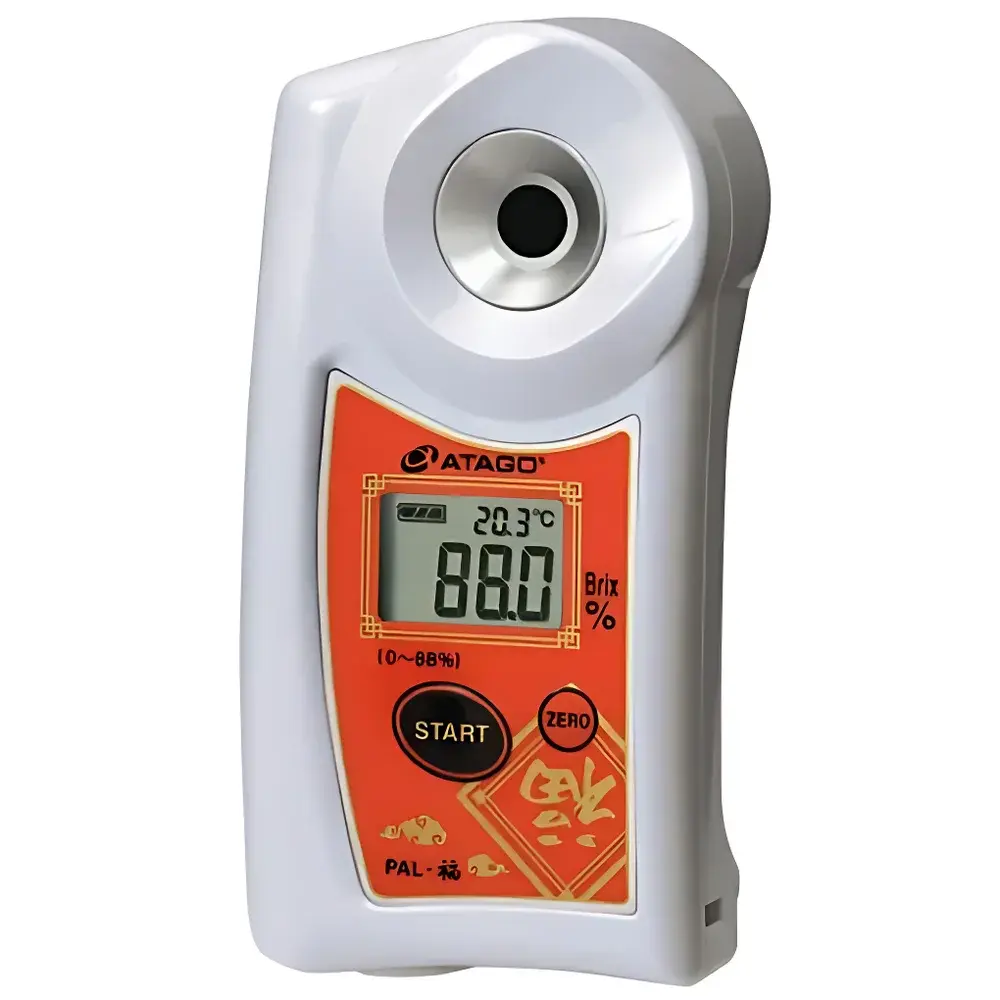
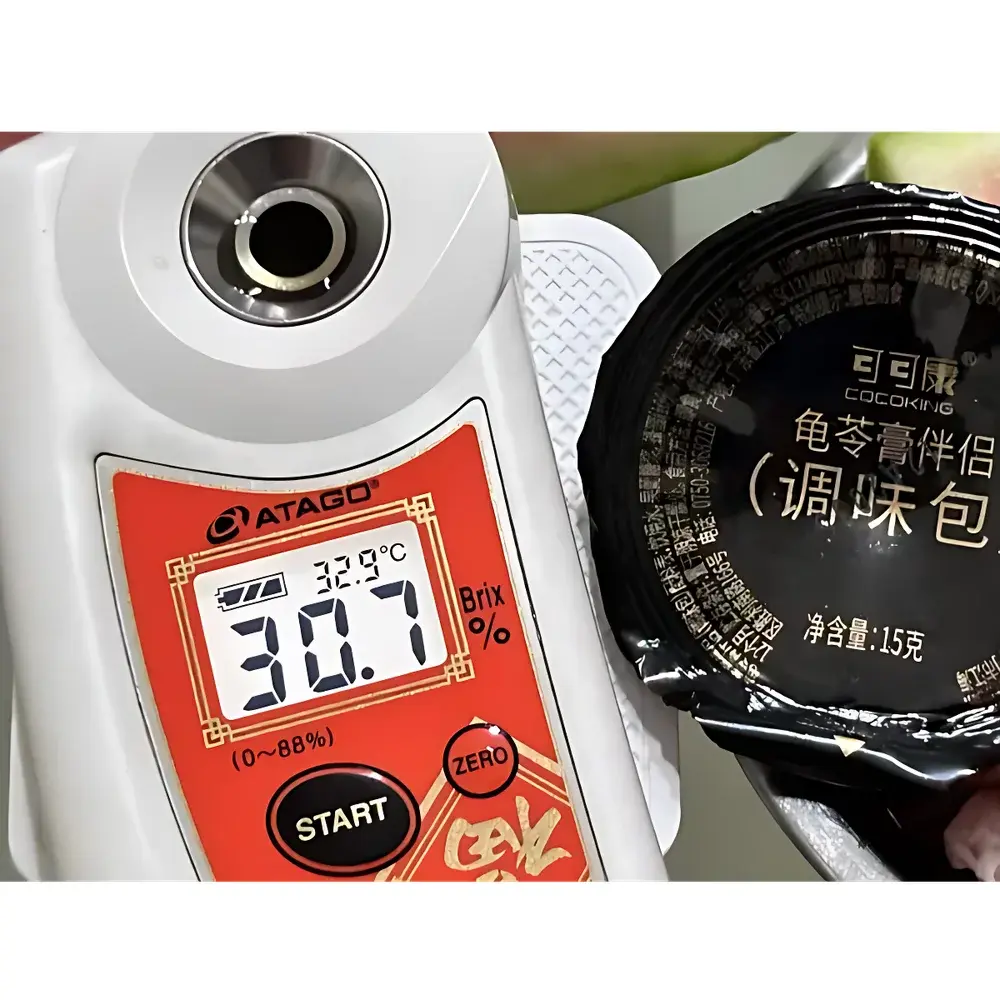
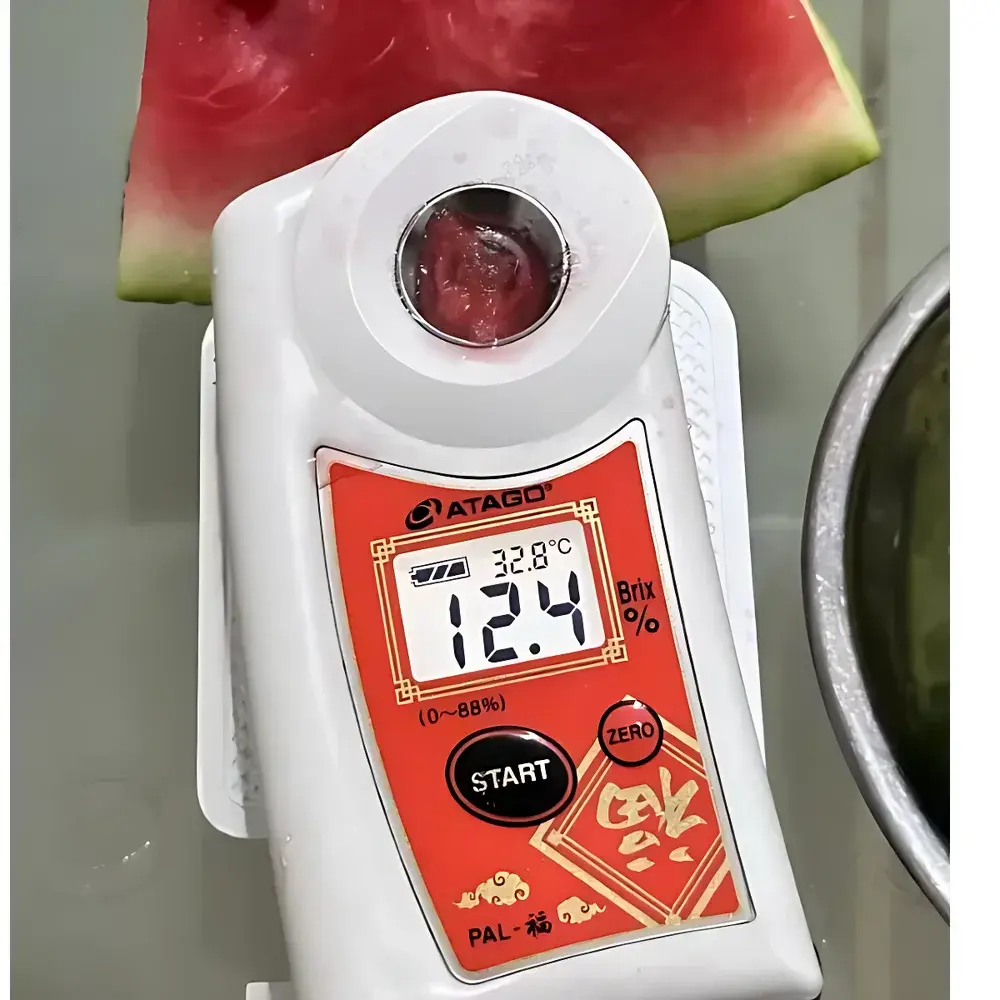
ATAGO PAL-F Portable Digital Refractometer
| Brand | ATAGO |
|---|---|
| Origin | Japan |
| Model | PAL-F |
| Type | Handheld Refractometer |
| Temperature Control | Yes (Automatic Temperature Compensation) |
| Digital Display | Yes |
| Measurement Range | Brix 0.0–88.0% |
| Accuracy | ±0.2% Brix |
| Resolution | 0.1% Brix / 0.1°C |
| Sample Volume | 0.3 mL |
| Measurement Time | 3 seconds |
| IP Rating | IP65 |
| Operating Temperature | 10–40°C |
| Measured Sample Temperature Range | 10–100°C |
| Power Supply | 2 × AAA batteries |
| Dimensions | 55(W) × 31(D) × 109(H) mm |
| Weight | 100 g (body only) |
Overview
The ATAGO PAL-F Portable Digital Refractometer is an optical instrument engineered for rapid, field-deployable measurement of refractive index and its derived parameter—Brix concentration—based on the principle of total internal reflection at the prism-sample interface. Designed and validated in ATAGO’s R&D facility in Tokyo, the PAL-F implements Abbe-type optical geometry with a high-stability sapphire prism and integrated thermistor-based temperature sensing. It applies automatic temperature compensation (ATC) across 10–100°C using a built-in algorithm compliant with ISO 2173:2003 and AOAC Official Method 932.12, ensuring traceable Brix readings independent of ambient or sample thermal drift. As part of ATAGO’s PAL series—continuously refined since 1982—the PAL-F reflects over four decades of empirical optimization in handheld refractometry, particularly for high-solids matrices where conventional low-range instruments fail.
Key Features
- Rapid quantitative analysis: Delivers stable Brix values within 3 seconds after sample application, enabling high-throughput screening in production lines or field inspections.
- Extended dynamic range: Measures Brix from 0.0 to 88.0%—covering undiluted fruit concentrates, tomato paste, honey, industrial glycols, and aqueous cutting fluids without dilution or range switching.
- Robust environmental resilience: Rated IP65 per IEC 60529, the unit withstands dust ingress and low-pressure water jets; the prism surface tolerates direct rinsing with distilled or deionized water post-measurement.
- Optical interference mitigation: Equipped with ATAGO’s proprietary ELI (Enhanced Light Immunity) system, which suppresses photometric error induced by ambient illumination exceeding 10,000 lux—including direct sunlight and LED factory lighting.
- On-site calibration simplicity: Zero-point adjustment is performed using distilled water only—no calibration solutions required—completed in ≤3 seconds with visual confirmation via LCD icon feedback.
- Integrated thermal metrology: Measures sample temperature simultaneously with refractive index (0.1°C resolution), supporting real-time validation of ATC performance and compliance with GLP documentation requirements.
Sample Compatibility & Compliance
The PAL-F is validated for use with heterogeneous, viscous, and particulate-laden samples common in food processing and industrial maintenance workflows—including whole-fruit purees, skin-in jam formulations, emulsified coolants, and antifreeze glycol blends. Its sapphire prism resists scratching from abrasive solids (e.g., pulp fibers, metal fines), while the sealed optical path prevents contamination migration into internal optics. The instrument conforms to ISO/IEC 17025-relevant design principles for measurement reliability and supports audit-ready data integrity when paired with optional PC connectivity (via RS-232 or Bluetooth adapter). It meets essential safety and EMC directives under CE marking (2014/30/EU, 2011/65/EU) and is routinely deployed in facilities operating under FDA 21 CFR Part 11–aligned quality systems for instrument qualification (IQ/OQ/PQ).
Software & Data Management
While the PAL-F operates as a standalone device, it supports external data capture through ATAGO’s optional PAL-Link software (Windows-compatible) or third-party SCADA/HMI interfaces via ASCII protocol over serial or Bluetooth. All measurements retain embedded timestamps and temperature metadata. Audit trails—including calibration events, zero adjustments, and firmware version logs—are stored internally and exportable as CSV or PDF reports. Firmware updates preserve backward compatibility with legacy PAL-series calibration profiles and maintain alignment with current ISO 5725 repeatability/reproducibility benchmarks.
Applications
- Food & Beverage QA/QC: Real-time Brix verification of incoming fruit batches, in-process jam consistency, honey adulteration screening (per Codex Alimentarius Stan 12-1981), and post-pasteurization syrup stability checks.
- Agricultural Harvest Optimization: Field-based assessment of grape, mango, or citrus maturity using Brix as a proxy for soluble solids content—correlating with harvest timing decisions per USDA AMS guidelines.
- Industrial Fluid Management: Monitoring glycol concentration in HVAC antifreeze loops, verifying alkalinity of aqueous cleaning agents (ASTM D1193 Type IV), and quantifying triethanolamine in metalworking emulsions.
- R&D Laboratory Support: Rapid formulation iteration for high-Brix functional foods (e.g., low-moisture protein bars), excipient concentration checks in semi-solid pharmaceutical gels, and solvent recovery validation in chemical synthesis.
FAQ
Does the PAL-F require user-performed temperature calibration?
No. The built-in thermistor is factory-calibrated and non-adjustable; ATC is applied automatically using NIST-traceable coefficients embedded in firmware.
Can the PAL-F measure samples below 10°C or above 100°C?
No. Sample temperature must remain within 10–100°C during measurement. Samples outside this range must be equilibrated prior to analysis.
Is the prism surface chemically resistant to strong acids or caustics?
The sapphire prism exhibits excellent resistance to pH 1–13 solutions; however, prolonged exposure to hydrofluoric acid or molten alkalis is not recommended.
How often should zero calibration be performed?
ATAGO recommends zeroing before each measurement session or after ambient temperature shifts exceeding 5°C—consistent with ISO 8655-5 guidance for volumetric instrument warm-up protocols.
What battery life can be expected under typical usage?
With alkaline AAA cells, the PAL-F delivers ≥5,000 measurements per set (assuming 10-second active display time per reading), verified per IEC 60086-2 test cycles.




