
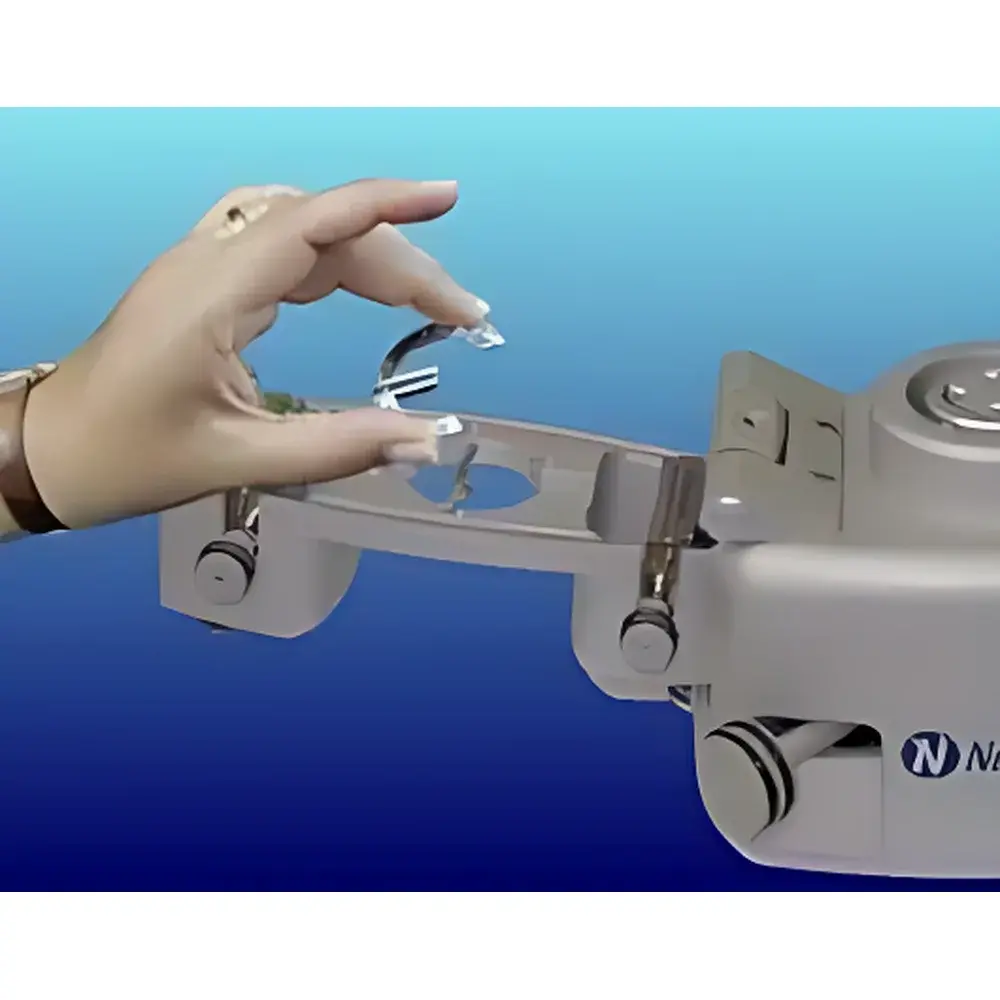
Nanonics Academia Atomic Force Microscope
| Brand | Nanonics |
|---|---|
| Origin | Israel |
| Model | Academia |
| Instrument Type | Materials-Focused AFM |
| Primary Technique | Combined Scanning Probe Microscopy (SPM) with Integrated Near-Field Optical & Raman Capabilities |
| Scan Range | XY = 70 µm, Z = 5 µm (optional 10 µm scanner) |
| Positional Resolution | <1 nm (70 µm scanner), <0.1 nm (10 µm scanner) |
| Max Sample Size | 15 mm × 15 mm |
| Detection Method | Optical Beam Deflection |
| Operational Modes | Contact, Non-Contact, Tapping |
| Probe Compatibility | Nanonics glass probes, electro-thermal probes, NanoFountainPen™, and standard commercial SPM cantilevers |
| Software Platform | LabVIEW-based modular architecture with user-customizable modules |
| Compliance Ready | Designed for GLP/GMP-aligned workflows |
Overview
The Nanonics Academia Atomic Force Microscope is a research-grade scanning probe microscope engineered for high-fidelity nanoscale topographic, mechanical, electrical, and thermal characterization of solid and soft matter surfaces. Built upon a robust, optically transparent platform, the Academia system uniquely integrates atomic force microscopy (AFM) with near-field scanning optical microscopy (NSOM) and optional Raman spectroscopic coupling—enabling correlative multimodal imaging at sub-diffraction-limited resolution. Its core architecture employs a closed-loop piezoelectric scanner with calibrated XY range up to 70 µm and Z range of 5 µm (expandable to 10 µm with high-resolution scanner option), delivering sub-nanometer positional stability under ambient, liquid, or controlled-environment conditions. Unlike conventional AFMs optimized solely for topography, the Academia platform is purpose-built for functional nanoscale metrology—including in situ electrochemical, thermally stimulated, and chemically active measurements—making it particularly suited for advanced materials development, semiconductor process control, and life science interface studies.
Key Features
- Modular SPM architecture supporting seamless integration of NSOM, micro-Raman (via Renishaw spectrometer coupling), and SEM-compatible sample stages.
- Dual-scan capability: Simultaneous real-time optical microscopy and AFM imaging enabled by an optically transparent scanner design and inverted optical path compatibility.
- Multi-functional probe ecosystem: Supports Nanonics’ proprietary glass fiber probes (for combined optical/electrical/thermal excitation), electro-thermal micro-pipettes, NanoFountainPen™ for localized nanofluidic delivery and nanolithography, and all standard silicon-based AFM cantilevers.
- Precision motion control: High-stability piezoceramic scanners with <1 nm step resolution (70 µm range) and <0.1 nm resolution (10 µm range), calibrated via interferometric feedback.
- Environmental flexibility: Compatible with liquid cells, inert gas enclosures, and low-temperature accessories (down to cryogenic ranges with third-party add-ons).
- Open software framework: LabVIEW-based acquisition and control environment with documented APIs, enabling custom automation, algorithm implementation, and integration into automated lab workflows.
Sample Compatibility & Compliance
The Academia AFM accommodates samples up to 15 mm × 15 mm in lateral dimension and up to 10 mm in height, including wafers, biological tissue sections, polymer films, and MEMS devices. Its non-destructive, low-force tapping mode enables high-resolution imaging of delicate biological specimens in buffer solutions without fixation artifacts. The system meets essential mechanical and electromagnetic compatibility (EMC) standards per IEC 61326-1. While the base configuration does not include certified validation documentation, the LabVIEW software architecture supports IQ/OQ/PQ protocol development and can be extended with 21 CFR Part 11-compliant electronic signature and audit trail modules for regulated environments. It is routinely deployed in laboratories adhering to ISO/IEC 17025, ASTM E2539 (for nanoscale measurement traceability), and USP analytical instrument qualification guidelines.
Software & Data Management
Acquisition and analysis are managed through a modular LabVIEW application suite, providing real-time visualization of topography, phase, amplitude, and force-distance curves. Raw data is stored in HDF5 format, ensuring long-term readability and interoperability with Python (NumPy/HDF5), MATLAB, and open-source SPM analysis tools such as Gwyddion. The software includes built-in routines for tip-sample convolution correction, thermal drift compensation, and multi-channel spectral correlation (e.g., correlating Raman peak intensity maps with AFM-derived modulus distributions). User-defined VIs (Virtual Instruments) can be embedded for automated batch processing, machine learning–assisted feature classification, or closed-loop feedback control during nanomanipulation experiments.
Applications
- Nanoscale mechanical mapping of composite thin films and battery electrode interfaces.
- In situ electrochemical AFM during cyclic voltammetry to monitor SEI layer evolution on Li-ion anodes.
- Localized thermal conductivity measurement across grain boundaries in 2D materials using Nanonics’ electro-thermal probes.
- Correlative NSOM–AFM imaging of plasmonic nanostructures to resolve near-field optical hotspots alongside surface topography.
- NanoFountainPen™-mediated deposition of biomolecules or conductive polymers with sub-100 nm spatial precision.
- Deep-trench and sidewall imaging of high-aspect-ratio semiconductor features using specialized high-aspect-ratio cantilevers.
- Combined AFM–Raman chemical identification of phase-separated domains in organic photovoltaic blends.
FAQ
Does the Academia AFM support true simultaneous AFM and optical imaging?
Yes—the scanner’s optically transparent construction and inverted illumination path allow concurrent high-magnification optical observation and AFM scanning without repositioning or alignment recalibration.
Can third-party Raman spectrometers be integrated besides Renishaw systems?
Yes—while Renishaw micro-Raman integration is factory-validated, the Academia platform provides standardized optical coupling ports and synchronization triggers compatible with most commercial Raman systems featuring XYZ stage coordination and TTL shutter control.
Is the NanoFountainPen™ functionality available as a field-upgradeable module?
Yes—NanoFountainPen™ is offered as an optional add-on kit including pressure-controlled microfluidic manifolds, glass capillary probes, and dedicated fluidic control firmware modules.
What level of technical support is provided for LabVIEW customization?
Nanonics supplies full VI source code access, detailed API documentation, and optional engineering consultation packages for developing domain-specific analysis pipelines or integrating with LIMS/ELN platforms.
Are calibration standards and traceable reference materials included?
A NIST-traceable grating standard (pitch = 1.0 µm) and thermal noise calibration routine are included; additional metrology-grade standards (e.g., Si grating SRM 2054) may be procured separately through authorized distributors.





