
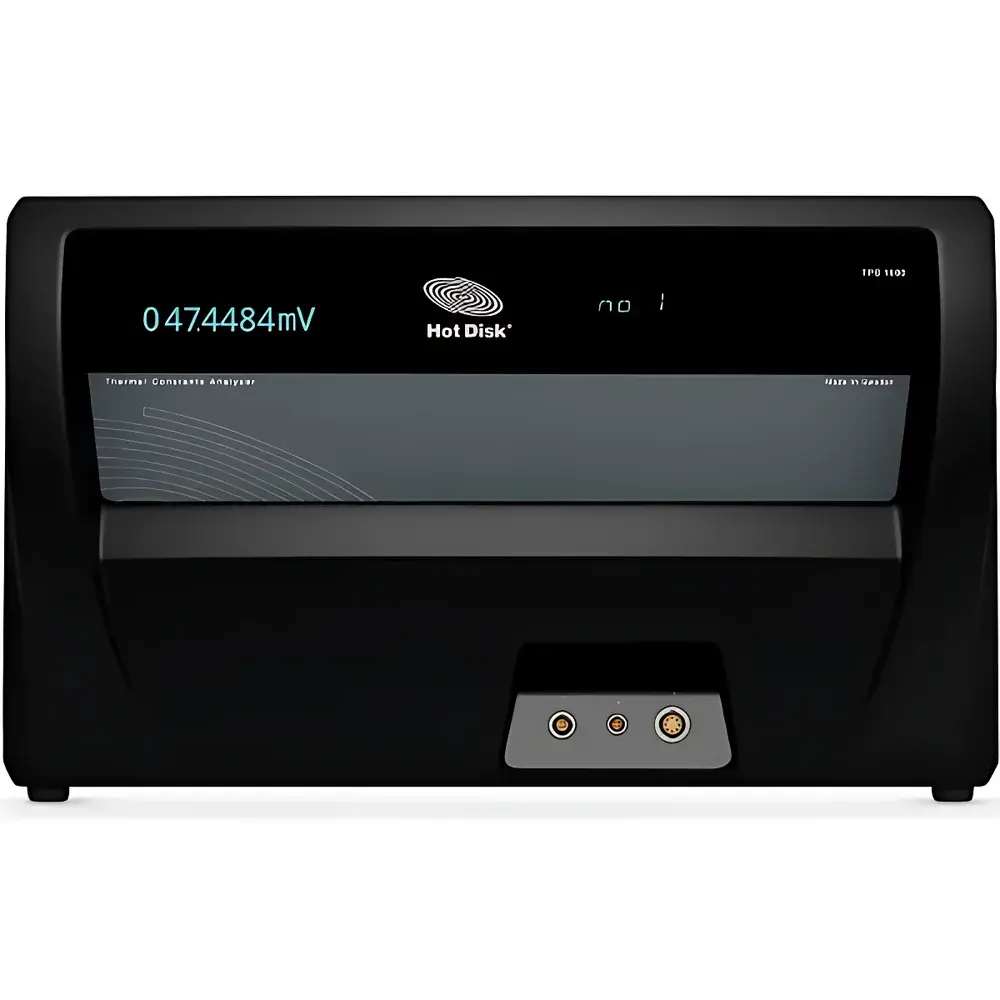
Hot Disk TPS 1500 Transient Plane Source Thermal Constants Analyzer
| Brand | Hot Disk |
|---|---|
| Origin | Sweden |
| Model | TPS 1500 |
| Measurement Principle | Transient Plane Source (TPS) Method |
| Thermal Conductivity Range | 0.005–20 W/m·K |
| Temperature Range | −50 to 750 °C |
| Accuracy | < ±3% |
| Repeatability | < ±1% |
| Sample Forms | Solids, Powders, Pastes, Anisotropic & Composite Materials |
| Test Atmosphere | Air, Vacuum, or Inert Gas |
| Dimensions (L×W×H) | 50 × 40 × 30 cm |
| Probe Sizes | 2–29.4 mm |
| Compliance | ISO 22007-2 |
Overview
The Hot Disk TPS 1500 is a high-precision thermal constants analyzer engineered for rapid, contact-free determination of thermal conductivity (λ), thermal diffusivity (α), and volumetric heat capacity (ρcp) using the transient plane source (TPS) method. Unlike steady-state or guarded-hot-plate techniques, the TPS method applies a constant power step to a thin, double-spiral nickel sensor sandwiched between two identical sample halves—or placed on a single surface—generating a localized, time-resolved temperature rise. By modeling the transient heat propagation in one dimension under ideal adiabatic conditions, the instrument solves the Fourier heat conduction equation numerically to extract λ, α, and ρcp from the same raw voltage-time dataset. This first-principles approach eliminates reliance on calibration standards for conductivity and avoids systematic errors induced by interfacial contact resistance—a critical limitation of comparative or static methods. The TPS 1500 is designed for laboratory-based R&D, quality assurance, and regulatory-compliant material characterization across academia, national metrology institutes, and industrial innovation centers.
Key Features
- True transient measurement with acquisition times ranging from 0.1 to 10 seconds per test—enabling high-throughput screening without thermal equilibration delays
- Modular probe architecture: interchangeable sensors from 2 mm to 29.4 mm diameter, optimized for small-volume samples, thin films, or low-conductivity insulators
- Integrated furnace and environmental chamber support operation from −50 °C to +750 °C under controlled atmospheres (air, N2, Ar, vacuum ≤10−3 mbar)
- No sample machining required beyond macroscopic surface planarity; accommodates as-cut solids, pressed powders, gels, anisotropic laminates, and fiber-reinforced composites
- Self-calibrating sensor design with traceable Ni resistivity temperature coefficient—ensuring long-term stability without external reference materials
- Robust mechanical housing (50 × 40 × 30 cm) with EMI-shielded electronics and thermally isolated measurement stage for ambient noise suppression
Sample Compatibility & Compliance
The TPS 1500 accepts heterogeneous and geometrically irregular specimens—including ceramics, refractories, polymers, phase-change materials, battery electrode coatings, biomaterials, and geological cores—without requiring symmetrical geometry or homogeneous density. Its dual-sample configuration satisfies ISO 22007-2:2015 Annex A for absolute thermal conductivity determination, while single-sided probing (with optional backing plate) conforms to ISO 22007-2 Annex B for non-destructive evaluation of coatings or substrates. All firmware and data handling routines comply with GLP documentation requirements, including full audit trails, user-access controls, and electronic signature support aligned with FDA 21 CFR Part 11. Traceability to NIST SRM 1470a (fused quartz) and PTB-certified reference materials is maintained through factory calibration certificates issued per ISO/IEC 17025.
Software & Data Management
The proprietary Hot Disk ThermTest™ v6 software provides real-time visualization of voltage decay curves, automatic curve-fitting using Levenberg–Marquardt nonlinear regression, and uncertainty propagation analysis per GUM (JCGM 100:2008). Raw data are stored in HDF5 format with embedded metadata (timestamp, operator ID, probe serial, ambient pressure, furnace ramp rate). Batch processing supports statistical comparison across sample sets, ANOVA-driven outlier detection, and export to CSV, MATLAB (.mat), or ASTM E1461-compliant XML schemas. Software validation packages—including IQ/OQ documentation, password-protected method locking, and version-controlled SOP templates—are available for regulated environments.
Applications
- Thermal interface material (TIM) qualification for EV battery packs and high-power semiconductor modules
- High-temperature insulation validation in aerospace thermal protection systems (TPS) and nuclear fuel cladding R&D
- Process optimization of additive-manufactured metal alloys via in-situ thermal diffusivity mapping
- Regulatory submission support for USP and ISO 1043-10 compliant thermal property declarations in medical device packaging
- Multi-scale thermal modeling input generation for COMSOL Multiphysics® and ANSYS Fluent® simulations
- Long-term aging studies of polymer matrix composites under thermo-oxidative stress (ASTM D5510)
FAQ
How does the TPS method differ from laser flash analysis (LFA)?
Unlike LFA—which measures thermal diffusivity only and requires opaque, disc-shaped samples—the TPS method simultaneously determines λ, α, and ρcp from a single transient response and accepts translucent, porous, or layered geometries without edge effects.
Can the TPS 1500 measure anisotropic materials?
Yes. By orienting the sensor parallel or perpendicular to principal axes—and applying tensor-based fitting algorithms—the system quantifies directional thermal conductivity components (e.g., in graphite foams or unidirectional carbon fiber laminates).
Is vacuum-compatible testing validated to ISO 22007-2?
Yes. The integrated vacuum chamber achieves ≤10−3 mbar and is certified for use in Annex C (vacuum environment) testing protocols per ISO 22007-2:2015.
What is the minimum sample thickness required for reliable measurement?
For standard two-sided configuration, minimum thickness is 3× probe radius. For single-sided mode with insulated backing, effective depth of measurement is ~2 mm at 1 s acquisition time.
Does the system support automated temperature ramping during sequential measurements?
Yes. Programmable thermal profiles (up to 100 steps) can be synchronized with measurement triggers, enabling continuous λ(T) sweeps across −50 °C to 750 °C with <0.1 °C/min stability.



