
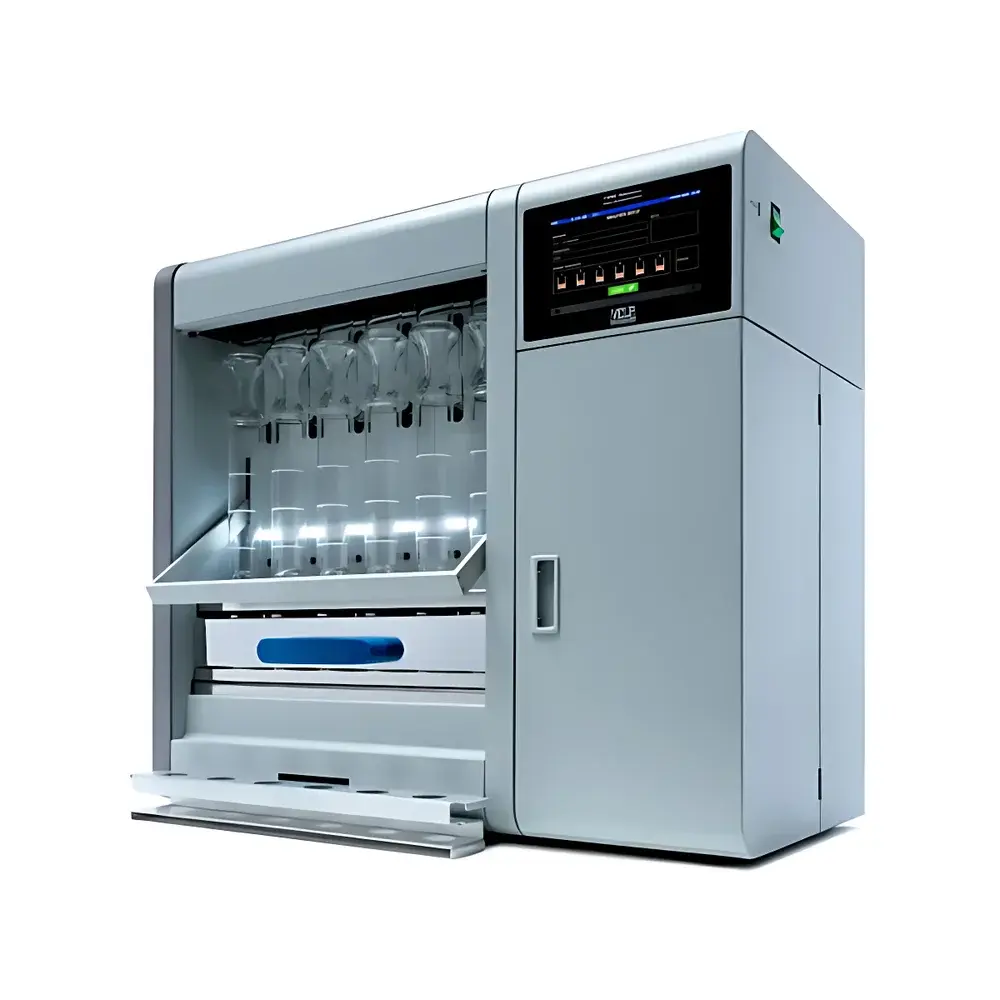
VELP FIWE ADVANCE Automated Fiber Analyzer
| Brand | VELP |
|---|---|
| Origin | Italy |
| Model | FIWE ADVANCE |
| Application Standards | AOAC, AACC, ISO 6865, ISO 13906, ASTM D2974, EN ISO 12151 |
| Automation Level | Fully Automated Acid/Alkali Digestion, Filtration, Washing, and Residue Drying |
| Reagent Handling | Auto-dosing of H₂SO₄, NaOH, α-amylase, protease, ethanol, acetone, and antifoaming agent |
| Filtration System | Pressure-assisted vacuum filtration with programmable air-backflush |
| Control Interface | 7″ capacitive touchscreen (graphical UI, multilingual support) |
| Connectivity | Ethernet and Wi-Fi enabled for VELP Ermes Cloud Platform integration |
| Data Integrity | Audit trail, user access levels, electronic signatures compliant with FDA 21 CFR Part 11 requirements |
| Throughput | Up to 6 samples per run (batch mode), optional 24-position carousel for unattended operation |
| Safety Compliance | CE, UL/CSA certified, integrated fume extraction interface |
| Sample Capacity | 0.5–3.0 g (dry weight), compatible with standard Gooch crucibles or fiber bags (ANKOM-style) |
| Drying Module | Integrated infrared drying unit (60–150 °C, ±1 °C accuracy) |
| Waste Management | Dual-compartment acid/alkali waste collection with level sensors |
Overview
The VELP FIWE ADVANCE Automated Fiber Analyzer is a fully integrated, walk-away system engineered for precise, reproducible quantification of dietary and structural fiber fractions in agricultural, food, and feed matrices. It implements standardized wet-chemical digestion protocols—including Weende, Van Soest (NDF, ADF, ADL), and AOAC-approved methods—based on sequential acid hydrolysis, alkaline saponification, enzymatic treatment, and solvent extraction. The instrument operates on the principle of selective solubilization and gravimetric isolation: non-fiber components (starch, protein, lipids, sugars) are removed under controlled temperature, reagent concentration, and dwell time, leaving behind insoluble fiber residues that are dried, ashed (optional), and weighed. This gravimetric foundation ensures traceability to primary reference standards and alignment with regulatory testing frameworks used by global food safety authorities and accreditation bodies.
Key Features
- Fully automated reagent delivery system with independent pumps for sulfuric acid, sodium hydroxide, α-amylase, protease, ethanol, acetone, and silicone-based antifoam—each dosed with ±0.2 mL accuracy per step.
- Programmable air-backflush filtration module prevents crucible clogging during high-lignin or mucilaginous sample processing, maintaining consistent flow rates across extended runs.
- Integrated infrared drying chamber (60–150 °C) enables rapid, uniform moisture removal without thermal degradation of cellulose or hemicellulose structures.
- 7-inch industrial-grade capacitive touchscreen with intuitive graphical workflow navigation, real-time progress visualization (including temperature, pressure, and reagent volume graphs), and method library management.
- Cloud-connected architecture via Ethernet or Wi-Fi supports remote monitoring, firmware updates, and centralized instrument fleet management through the VELP Ermes platform.
- Compliant with FDA 21 CFR Part 11 requirements: full electronic audit trail, role-based user authentication (admin/operator/technician), and tamper-evident data export (CSV, PDF, XML).
- Robust mechanical design validated for continuous 24/7 operation in QC laboratories; includes leak detection, overpressure relief, and emergency stop circuitry.
Sample Compatibility & Compliance
The FIWE ADVANCE accommodates solid, semi-solid, and homogenized matrices—including cereal grains, legumes, forages, pet food, infant formula, bakery products, and dietary supplements. It supports both crucible-based (Gooch-type porcelain or sintered glass) and filter-bag methodologies (compatible with ANKOM F57/F58 bag dimensions). All operational parameters align with internationally recognized standards: AOAC Official Methods 978.10 (crude fiber), 991.43 (total dietary fiber), 2009.01 (soluble/insoluble fiber); AACC Method 32-25 (NDF/ADF); ISO 6865:2000 (crude fiber); ISO 13906:2014 (dietary fiber); ASTM D2974–22 (forage fiber); and EN ISO 12151:2021 (feed analysis). Instrument validation documentation meets GLP and GMP laboratory requirements for method verification, equipment qualification (IQ/OQ/PQ), and routine performance checks.
Software & Data Management
The embedded firmware provides method editor functionality for custom protocol development—including variable digestion times, multi-step enzyme incubations, gradient solvent washes, and conditional branching (e.g., ash correction if residue >5% ash content). Data is stored locally with automatic timestamping and synchronized to the Ermes Cloud for secure backup, cross-instrument comparison, and LIMS integration via RESTful API. Reports include raw mass values, blank corrections, moisture adjustment factors, and uncertainty estimation per ISO/IEC 17025:2017 Annex A. Export formats preserve metadata integrity for regulatory submissions and third-party audits.
Applications
- Crude fiber determination in animal feed formulations per Weende analysis (ISO 6496).
- NDF (neutral detergent fiber) and ADF (acid detergent fiber) quantification for ruminant nutrition modeling and digestibility prediction.
- ADL (acid detergent lignin) measurement to estimate indigestible cell wall fraction in forage quality assessment.
- Total, soluble, and insoluble dietary fiber analysis in functional foods and nutraceuticals per AOAC 2009.01 and EU Regulation (EC) No 1924/2006.
- Cellulose, hemicellulose, and pectin fractionation in plant biomass research and biofuel feedstock characterization.
- Quality control of fiber-enriched bakery products, cereals, and dietary supplements for label claim verification.
FAQ
Which regulatory standards does the FIWE ADVANCE support out-of-the-box?
Preloaded methods cover AOAC 978.10, 991.43, 2009.01; AACC 32-25; ISO 6865, 13906, 12151; ASTM D2974; and EN 15510.
Can the system perform ash correction automatically?
Yes—the optional integrated muffle furnace module (FIWE ADVANCE + ASH) enables automated post-digestion ashing at 550 °C per AOAC 923.03, with gravimetric correction applied in final reporting.
Is method transfer possible from legacy fiber analyzers?
Method templates can be imported/exported as XML files; VELP provides conversion guides for ANKOM, Gerhardt, and Foss instrument protocols.
What maintenance intervals are recommended for long-term reliability?
Daily: rinse lines and check waste levels. Quarterly: calibrate reagent pumps and verify temperature uniformity. Annually: full system qualification with NIST-traceable reference materials.
Does the instrument require external fume hood integration?
It includes a dedicated exhaust port for connection to lab ventilation systems; optional built-in activated carbon filter kit available for standalone operation.






