
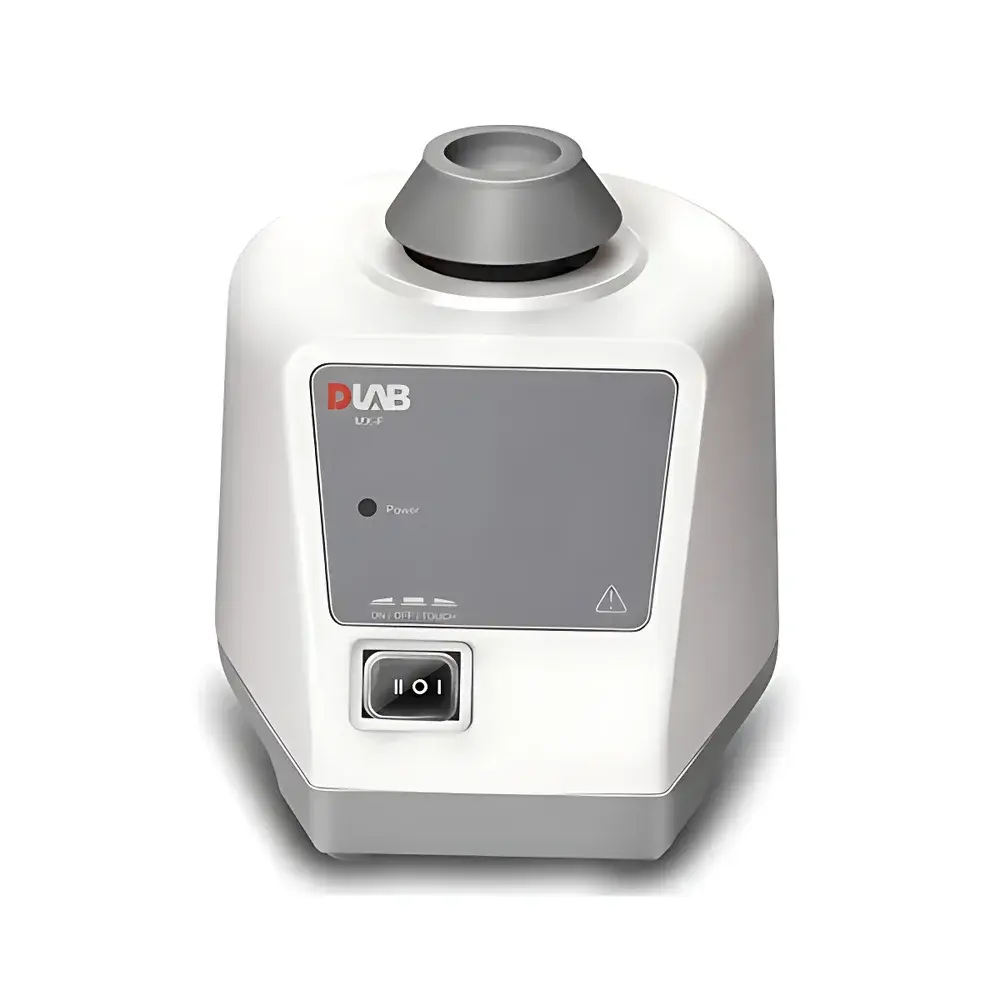
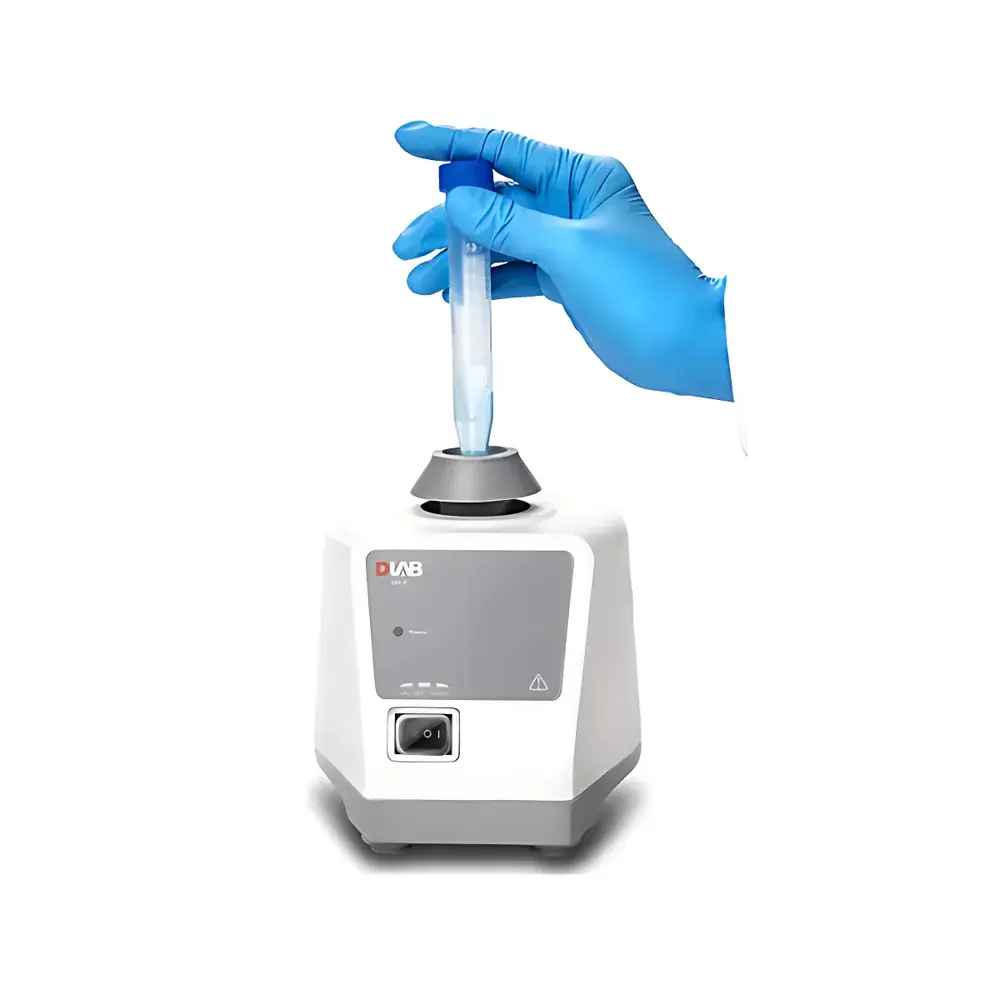
DLAB MX-F Classic Fixed-Speed Vortex Mixer
| Brand | DLAB |
|---|---|
| Origin | Beijing, China |
| Manufacturer Type | Direct Manufacturer |
| Region of Origin | Domestic (China) |
| Model | MX-F |
| Instrument Category | Stirring & Mixing Equipment |
| Timer Modes | Momentary (Touch) / Continuous Operation |
| Oscillation Speed | 3000 rpm |
| Orbital Diameter | 4 mm |
| Temperature Control Range | 5–40 °C |
| Platform Quantity | 1 |
| Input Voltage | 100–120 V / 200–240 V, 50/60 Hz |
| Power Consumption | 60 W |
| Motor Type | Shaded-Pole Motor |
| Motor Output Power | 10 W |
| Dimensions (L×W×H) | 127 × 130 × 160 mm |
| Net Weight | 2 kg |
| Operating Ambient Temperature | 5–40 °C |
| Max. Relative Humidity | 80 % RH |
| Enclosure Rating | IP21 |
Overview
The DLAB MX-F Classic Fixed-Speed Vortex Mixer is a compact, benchtop orbital shaker engineered for reproducible, high-intensity mixing of small-volume liquid samples in life science laboratories. It operates on the principle of eccentric orbital motion—generating controlled circular agitation with a fixed 4 mm orbit diameter—to induce rapid vortex formation and homogeneous suspension of particulates, cells, reagents, or precipitates within tubes and microcontainers. Unlike variable-speed vortexers, the MX-F delivers consistent 3000 rpm output without speed regulation, making it ideal for standardized protocols requiring deterministic mixing intensity—such as cell resuspension prior to lysis, reagent homogenization before PCR setup, or uniform dispersion of enzyme-substrate mixtures. Its fixed-speed architecture eliminates calibration drift and ensures long-term operational stability across daily QC workflows.
Key Features
- Fixed 3000 rpm orbital speed optimized for vigorous yet controllable sample agitation—enabling efficient re-suspension of pelleted cells, bacterial cultures, and protein aggregates.
- Momentary (touch-activated) and continuous operation modes support both transient mixing tasks and extended incubation-compatible shaking cycles.
- Single-platform design with integrated universal adapter accommodates tubes up to 30 mm in diameter—including 0.5 mL, 1.5 mL, and 2.0 mL microcentrifuge tubes, PCR strips, and small vials—without requiring accessory swaps.
- Stainless steel baseplate and vacuum suction feet provide mechanical decoupling from the work surface, minimizing energy loss and preventing lateral displacement during high-RPM operation.
- Die-cast aluminum housing offers thermal stability, corrosion resistance, and structural rigidity—ensuring durability under repeated sterilization wipe-downs and routine lab handling.
- IP21-rated enclosure provides protection against vertically falling drips and solid objects >12.5 mm, meeting standard laboratory environmental safety requirements.
Sample Compatibility & Compliance
The MX-F is validated for use with aqueous buffers, saline solutions, glycerol-diluted reagents, and low-viscosity biological suspensions (e.g., E. coli cultures in LB broth, mammalian cell suspensions in PBS). It is not intended for viscous media (>50 mPa·s), volatile organic solvents, or pressurized containers. The device complies with IEC 61010-1:2010 for electrical safety in laboratory equipment and meets EMC requirements per EN 61326-1:2013. While not a regulated medical device, its design supports GLP-aligned documentation practices through traceable operational consistency—particularly when deployed in method-defined steps within ISO/IEC 17025-accredited testing laboratories.
Software & Data Management
As a manually operated analog instrument, the MX-F does not incorporate digital control firmware, onboard memory, or data logging capabilities. Its interface consists solely of a tactile momentary switch and a mechanical power toggle—eliminating software validation requirements and ensuring full compatibility with environments governed by FDA 21 CFR Part 11 Annex 11 and EU GMP Annex 11 where electronic records are restricted. This architecture facilitates straightforward IQ/OQ execution and reduces qualification burden in regulated QC labs performing routine mixing steps within validated assay protocols.
Applications
- Routine resuspension of centrifuged cell pellets prior to lysis or staining procedures.
- Homogenization of antibody-conjugated beads in immunoassay preparation workflows.
- Uniform mixing of master mixes for qPCR, RT-PCR, and NGS library preparation.
- Dispersion of lyophilized reagents or enzymatic reaction components in low-volume formats.
- Supporting temperature-sensitive protocols when used inside refrigerated or ambient-controlled incubators (5–40 °C operating range).
- Pre-analytical sample conditioning in clinical chemistry, microbiology, and biobanking operations.
FAQ
Is the MX-F suitable for mixing viscous samples such as glycerol stocks or agarose solutions?
No—the MX-F is optimized for low-to-medium viscosity liquids (<30 mPa·s). Highly viscous or non-Newtonian fluids may result in reduced effective orbital amplitude and inconsistent mixing performance.
Can the MX-F be operated inside a cold room or CO₂ incubator?
Yes, provided ambient conditions remain within 5–40 °C and relative humidity does not exceed 80 % RH. Its IP21 rating and absence of internal electronics make it compatible with controlled-environment enclosures.
Does the unit include speed calibration documentation?
As a fixed-speed device with no adjustable RPM setting, the MX-F undergoes factory verification at 3000 rpm ±3 % under nominal load (12 × 1.5 mL tubes). Calibration certificates are available upon request for IQ/OQ validation packages.
What maintenance is required for long-term reliability?
Routine cleaning with 70 % ethanol and periodic inspection of suction feet adhesion are sufficient. No lubrication or motor servicing is required due to the sealed shaded-pole motor design.
Is the MX-F compliant with ISO 13485 or FDA 21 CFR Part 820?
While not a medical device, its manufacturing quality system adheres to ISO 9001:2015 standards. Device-level regulatory compliance is determined by end-use application and integration into broader quality systems.




