
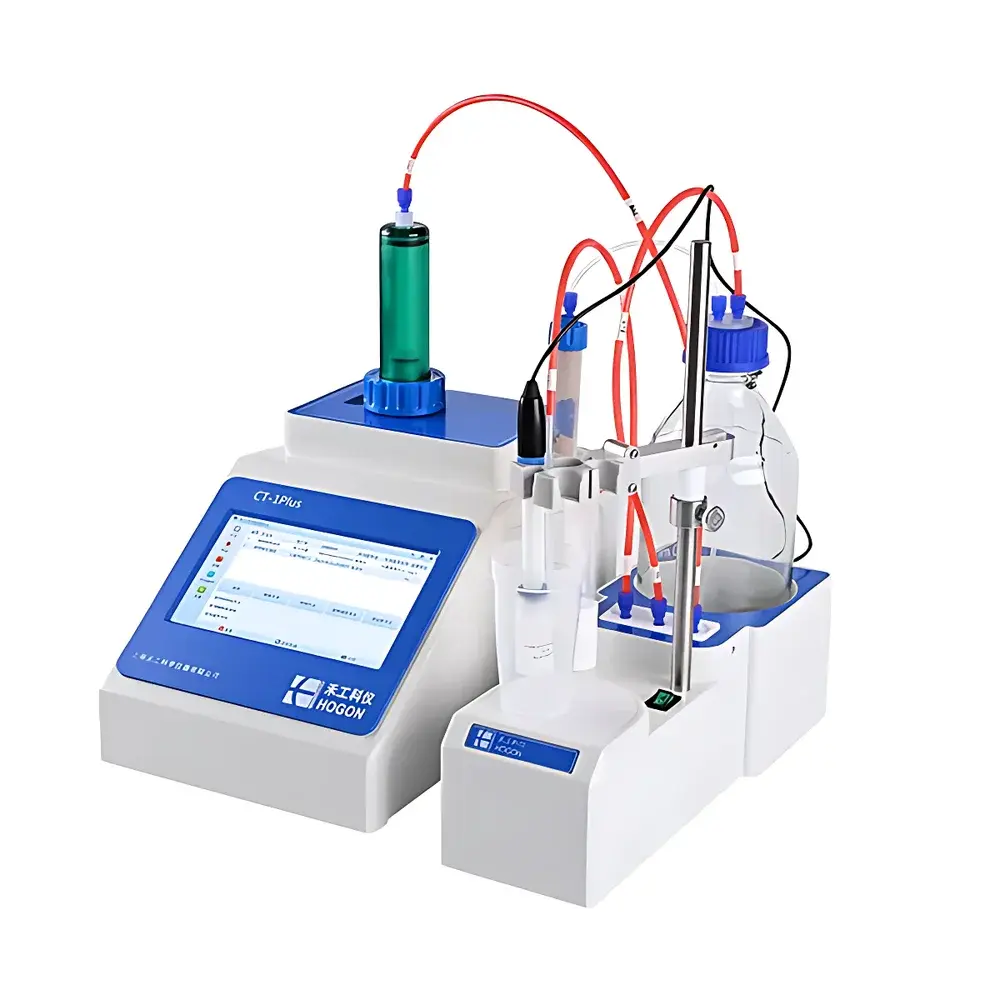
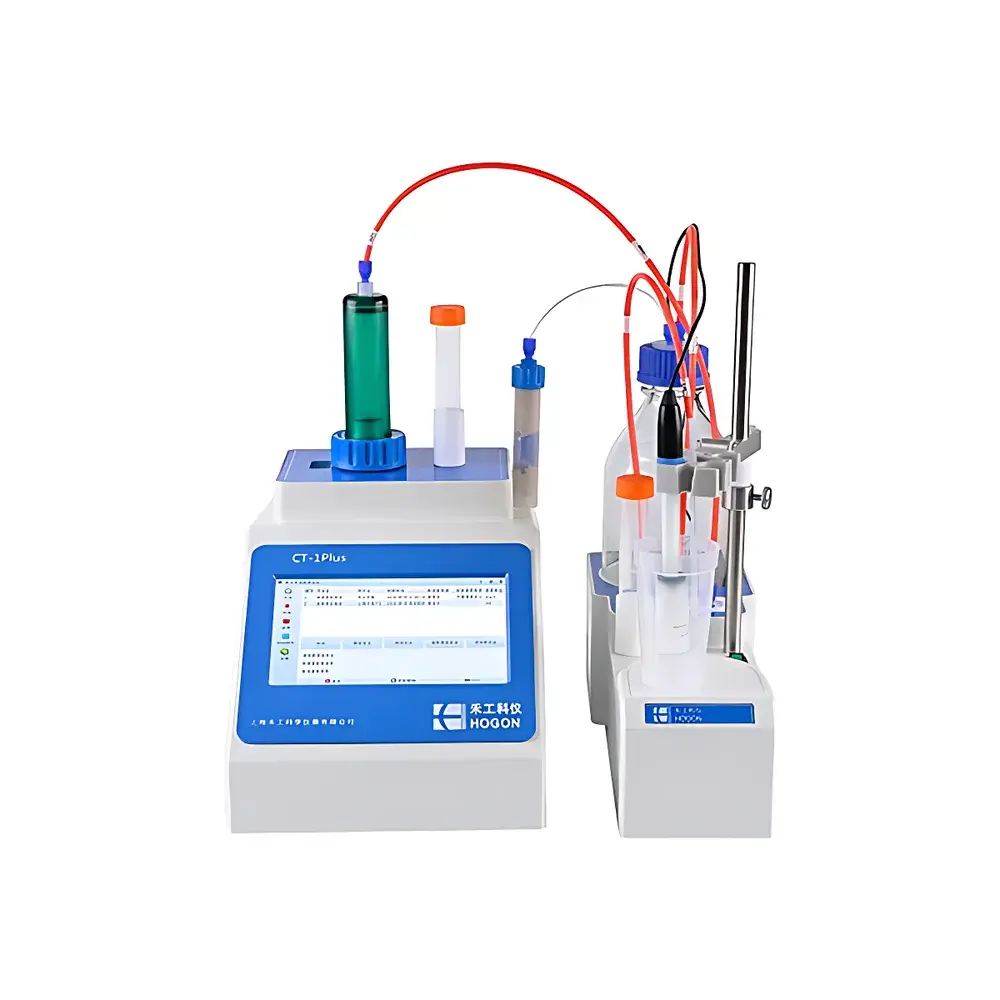
HOGON CT-1Plus Automatic Potentiometric Titrator for Polyethylene Glycol Acid Value Determination
| Brand | HOGON |
|---|---|
| Origin | Shanghai, China |
| Manufacturer Type | Direct Manufacturer |
| Regional Classification | Domestic (China) |
| Model | CT-1Plus |
| Instrument Category | General-Purpose Potentiometric Titrator |
| Price | ¥29,800 CNY |
| Key | High-precision burette (20 µL minimum & maximum dispensing volume) |
| Key | Composite pH/membrane electrode system |
| Key | Differential endpoint detection with adjustable slope threshold (e.g., 300 mV/mL) |
| Key | Fully automated titration cycle including stirring, reagent delivery, and endpoint recognition |
| Key | Typical analysis time ≤ 2 min for PEG acid value determination |
| Key | Compliant with ASTM D974, ISO 3682, and USP <771> for acid number titrations |
Overview
The HOGON CT-1Plus Automatic Potentiometric Titrator is an engineered solution for standardized acid value determination in polyethylene glycol (PEG) and other hydrophilic polymers, fatty acids, esters, and pharmaceutical excipients. It operates on the fundamental principle of potentiometric titration—measuring the potential shift across a composite ion-selective electrode (typically a combination glass/pH electrode with integrated reference junction) as a standardized potassium hydroxide (KOH) ethanol solution is incrementally delivered into the sample matrix. The instrument detects the inflection point of the titration curve using first-derivative (dE/dV) analysis, enabling objective, operator-independent endpoint identification without reliance on visual indicators or subjective interpretation. Designed for routine QC laboratories in chemical manufacturing, API development, and polymer quality control, the CT-1Plus delivers traceable, repeatable results aligned with internationally recognized test methods including ASTM D974 (Standard Test Method for Neutralization Number of Petroleum Products), ISO 3682 (Titrimetric determination of acid number), and USP (Acid Number).
Key Features
- Precision fluid handling system featuring a calibrated glass burette with 20 µL minimum dispensing resolution and reproducible 20 µL incremental delivery—critical for low-acid-value samples where volumetric error directly impacts mg KOH/g calculation accuracy.
- Integrated composite electrode assembly optimized for non-aqueous and semi-polar media (e.g., 95% ethanol/toluene mixtures), minimizing junction potential drift and ensuring stable baseline response during prolonged titrations.
- Automated three-phase titration sequence: motor-driven magnetic stirring at constant speed, controlled reagent addition via stepper-motor-driven piston pump, and real-time potential acquisition at ≥10 Hz sampling rate.
- Differential endpoint algorithm with user-configurable slope threshold (default 300 mV/mL); supports multi-stage titration protocols for samples exhibiting overlapping endpoints or buffering regions.
- Onboard data logging with timestamped raw E-V curves, derivative plots, and final calculated acid values—exportable in CSV format for LIMS integration or audit-ready reporting.
Sample Compatibility & Compliance
The CT-1Plus accommodates solid, liquid, and viscous samples within standard 100–250 mL titration beakers. For PEG acid value testing, typical sample mass ranges from 2.5 to 3.5 g dissolved in warm ethanol/toluene (1:1 v/v). It is validated for use with common titrants (0.1 mol/L KOH in ethanol), blank correction protocols, and temperature-stabilized environments (20–25 °C). The system conforms to GLP documentation requirements: all method parameters (burette calibration date, electrode serial number, titrant concentration, sample ID, analyst ID) are embedded in each result record. Audit trails meet FDA 21 CFR Part 11 expectations for electronic records when paired with password-protected user accounts and configurable electronic signatures.
Software & Data Management
The CT-1Plus runs embedded firmware with a touchscreen GUI supporting multilingual interface (English default). Preloaded method templates include “PEG Acid Value – USP/ISO”, “Free Fatty Acid – AOAC”, and “Total Acid Number – ASTM D664”. All raw potential (mV) vs. volume (mL) datasets are stored locally with automatic backup to USB drive. Export formats include plain-text CSV (for Excel or statistical software), PDF reports with embedded chromatogram-style titration curves, and XML files compatible with enterprise LIMS platforms. Calibration logs, maintenance history, and electrode performance metrics are retained for ≥12 months per ICH Q7 Annex 11 guidance.
Applications
- Quantification of carboxylic end-group concentration in PEG diacids and monoacids used as linkers in bioconjugation and prodrug synthesis.
- Stability-indicating assay for hydrolytic degradation monitoring of polyester-based drug delivery systems (e.g., PLGA, PCL).
- Quality release testing of surfactants, emulsifiers, and lipid-based excipients per EP 2.5.1 and JP 6.05.
- Raw material verification of fatty acid feedstocks in cosmetic and nutraceutical manufacturing.
- Educational use in analytical chemistry laboratories for teaching potentiometric principles, calibration theory, and uncertainty propagation in titrimetric analysis.
FAQ
What titration standards is the CT-1Plus validated against?
ASTM D974, ISO 3682, USP , and EP 2.5.1 for acid number determination in non-aqueous matrices.
Can the instrument perform back-titration or multi-step titrations?
Yes—user-defined methods support sequential reagent addition, pause intervals, and conditional endpoint logic based on slope magnitude or absolute potential thresholds.
Is electrode calibration required before each analysis?
A two-point calibration (pH 4.01 and 7.00 buffers) is recommended daily; however, the composite electrode’s stability in ethanol permits up to 8-hour continuous operation without recalibration under controlled lab conditions.
How is measurement uncertainty estimated for acid value results?
The instrument calculates combined uncertainty per GUM (JCGM 100:2008) incorporating burette volumetric error (±0.5%), titrant molarity uncertainty (±0.2%), sample weighing error (±0.1 mg), and endpoint detection repeatability (RSD ≤ 0.8% n=6).
Does the system support remote diagnostics or firmware updates?
Firmware updates are performed via USB; remote access is not supported to maintain data integrity and regulatory compliance in GMP environments.



