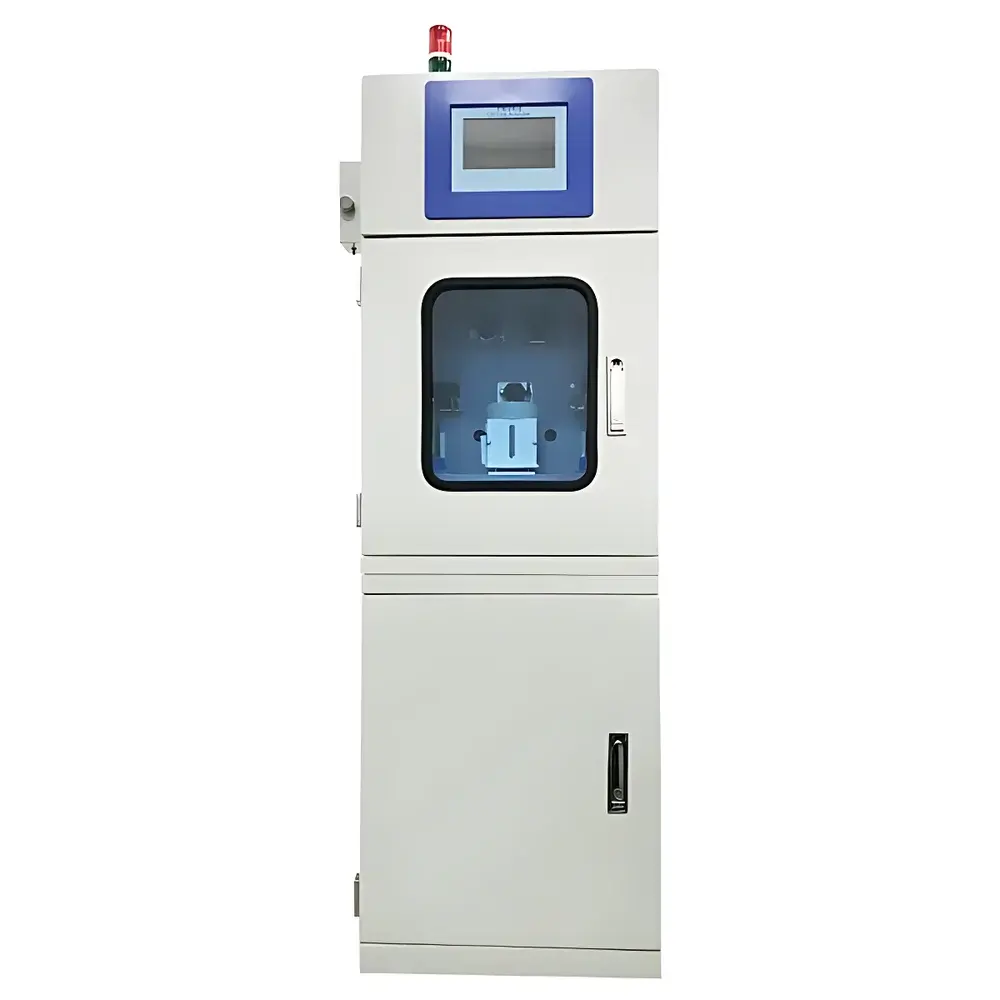
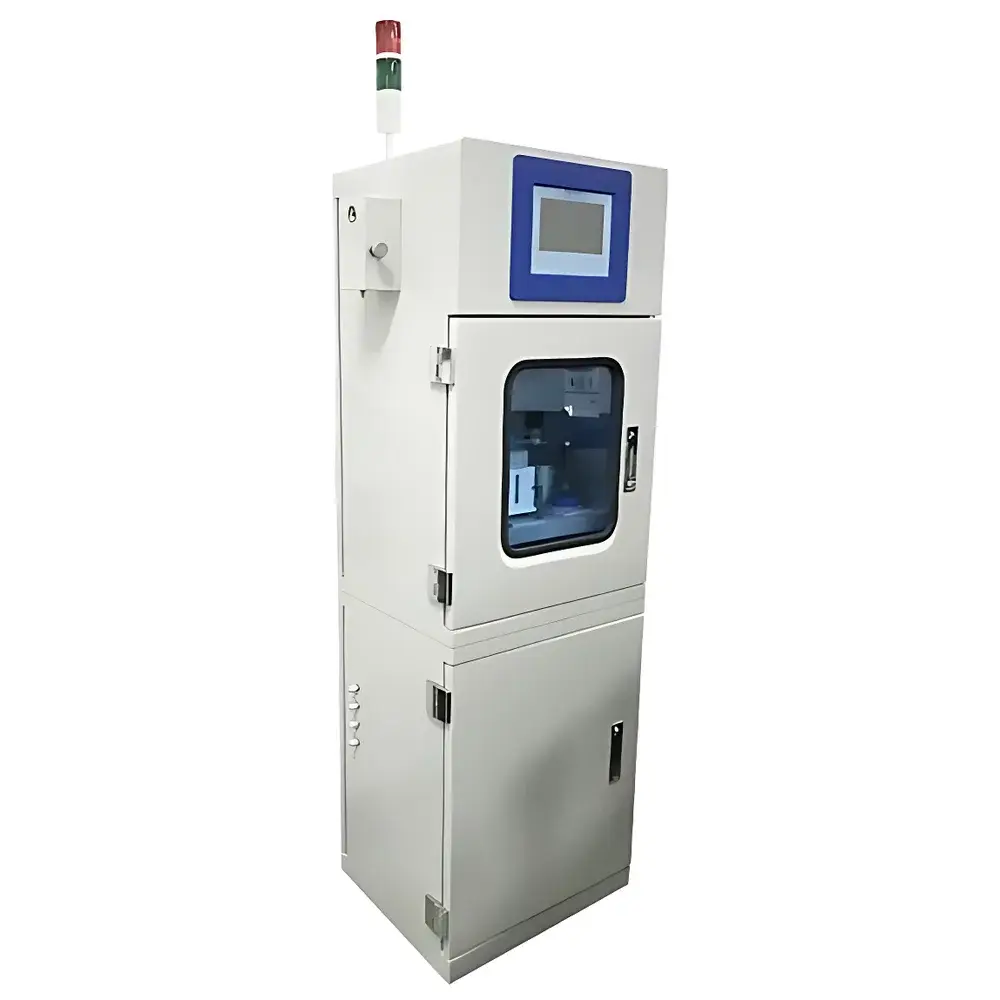
HOGON ALT Online Free Acid & Total Acid Analyzer for Electrolytic Phosphating Baths
| Brand | HOGON |
|---|---|
| Model | ALT Online Free Acid & Total Acid Analyzer |
| Origin | Shanghai, China |
| Manufacturer | HOGON Scientific Instruments Co., Ltd. |
| Application | Real-time titrimetric monitoring of free acid (H₃PO₄, HNO₃) and total acid in electrolytic phosphating bath solutions |
| Measurement Principle | Potentiometric and colorimetric endpoint detection with dual-mode titration control |
| Display | 7-inch full-color TFT touchscreen interface |
| Processor | ARM Cortex-A8 |
| Connectivity | RS-232, TCP/IP, Modbus RTU/TCP |
| Compliance | Designed for industrial process environments per IEC 61000-6-2/4 EMC standards |
| Data Output | Structured ASCII or JSON via Ethernet |
| Maintenance Interval | ≥30 days between cleaning cycles under continuous operation |
Overview
The HOGON ALT Online Free Acid & Total Acid Analyzer is an industrial-grade, fully automated titration system engineered for continuous, unattended monitoring of free acid concentration (expressed as point acidity, typically in mL of 0.1 mol/L NaOH to phenolphthalein endpoint) and total acid concentration (expressed as titratable acidity, typically in mL of 0.1 mol/L NaOH to methyl orange or potentiometric endpoint) in electrolytic phosphating baths. It operates on standardized acid–base titration principles—leveraging both potentiometric (via dual-platinum electrode) and photometric (high-resolution RGB color sensing) endpoint detection to ensure robust, matrix-independent endpoint recognition across variable bath compositions. Unlike manual titration or single-parameter sensors, the ALT analyzer dynamically selects titration mode—pH-based, redox, complexometric, or colorimetric—based on real-time sample characteristics, enabling accurate quantification even in turbid, colored, or oxidizing phosphating solutions containing Zn²⁺, Ni²⁺, Mn²⁺, NO₃⁻, PO₄³⁻, and residual accelerators.
Key Features
- Fully autonomous operation: Integrated sampling probe, peristaltic aspiration pump, precision burette (±0.01 mL repeatability), electromagnetic valve manifold, and programmable stirrer enable end-to-end analysis without operator intervention.
- Dual-mode endpoint detection: Simultaneous potentiometric slope analysis and RGB color trajectory tracking eliminate false endpoints caused by bath discoloration or electrode passivation.
- Modular architecture: Field-replaceable titration modules—including pH titration kit, redox titration kit, and colorimetric titration kit—allow reconfiguration for other process streams (e.g., passivation baths, etching solutions, rinse water hardness).
- Industrial-grade HMI: 7-inch capacitive touchscreen with localized multilingual UI (English default), configurable alarm thresholds, and embedded audit trail logging compliant with GLP-aligned data integrity requirements.
- Process-coupled dosing control: Built-in analog/digital I/O and Modbus TCP server functionality enable direct interfacing with peristaltic dosing pumps; calculated acid deficit triggers proportional-additive reagent delivery to maintain bath ratio within ±0.2 mL titrant tolerance.
- Embedded ARM Cortex-A8 processor: Supports concurrent execution of titration sequence, data validation, communication stack (RS-232/Modbus RTU/Ethernet), and local database storage (≥10,000 result records with timestamps, operator ID, and method version).
Sample Compatibility & Compliance
The ALT analyzer is validated for use with aqueous electrolytic phosphating baths operating at temperatures from 25 °C to 55 °C and conductivity ranges of 5–30 mS/cm. It accommodates suspended solids ≤50 ppm and oil content ≤10 ppm without clogging, thanks to integrated filtration and self-cleaning rinse cycles using deionized water or low-conductivity rinse solution. All wetted parts—including PTFE-coated tubing, borosilicate glass titration vessel, and platinum-tipped electrodes—are chemically resistant to phosphoric/nitric acid mixtures, metal phosphates, and common accelerators (e.g., sodium nitrite, sodium chlorate). The system meets CE marking requirements under Directive 2014/30/EU (EMC) and 2014/35/EU (LVD); its firmware implements time-stamped event logging and user-access-level controls aligned with FDA 21 CFR Part 11 Annex 11 expectations for electronic records in regulated manufacturing environments.
Software & Data Management
The embedded HOGON TitrationOS v3.2 provides a deterministic state-machine controller for titration sequences, supporting custom method scripting in a structured logic language (IF-THEN-ELSE, WHILE loops, conditional branching based on intermediate readings). Each analysis generates a complete digital record including raw electrode potential vs. volume curve, RGB intensity traces, derivative plots, endpoint confirmation flags, and uncertainty estimation per ISO/IEC 17025:2017 Clause 7.6. Data export options include CSV over FTP, MQTT publishing to cloud historian platforms, and native OPC UA server support. Remote diagnostics and firmware updates are performed via secure TLS 1.2 HTTPS channel. Audit trails retain all user actions (login/logout, method edits, calibration events) with immutable SHA-256 hashing and hardware timestamping.
Applications
Primary deployment includes real-time control of zinc- or manganese-based electrolytic phosphating lines in automotive OEM coating plants, Tier-1 suppliers, and metal finishing service providers. Secondary applications extend to continuous monitoring of acid concentration in chromating baths, alkaline cleaner regeneration loops, and wastewater neutralization basins where stoichiometric reagent dosing is required. The platform has been deployed in PCB surface treatment lines for micro-etchant (CuCl₂/HCl) bath control and in textile dyeing auxiliaries where acid buffer capacity must be maintained across batch transitions. Method templates for ASTM D974 (acid number), ISO 3682 (potentiometric titration), and internal customer-defined specifications are preloaded and field-customizable.
FAQ
What titration methods does the ALT analyzer support?
It natively executes pH titration, redox titration, complexometric titration (e.g., EDTA for metal ion content), and colorimetric titration—each selectable per sample type via method configuration.
Can the system integrate with existing PLC-based production control systems?
Yes—through Modbus TCP, Modbus RTU over RS-485, or discrete 4–20 mA analog outputs mapped to free acid value, total acid value, or dosing command signals.
How often does the system require maintenance or recalibration?
Electrode calibration is recommended every 72 operational hours or after 50 analyses; full system verification (including burette linearity and photometric baseline) is advised monthly per ISO 8655-6.
Is remote access and troubleshooting supported?
Yes—the unit hosts a secure web interface accessible via authenticated HTTPS; remote desktop assistance requires prior customer authorization and operates over encrypted SSH tunneling.
Does the analyzer comply with data integrity requirements for regulated industries?
It implements role-based user authentication, electronic signatures for critical actions, tamper-evident audit logs, and exportable raw data files compatible with LIMS validation protocols.