
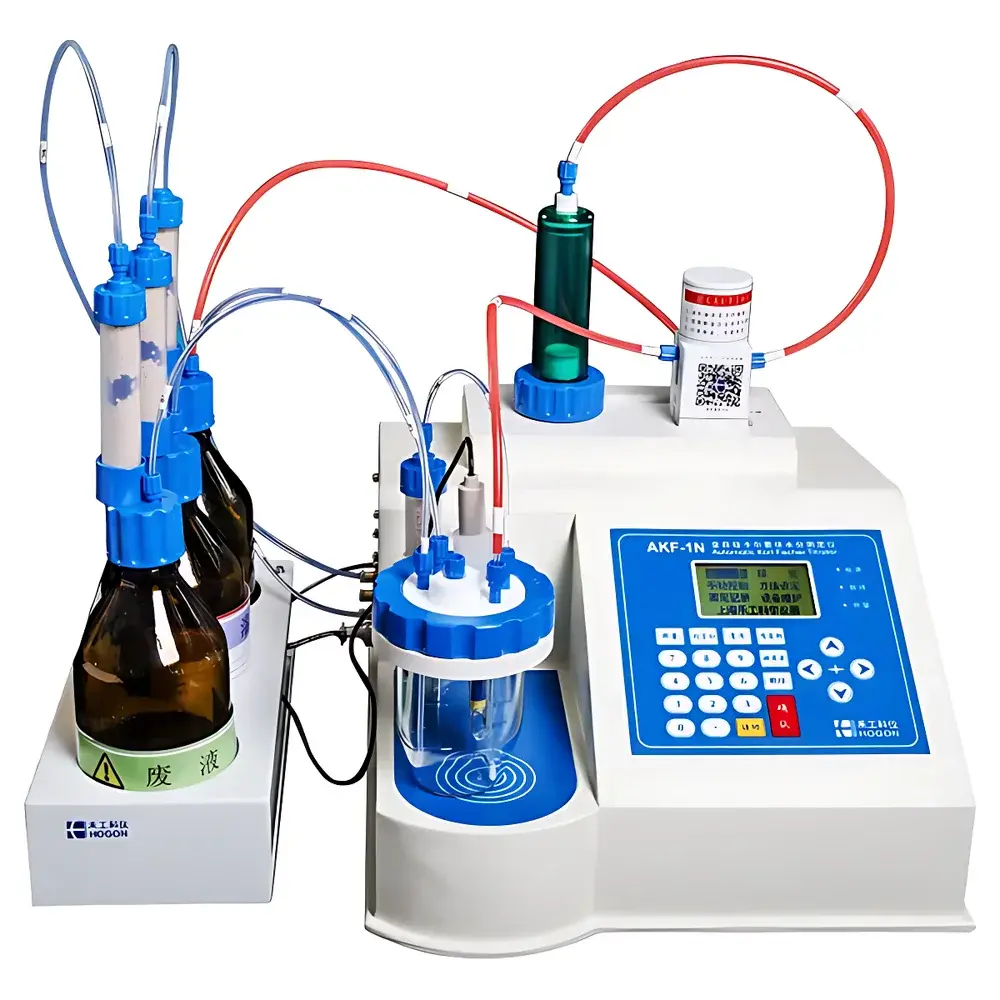
HOGON AKF-1N Fully Automatic Volumetric Karl Fischer Moisture Titrator
| Brand | HOGON |
|---|---|
| Origin | Shanghai, China |
| Manufacturer Type | Original Equipment Manufacturer (OEM) |
| Product Category | Domestic |
| Model | AKF-1N (Fully Automatic) |
| Titration Method | Fully Automatic Volumetric Titration |
| Instrument Type | Volumetric Karl Fischer Moisture Analyzer |
| Measurement Resolution | 1 ppm |
| Moisture Content Range | 0.001–100% (w/w) |
| Measurement Accuracy | ±0.001 mg H₂O |
| Minimum Dispensing Volume | 1/2000 of Burette Capacity |
| Titration Control Precision | 1.0 µL |
| Repeatability | RSD ≤ 0.5% (at 20 mg H₂O) |
| Sample Throughput | ~2 minutes per analysis (average) |
| Burette Capacity | 20 mL |
| Electrode Type | Dual Platinum Electrode |
| Display | Button-Operated LCD with Real-Time Parameter Monitoring |
| Data Storage | 60 test records |
| Method Storage | 5 user-defined methods |
| Environmental Humidity Limit | ≤80% RH |
| Power Supply | 110–220 V AC, 50 Hz |
| Net Weight | 5.5 kg |
Overview
The HOGON AKF-1N is a fully automatic volumetric Karl Fischer (KF) moisture titrator engineered for precision, reliability, and operational safety in regulated laboratory environments. It implements the classical coulometric-free volumetric KF titration principle—based on the stoichiometric reaction between iodine, sulfur dioxide, water, and a base in methanol or other anhydrous solvents—to quantify trace to bulk water content in solid, liquid, and gaseous samples. Unlike coulometric systems, the AKF-1N delivers high accuracy across the full dynamic range (0.001–100% w/w, equivalent to 10 ppm–100%) by precisely dispensing standardized KF reagent via a high-fidelity 20 mL burette. Its sealed titration cell design minimizes ambient moisture ingress and reagent degradation, while integrated solvent handling—including automatic reagent aspiration, waste ejection, and drift compensation—ensures long-term baseline stability and low system drift (<10 µg H₂O/min typical). The instrument complies with fundamental analytical requirements outlined in ASTM E203, ISO 760, and USP , serving as a primary method for moisture quantification in quality control and release testing.
Key Features
- Fully automated volumetric titration with intelligent endpoint detection using dual platinum electrode polarization—eliminates manual endpoint judgment and ensures consistent result interpretation.
- High-precision piston-driven burette delivering 1.0 µL titrant resolution; capable of sub-microliter incremental dosing even at full 20 mL capacity, enabling accurate quantification down to 1 ppm water content.
- Hermetically sealed titration vessel with proprietary quick-connect fittings and chemically resistant seals (PTFE, PEEK), minimizing vapor leakage and operator exposure to toxic solvents such as pyridine-free KF reagents.
- Adaptive titration speed control: algorithm dynamically adjusts delivery rate based on real-time water concentration and reagent titer—no manual fast/slow titration mode selection required.
- Integrated hardware-level fault detection: automatic shutdown upon abnormal current draw, electrode short-circuit, or waste bottle overflow—protects critical components and preserves data integrity.
- Low-noise mechanical architecture featuring suspended drive assembly and optimized gear train, reducing operational acoustic emissions to <45 dB(A) and extending service intervals.
Sample Compatibility & Compliance
The AKF-1N supports direct analysis of diverse sample matrices without derivatization, including hygroscopic powders (e.g., APIs, excipients), viscous liquids (lubricants, resins), volatile solvents (acetone, THF), and gas-phase moisture via headspace sampling adapters (optional). All wetted materials—including tubing, valves, and electrode housings—are constructed from corrosion-resistant polymers (e.g., ETFE, FEP) and inert metals compatible with aggressive KF reagents. The system meets essential design criteria for GLP/GMP compliance: audit-trail-capable event logging (via optional PC interface), password-protected method editing, and electronic signature readiness. While the standalone unit does not include 21 CFR Part 11-compliant software out-of-the-box, its RS-232/USB output enables integration with validated LIMS or CDS platforms supporting electronic records and signatures.
Software & Data Management
Operation is managed through an embedded microcontroller with a tactile button-operated LCD interface displaying real-time parameters: cumulative titrant volume, elapsed time, calculated water mass (µg), drift rate (µg/min), and dynamic titration curve overlay. Up to five user-defined methods—including solvent type, titer calibration factor, endpoint threshold, and delay settings—can be stored onboard. Sixty complete test records are retained locally with timestamp, sample ID (user-input), moisture %, absolute water mass, and reagent consumption. Optional thermal printer support provides immediate hardcopy output compliant with internal QA documentation standards. For extended data governance, ASCII-formatted export via serial/USB allows seamless import into Excel, LabArchives, or validated ELN systems.
Applications
The AKF-1N is routinely deployed in pharmaceutical manufacturing for residual moisture analysis in lyophilized products (per ICH Q5C), active pharmaceutical ingredients (APIs), and polymer-based medical device coatings. In petrochemical QA labs, it verifies water limits in jet fuels (ASTM D6304), transformer oils (IEC 60814), and lubricant basestocks. Food and feed producers apply it to verify moisture specifications in dairy powders, cereal grains, and dehydrated vegetables—supporting shelf-life modeling and HACCP critical control point monitoring. Additionally, battery material R&D labs use it to quantify trace water in Li-ion cathode precursors (e.g., NMC, LFP), where sub-50 ppm levels directly impact slurry rheology and cell cycle life.
FAQ
What KF reagent types are compatible with the AKF-1N?
The instrument accepts all commercially available single-component and two-component volumetric KF reagents, including pyridine-free formulations. No recalibration is required when switching reagents due to adaptive endpoint recognition.
Does the AKF-1N support external sample changers?
It does not feature native autosampler integration; however, its RS-232 command protocol is documented and supports third-party robotic handler synchronization via TTL-triggered start/stop signals.
How often must the burette be cleaned or recalibrated?
Under normal operation with high-purity reagents, the 20 mL burette requires cleaning every 200–300 titrations; volumetric calibration is recommended quarterly or after any maintenance involving the piston assembly.
Can the AKF-1N measure water in oils with high viscosity?
Yes—when paired with a heated sample vial adapter (optional accessory), it reliably analyzes oils up to 500 cSt by enhancing solubilization kinetics and minimizing adsorption losses on vessel walls.
Is drift correction performed automatically?
Yes—the system continuously monitors background drift during standby and sample introduction phases, subtracting the real-time drift contribution from final water mass calculations per ISO 760 Annex B guidelines.






