
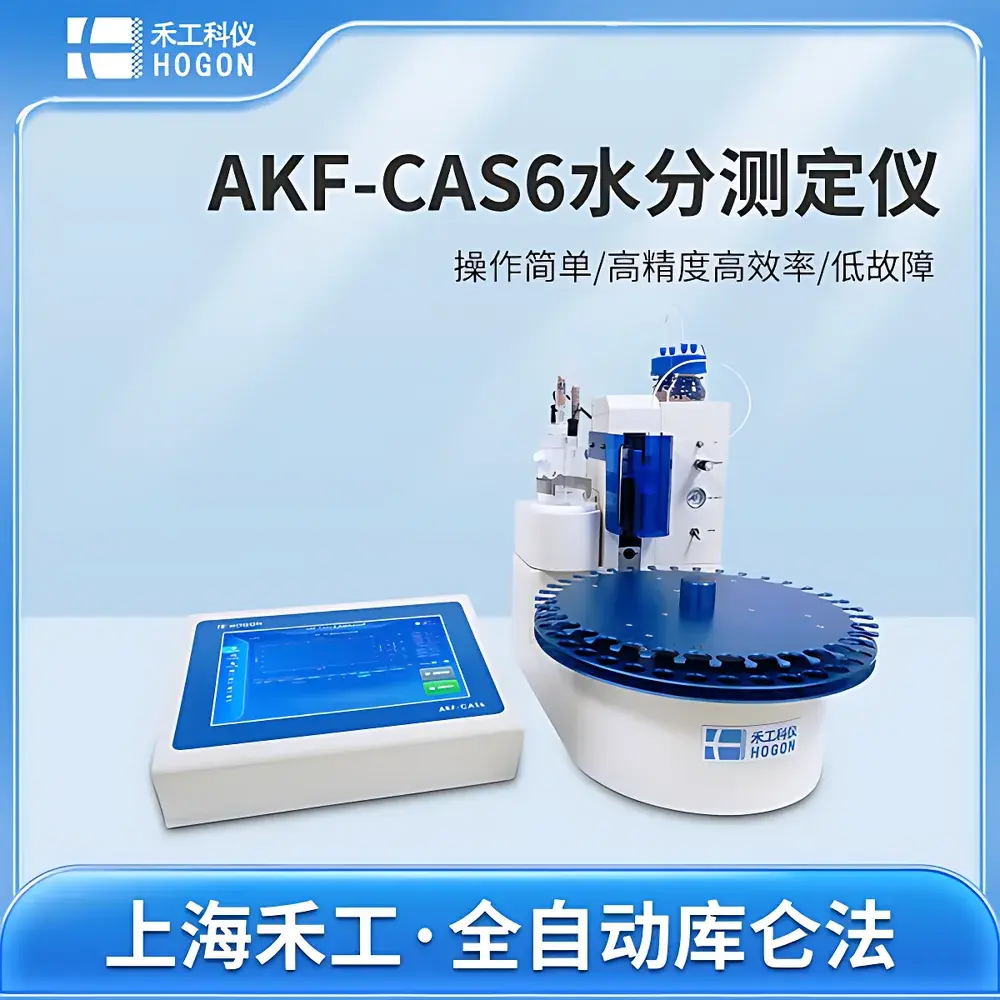
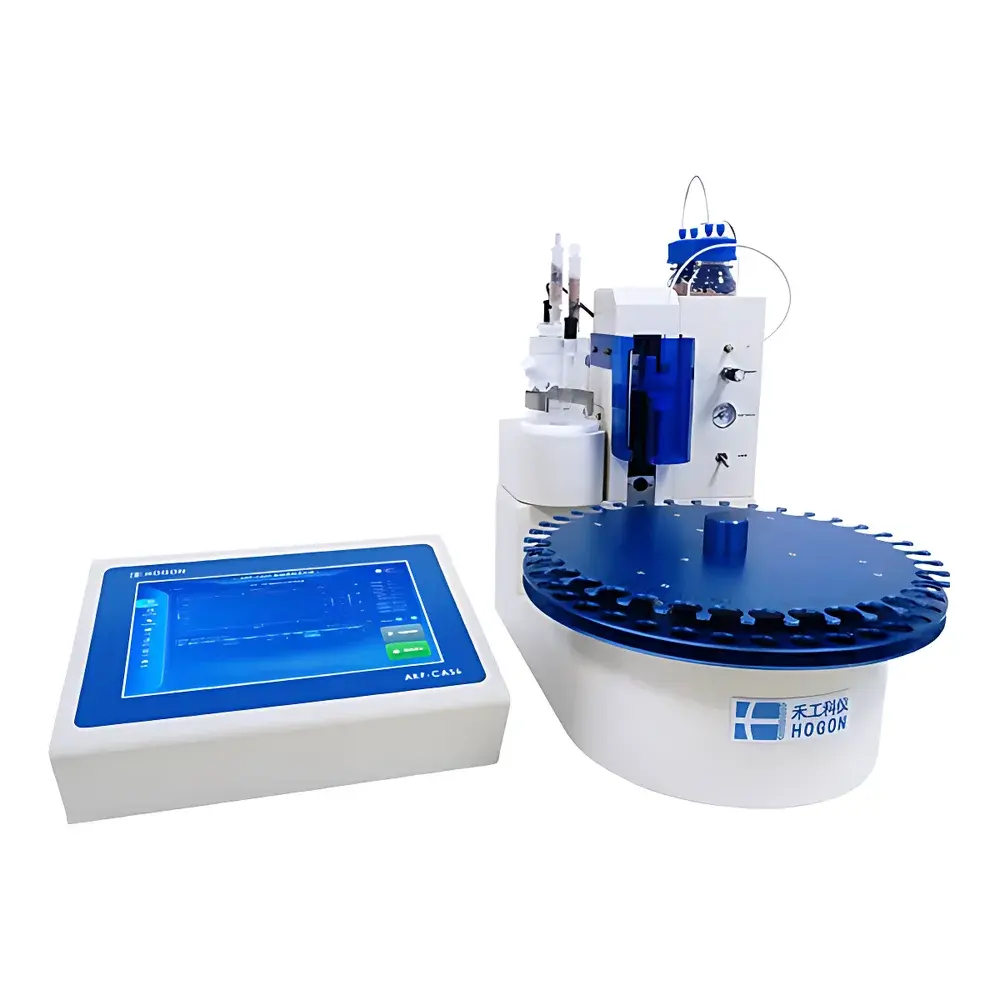
HOGON AKF-CAS6 Multi-Station Automated Karl Fischer Coulometric Moisture Analyzer for Plastic Pellets
| Brand | HOGON |
|---|---|
| Origin | Shanghai, China |
| Manufacturer Type | Direct Manufacturer |
| Instrument Type | Coulometric Karl Fischer Moisture Analyzer |
| Moisture Measurement Range | 3 µg – 199 mg (H₂O mass) |
| Resolution | 0.01 µg |
| Accuracy | >99.7% (at 1000 µg pure water) |
| Minimum Dispensing Volume | 1/2000 of burette volume |
| Repeatability | ±0.3% (for samples containing >1 mg H₂O) |
| Linearity Correlation Coefficient | 0.999 |
| Electrolysis Electrode | Membrane-separated dual-platinum coulometric electrode |
| Titration Current Control Precision | ±0.1 mA |
| Power Supply | 110–240 V AC, 50–62 Hz |
| Data Storage Capacity | Unlimited (internal flash memory with timestamped audit trail) |
Overview
The HOGON AKF-CAS6 is a fully automated, multi-station coulometric Karl Fischer moisture analyzer engineered specifically for high-throughput, trace-level water quantification in hygroscopic polymeric materials—particularly plastic pellets used in injection molding, extrusion, and fiber spinning. Unlike volumetric KF systems, the AKF-CAS6 employs controlled-current coulometric generation of iodine at the anode (per the stoichiometric reaction: I⁻ → ½I₂ + e⁻), enabling direct, absolute quantification of water without reliance on standardized titrant concentration or calibration drift. This principle delivers inherent accuracy for low-moisture matrices (<1000 ppm), where conventional methods suffer from reagent instability, endpoint ambiguity, and sample handling artifacts. The instrument integrates a sealed, inert-gas-purged titration cell with membrane-isolated electrolysis electrodes to prevent ambient moisture ingress and cross-contamination—critical for reproducible sub-10 µg measurements in polymer feedstocks.
Key Features
- Multi-position automated sample handling: Supports up to 32 independent sample positions with programmable sequence execution, enabling unattended overnight operation and batch processing aligned with production shift cycles.
- Coulometric precision architecture: Dual-platinum indicator electrodes with real-time polarization monitoring ensure robust endpoint detection; electrolysis current regulated to ±0.1 mA for stable iodine generation and minimal over-titration.
- Hermetically sealed titration cell: Equipped with gas-tight septum ports, integrated drying tube, and continuous N₂ purge (flow rate adjustable from 50–200 mL/min) to maintain <1 ppm ambient moisture interference.
- Intelligent parameter optimization: User-configurable endpoints—including dynamic potential threshold, stabilization time, and drift compensation—allow method adaptation for diverse polymer types (e.g., PET, PA6, PC, PBT) with varying solubility and hydrolysis kinetics.
- Integrated balance interface: Direct RS232/USB connection to analytical balances (0.01 mg readability) enables automatic sample mass import, eliminating manual entry errors and supporting GLP-compliant weight traceability.
Sample Compatibility & Compliance
The AKF-CAS6 is validated for direct analysis of solid polymer granules, flakes, and powders without solvent pre-dissolution—leveraging optimized anhydrous methanol-based KF reagents with proprietary stabilizers that enhance pellet wetting and accelerate water release from crystalline domains. It complies with ASTM D6304 (Standard Test Method for Determination of Water in Petroleum Products, Liquid Hydrocarbons, and Used Lubricating Oils by Coulometric Karl Fischer Titration), ISO 15512 (Plastics — Determination of water content), and USP (Water Determination). All measurement data include full electronic audit trails (user ID, timestamp, method version, raw current/potential curves, and calibration logs), satisfying FDA 21 CFR Part 11 requirements for electronic records and signatures when deployed in GMP-regulated environments.
Software & Data Management
Controlled via HOGON’s proprietary KF-Studio v4.2 software, the AKF-CAS6 provides role-based access control, method library management, and automated report generation in PDF/CSV formats compliant with ISO/IEC 17025 documentation standards. Raw coulometric charge integration (Q = ∫I·dt) is logged at 100 Hz resolution, allowing post-acquisition review of titration kinetics and drift correction. Data storage is unlimited on internal industrial-grade flash memory with automatic daily backup to network drives or USB media. All user actions—including method edits, result approvals, and system maintenance—are immutably recorded with digital signatures and time-stamped metadata, supporting full traceability during regulatory inspections.
Applications
- Quality assurance of hygroscopic engineering thermoplastics (e.g., polyamide 6/66, polycarbonate, PET) prior to melt processing—ensuring moisture levels remain below critical thresholds (typically <50 ppm for PA6) to prevent hydrolytic degradation and surface defects.
- Batch release testing in polymer compounding facilities, where rapid turnaround (<10 min/sample) supports just-in-time logistics and minimizes inventory holding time for moisture-sensitive masterbatches.
- R&D studies on drying protocol optimization—correlating dryer temperature/duration with residual moisture profiles across pellet size distributions and crystallinity grades.
- Stability monitoring of stored resin lots under variable warehouse humidity conditions, generating trending reports for predictive quality maintenance.
FAQ
What sample preparation is required for plastic pellets?
No grinding or dissolution is needed. Pellets are weighed directly into glass vials and introduced into the sealed cell via the auto-sampler; the KF reagent penetrates the surface layer and liberates bound water through controlled solvation.
Can the AKF-CAS6 measure moisture in filled or reinforced polymers (e.g., glass-fiber PA6)?
Yes—its coulometric sensitivity and adaptive endpoint logic accommodate heterogeneous matrices. Validation per ISO 15512 confirms linearity across filler loadings up to 40 wt% without matrix interference.
How does the system handle carryover between high- and low-moisture samples?
Each sample position includes dedicated vial handling and automatic cell purging (30 s N₂ flush) before titration initiation, verified by baseline drift <0.1 µg/s prior to assay.
Is method validation support available?
HOGON provides IQ/OQ documentation templates, certified reference material (CRM) verification protocols (e.g., sodium tartrate dihydrate), and on-site qualification assistance meeting GMP Annex 15 requirements.
What maintenance intervals are recommended for routine operation?
Electrode cleaning every 200 analyses; reagent replacement every 6 weeks (based on average usage); annual performance verification using certified water standards traceable to NIST SRM 2890.
Related Products




