
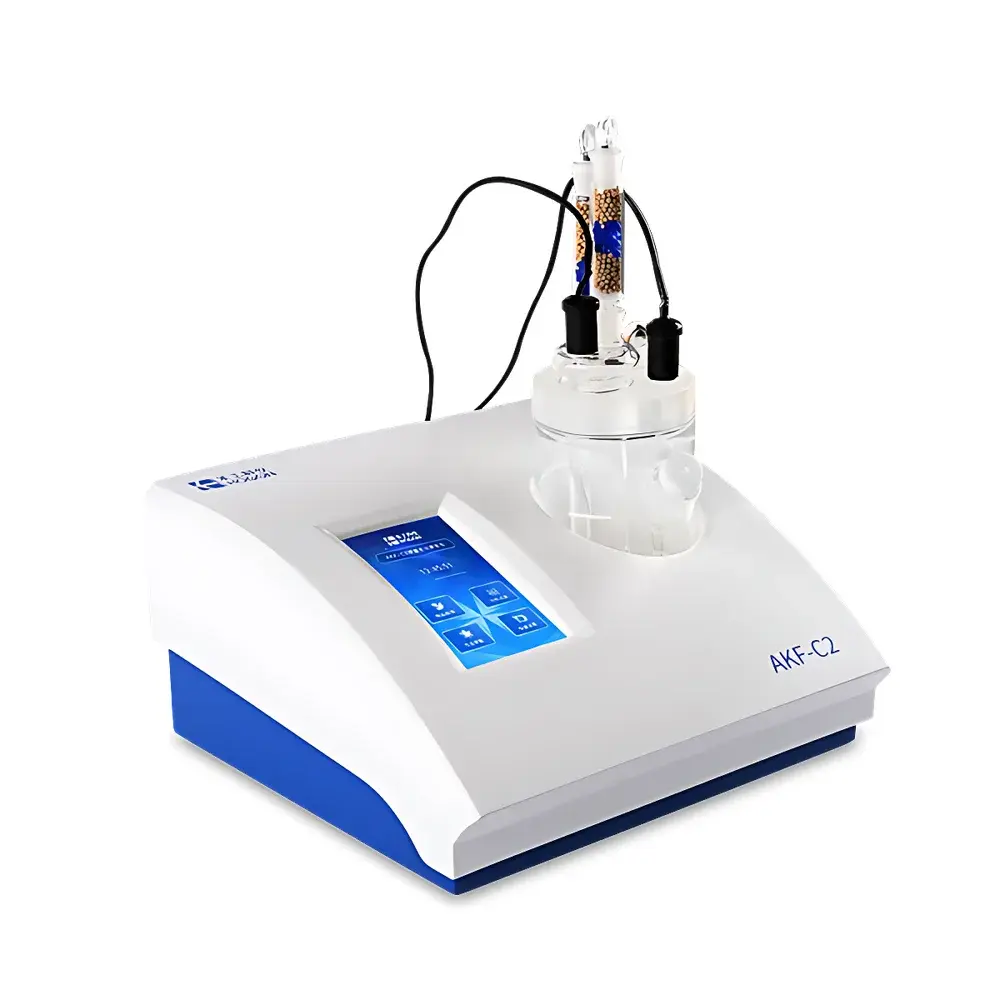
HOGON AKF-C2 Coulometric Karl Fischer Moisture Titrator
| Brand | HOGON |
|---|---|
| Origin | Shanghai, China |
| Manufacturer Type | Direct Manufacturer |
| Country of Origin | China |
| Model | AKF-C2 |
| Power Supply | External 12 V DC adapter (compatible with 12 V Li-ion battery or vehicle power) |
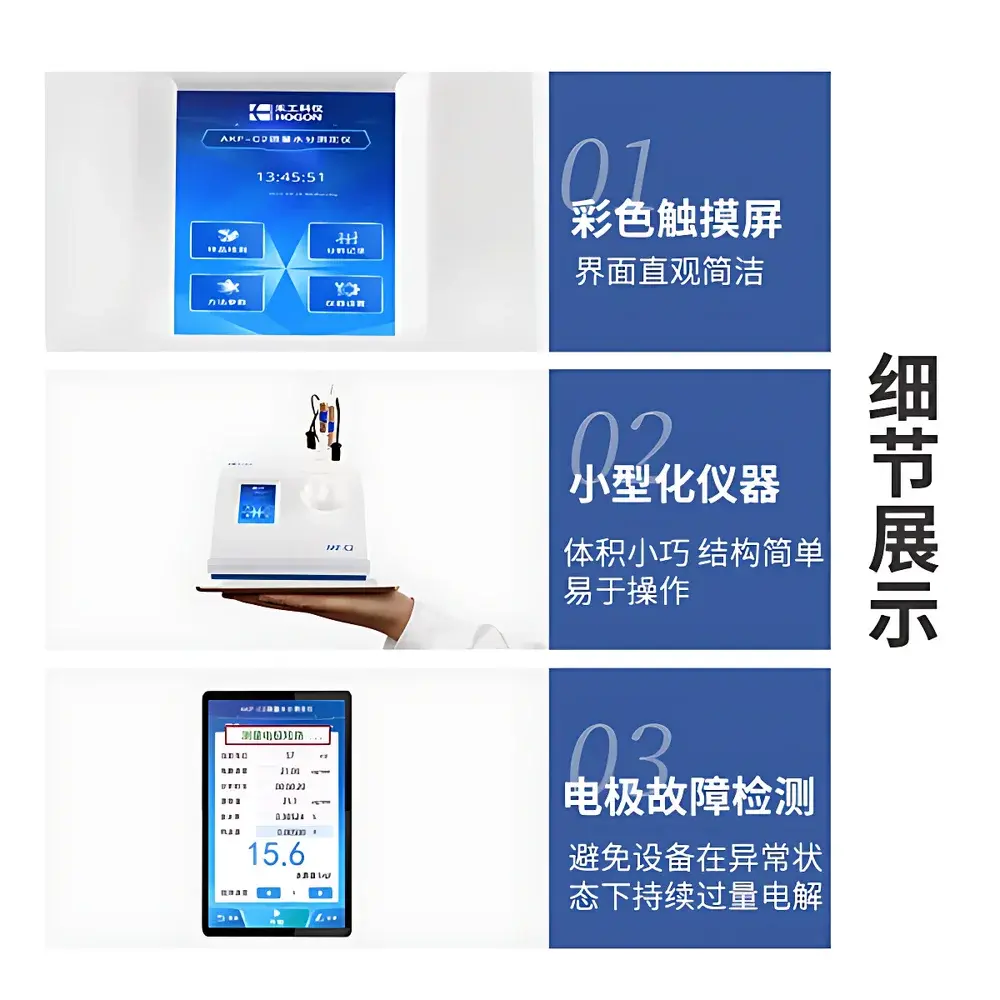
| Display | Full-color capacitive touchscreen |
| Input | Digital keypad with one-touch start |
| Titration Principle | Coulometric Karl Fischer method (electrolytic generation of iodine) |
| Speed Control | 6-step adjustable electrolysis current (5 manual + 1 auto mode) |
| Data Handling | Automatic calculation using 5 built-in formulas |
| Advanced Functions | Drift correction, blank subtraction, analysis delay, fixed-duration titration, electrode fault detection, electrolysis efficiency calibration (K-factor adjustment) |
| Compliance | GB/T 6324.8, GB/T 6023, GB/T 7376, GB/T 18619.1, ASTM E1064, ASTM D1492, SJ/T 11723-2018, SJ/T 11568-2016, SH/T 1551 |
Overview
The HOGON AKF-C2 Coulometric Karl Fischer Moisture Titrator is a precision-engineered benchtop analyzer designed for trace-level water quantification in non-aqueous and low-water-content matrices. It operates on the fundamental electrochemical principle of coulometric Karl Fischer titration: iodine is generated *in situ* via controlled electrolysis of iodide-containing reagent at the anode, with stoichiometric 1:1 reaction to water (H2O + I2 + SO2 + 3RN + CH3OH → 2RN·HI + RN·HSO4CH3). This method delivers high accuracy (detection limit ≤ 1 µg H2O), excellent reproducibility (< 2% RSD), and immunity to sample volume variability—ideal for volatile, viscous, or thermally labile substances where volumetric KF titration is impractical. The instrument is optimized for routine QC/QA workflows across regulated industrial laboratories requiring compliance with pharmacopeial and industrial standards.
Key Features
- Full-color capacitive touchscreen interface with intuitive icon-driven navigation and real-time titration curve visualization—including dynamic endpoint detection and slope-based termination logic.
- Dual-power architecture: supports operation via external 12 V DC adapter (included), enabling seamless integration into mobile labs, field vehicles, or off-grid environments; fully compatible with rechargeable 12 V lithium-ion battery packs for true portability.
- Six-step electrolysis current control: five discrete manual settings (1–5) and one adaptive auto-mode that continuously modulates current based on residual signal deviation from the preset endpoint potential—ensuring optimal speed/precision balance across diverse reagent systems (e.g., pyridine-free vs. traditional solvents).
- Comprehensive drift management suite: configurable drift correction algorithms, programmable blank subtraction, user-defined analysis delay, and fixed-duration titration modes to mitigate interference from slow-reacting or hygroscopic samples.
- Electrode health monitoring system: real-time diagnostics detect open-circuit, short-circuit, or abnormal polarization states—preventing uncontrolled over-electrolysis and extending electrode service life.
- Integrated K-factor calibration module: enables precise adjustment of electrolysis efficiency using certified water standards (e.g., 1.00 mg/g or 10.00 mg/g), ensuring long-term measurement traceability per ISO/IEC 17025 requirements.
Sample Compatibility & Compliance
The AKF-C2 accommodates a broad spectrum of challenging matrices without modification: hydrocarbons (gasoline, jet fuel, lubricants), halogenated solvents (R-134a, HCFCs), polymer precursors (ethylene oxide, propylene oxide), pharmaceutical excipients (lactose, microcrystalline cellulose), battery electrolytes (LiPF6 in EC/DMC), and high-purity gases (SF6, natural gas). Its design adheres to critical regulatory frameworks including ASTM E1064 (organic liquids), GB/T 18619.1 (natural gas), SJ/T 11723-2018 (Li-ion battery electrolytes), and USP moisture determination principles. All data handling conforms to ALCOA+ principles—audit trails, electronic signatures, and immutable record storage support FDA 21 CFR Part 11 readiness when deployed with validated LIMS integration.
Software & Data Management
Embedded firmware provides full local data governance: every titration generates a timestamped record containing raw current/time data, calculated water mass (µg), concentration (ppm or %), K-factor value, drift rate (µg/min), and operator ID. Records are stored in encrypted internal memory (≥10,000 results) and exportable via USB to CSV or PDF formats. Five preloaded calculation formulas cover standard mass-based, volume-based, and density-corrected protocols—custom formula entry is disabled to maintain method integrity. No cloud dependency: all processing occurs on-device, eliminating cybersecurity exposure and ensuring uninterrupted operation in air-gapped facilities.
Applications
- Petrochemical QA: Quantifying trace water in crude fractions, distillates, and specialty solvents per ASTM D6304 and GB/T 6324.8.
- Pharmaceutical manufacturing: Release testing of active pharmaceutical ingredients (APIs) and excipients per ICH Q5C stability guidelines.
- Electric vehicle supply chain: Moisture verification in Li-ion battery electrolytes and separator films per SJ/T 11568-2016.
- Power industry: Monitoring moisture in transformer insulating oils (IEC 60814) and SF6 gas compartments.
- Food safety labs: Determination of residual moisture in dehydrated spices, dairy powders, and functional food additives.
FAQ
What is the detection limit and typical measurement range?
The instrument achieves a theoretical detection limit of 1 µg H2O with a practical working range of 10 µg to 100 mg water per sample, depending on cell geometry and reagent selection.
Does the AKF-C2 support GLP-compliant audit trails?
Yes—each analysis logs operator ID, timestamp, method parameters, raw sensor data, and final result in an immutable binary record. Exported files retain embedded metadata for full traceability.
Can it be used with non-aqueous solvents like chloroform or THF?
Absolutely. The coulometric cell is chemically inert to common KF solvents; compatibility is governed by reagent formulation, not instrument hardware.
Is external computer software required for operation?
No. All functions—including method setup, titration execution, data review, and report generation—are fully self-contained within the onboard operating system.
How often must the K-factor be recalibrated?
Calibration frequency follows risk-based assessment per ISO/IEC 17025: typically before each analytical batch, after reagent change, or at defined intervals (e.g., daily or per 20 analyses) verified by control chart trending.



