

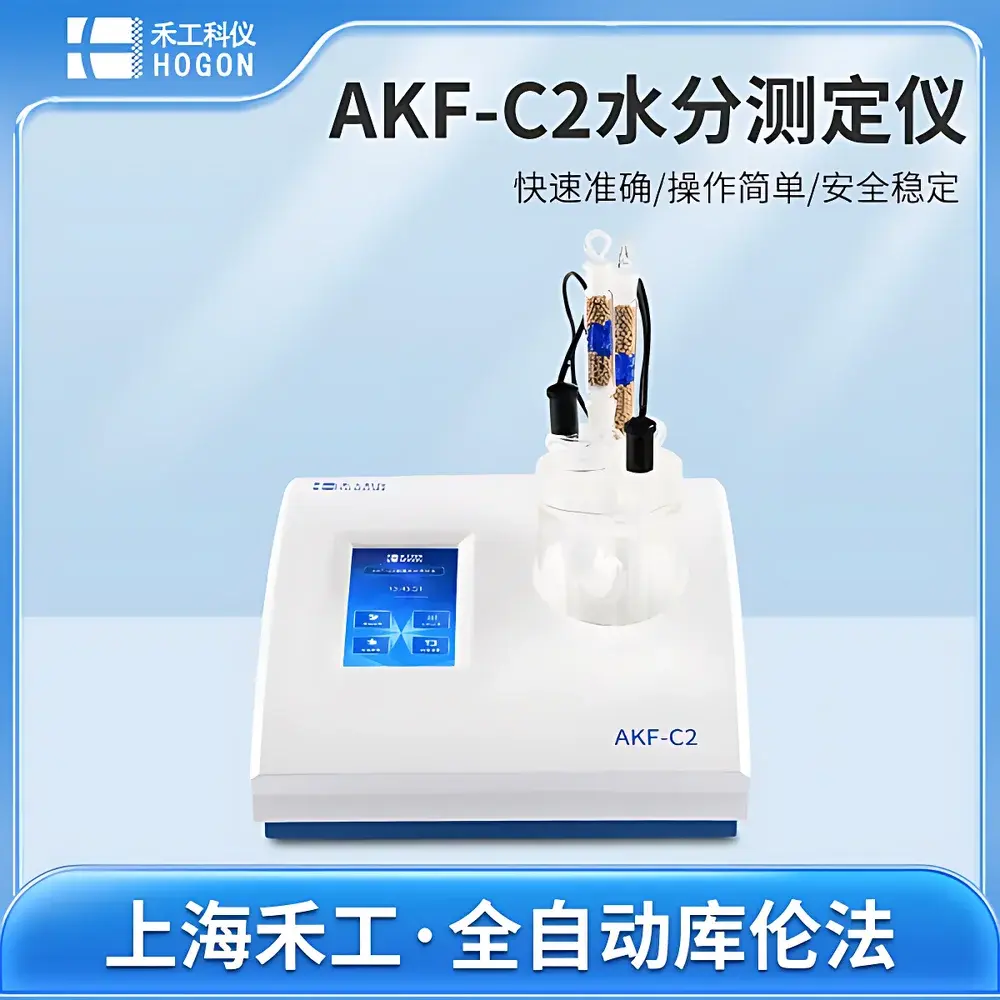
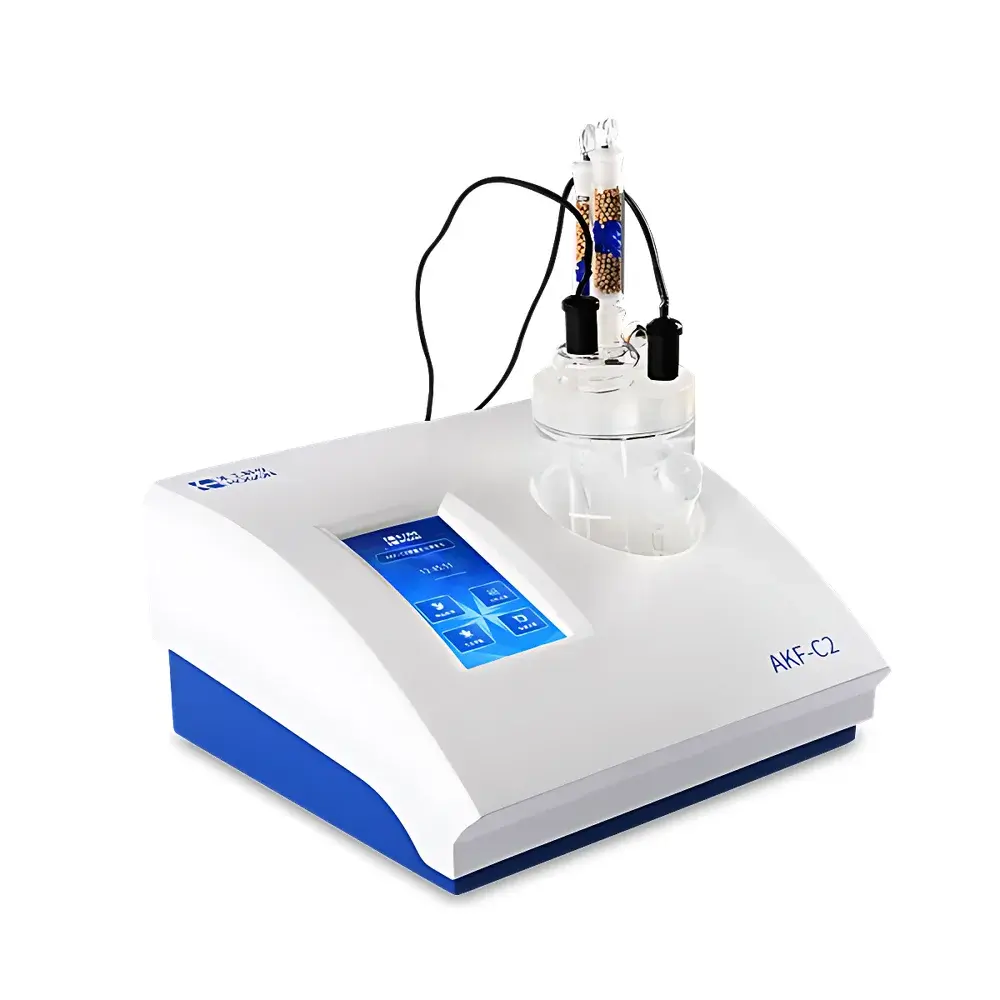
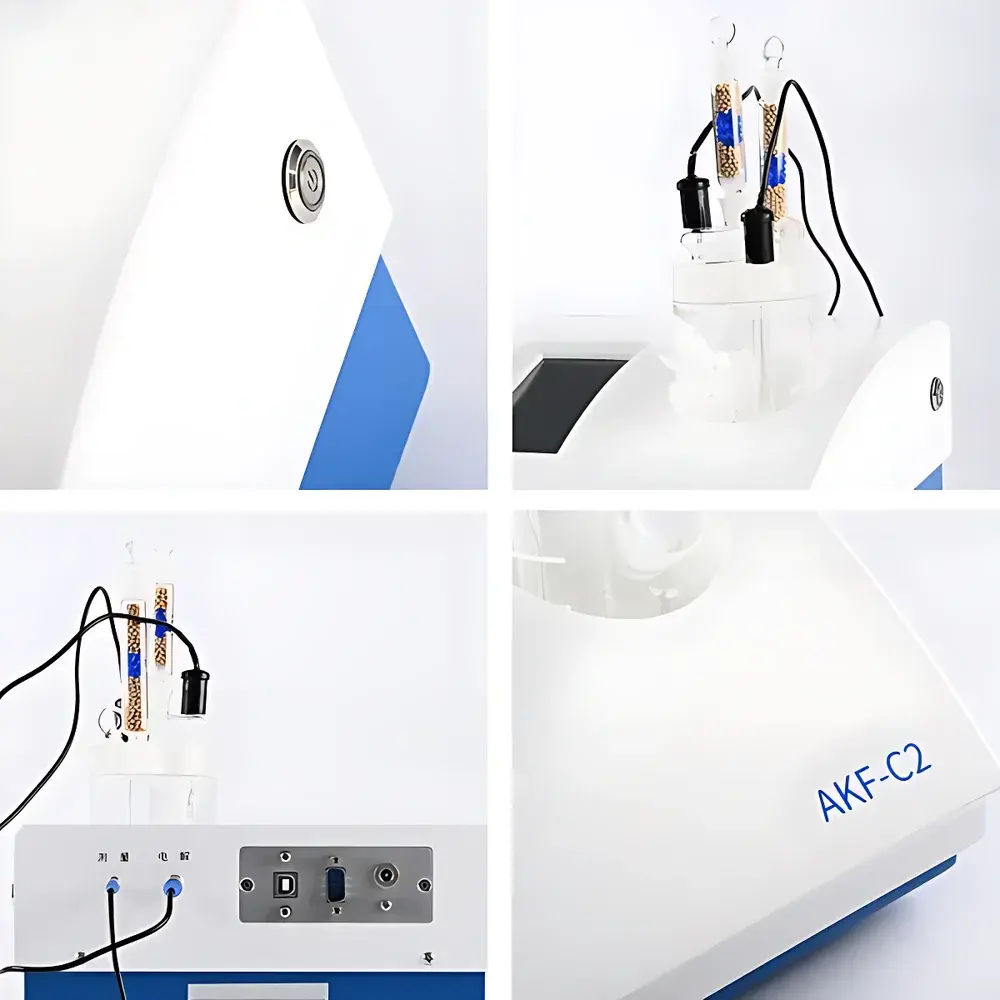
HOGON AKF-C2 Coulometric Karl Fischer Moisture Titrator
| Brand | HOGON |
|---|---|
| Origin | Shanghai, China |
| Manufacturer Type | Direct Manufacturer |
| Instrument Type | Coulometric Karl Fischer Moisture Analyzer |
| Model | AKF-C2 |
| Titration Method | Fully Automatic Coulometric Titration |
| Water Content Range | 3 µg – 199 mg (as H₂O mass) |
| Resolution | 0.1 µg |
| Measurement Precision | ±1 mV |
| Repeatability | ≥99% RSD |
| Linearity Correlation Coefficient | ≥0.995 |
| Polarization Voltage Adjustment Range | ±10 mV |
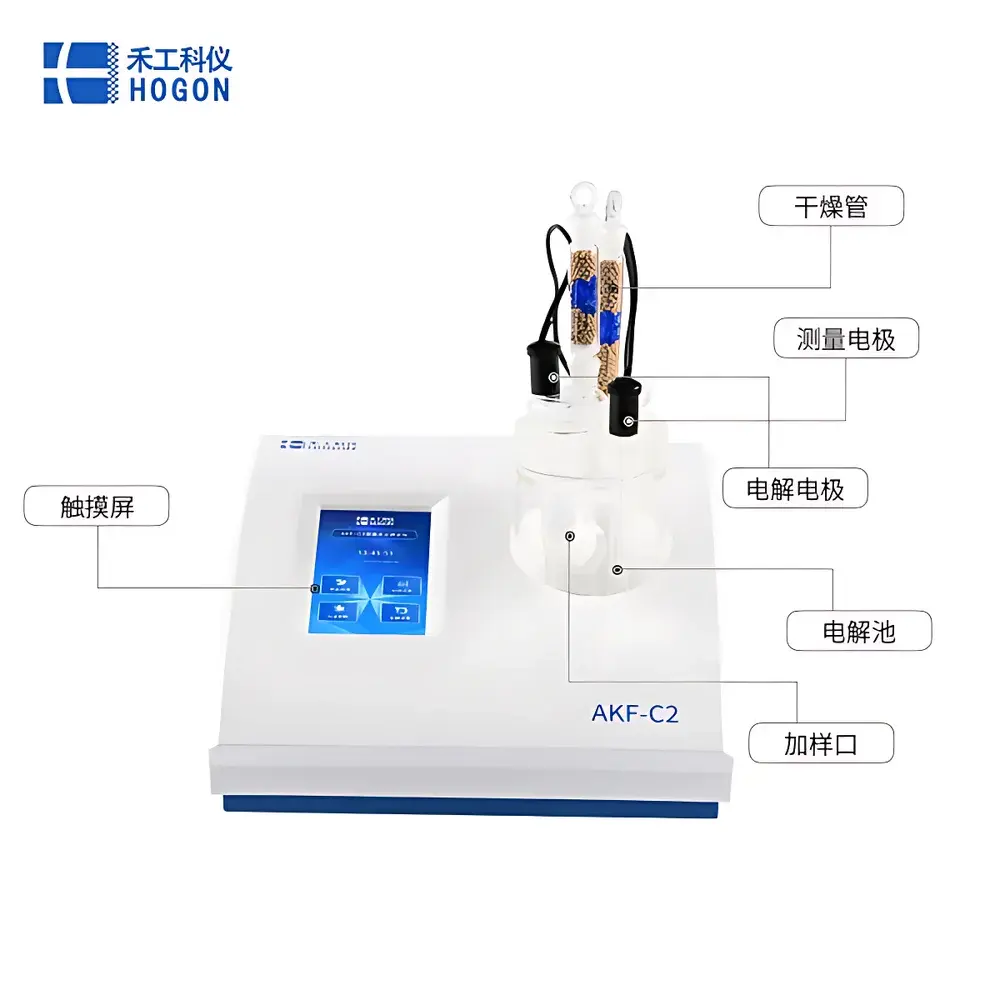
| Electrode Configuration | Dual-electrode Coulometric Cell (Generator & Indicator) |
| Current Control Accuracy | ±1 mA |
| Power Supply | 110–240 V AC, 50–60 Hz |
| Data Storage Capacity | 10 test records |
| External Power Option | 12 V DC input compatible with vehicle power systems and rechargeable Li-ion batteries |
Overview
The HOGON AKF-C2 Coulometric Karl Fischer Moisture Titrator is a compact, field-deployable analytical instrument engineered for trace-level water quantification in non-aqueous matrices using the coulometric Karl Fischer (KF) principle. Unlike volumetric KF titrators that rely on standardized reagent delivery, the AKF-C2 generates iodine electrochemically at the anode via controlled current application—enabling direct stoichiometric correlation between charge passed (Coulombs) and water consumed (1 mole H₂O ≡ 2 × 96,485 C). This fundamental electrochemical equivalence ensures high intrinsic accuracy and eliminates reagent standardization drift. Designed for laboratories requiring portability without compromising metrological integrity, the AKF-C2 integrates a precision coulometric cell, real-time potentiometric endpoint detection, and adaptive current regulation—making it suitable for routine QC, field-based process monitoring, and research environments where sample transport is impractical or contamination-sensitive.
Key Features
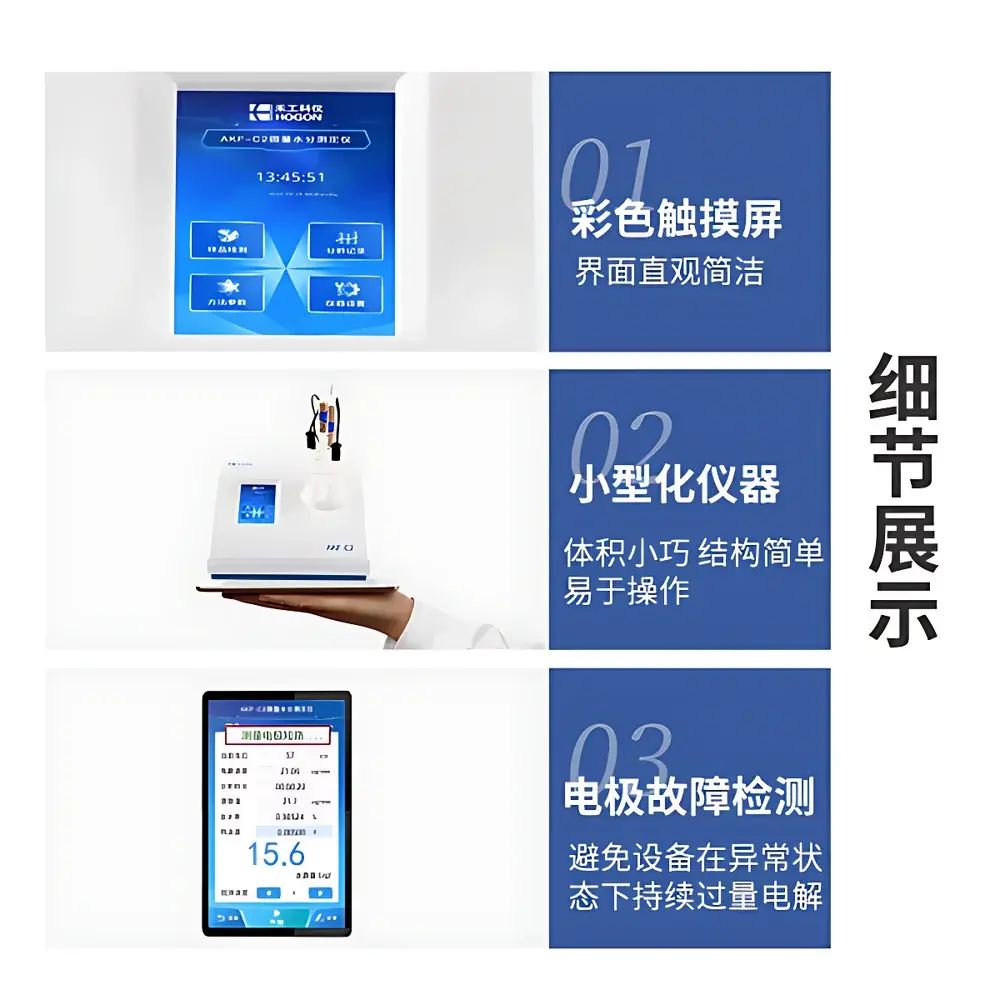
- Full-color capacitive touchscreen interface with intuitive icon-driven navigation and one-touch assay initiation
- Compact benchtop footprint (270 × 220 × 180 mm) with external 12 V DC power adapter—enabling operation from automotive electrical systems or portable lithium-ion battery packs
- Six-step electrolysis speed control: five manual levels (1–5) and one auto-adaptive mode; higher levels increase generator current proportionally to accelerate titration kinetics for low-water-content samples or high-viscosity matrices
- Five built-in calculation formulas supporting mass-, volume-, and percentage-based reporting formats; all results automatically computed and timestamped
- Advanced baseline correction suite including drift compensation, blank subtraction, analysis delay, and fixed-duration titration modes—critical for volatile, hygroscopic, or slow-reacting samples
- Electrode health diagnostics with real-time impedance monitoring and automatic over-titration prevention logic to safeguard cell longevity and data validity
- Calibration factor adjustment for coulometric efficiency verification—supporting traceable recalibration against certified water standards (e.g., 1.00 mg/g sodium tartrate dihydrate)
Sample Compatibility & Compliance
The AKF-C2 accommodates diverse sample types across petroleum distillates, organic solvents, polymer precursors, pharmaceutical excipients, battery electrolytes, and food-grade oils. Its coulometric architecture avoids solvent saturation issues common in volumetric systems, permitting direct injection of viscous or low-dielectric media (e.g., silicone oils, molten polymers) when paired with appropriate KF reagents (e.g., two-component methanol-free electrolytes). The instrument complies with major international standards governing coulometric moisture determination, including ASTM E1064 (Standard Test Method for Water in Organic Liquids by Coulometric Karl Fischer Titration), GB/T 6324.8 (Organic Chemical Products—Determination of Water Content—Coulometric Karl Fischer Method), GB/T 18619.1 (Water in Natural Gas), and SJ/T 11723–2018 (Water in Lithium-Ion Battery Electrolytes). All measurement protocols are fully documented and support GLP-compliant audit trails when used in regulated environments.
Software & Data Management
Data handling is managed through embedded firmware—not PC-dependent software—ensuring deterministic response and minimal configuration overhead. Each assay stores raw potential vs. time traces, integrated charge values, calculated water mass (µg), relative standard deviation (RSD), and user-defined metadata (sample ID, operator, date/time). Ten assay records are retained onboard with overwrite protection for critical validation runs. Export is facilitated via USB flash drive (FAT32 formatted) in CSV format for downstream statistical analysis in Excel or LIMS integration. While the AKF-C2 does not implement FDA 21 CFR Part 11 electronic signature functionality natively, its immutable timestamped logs, calibration factor logging, and electrode fault event tagging provide foundational elements for GMP-aligned documentation workflows.
Applications
- Petroleum refining: Quantification of trace water in jet fuels (ASTM D6304), transformer oils (IEC 60814), and liquefied petroleum gas (LPG)
- Pharmaceutical manufacturing: Residual moisture in lyophilized APIs, excipients, and sterile packaging headspace validation
- Electrochemical materials: Water content control in lithium hexafluorophosphate (LiPF₆) solutions per SJ/T 11568–2016
- Chemical synthesis: Monitoring dehydration endpoints in esterification, amidation, and condensation reactions
- Food safety: Detection of adulteration in edible oils and verification of desiccant efficacy in dry product packaging
- Environmental testing: Water interference assessment in soil extractants and VOC sampling media
FAQ
What distinguishes coulometric from volumetric Karl Fischer titration?
Coulometric KF generates iodine electrochemically within the titration cell, enabling sub-microgram water detection with no reagent standardization required. Volumetric KF delivers pre-standardized iodine solution via burette, limiting sensitivity and introducing reagent stability variables.
Can the AKF-C2 analyze solid or paste-like samples?
Yes—when dissolved or suspended in compatible KF solvents (e.g., chloroform/methanol mixtures) and introduced via syringe injection. Sample homogeneity and dissolution kinetics must be validated per method development guidelines.
Is method validation support available for regulated industries?
HOGON provides application notes aligned with ICH Q2(R2) principles, including specificity, linearity, accuracy, precision, and robustness test templates for internal validation. Full IQ/OQ documentation packages are available upon request.
How is electrode maintenance performed?
The dual-electrode coulometric cell requires periodic cleaning with anhydrous methanol and visual inspection for platinum black deposition. Generator electrode regeneration is achievable via reverse-current cycling; indicator electrode replacement intervals depend on cumulative charge throughput (typically >500 kC).
Does the instrument support multi-language UI?
The firmware supports English and Simplified Chinese display languages, selected during initial setup. No runtime switching is implemented to maintain firmware determinism and regulatory compliance.





