IEC 62493 Human Exposure Assessment System for Lighting Equipment
| Brand | PMM |
|---|---|
| Model | VDH-01 |
| Compliance | IEC 62493 |
| Frequency Range | 20 kHz – 10 MHz |
| Output Impedance | 50 Ω |
| Interface | BNC |
| Weight | 1.7 kg |
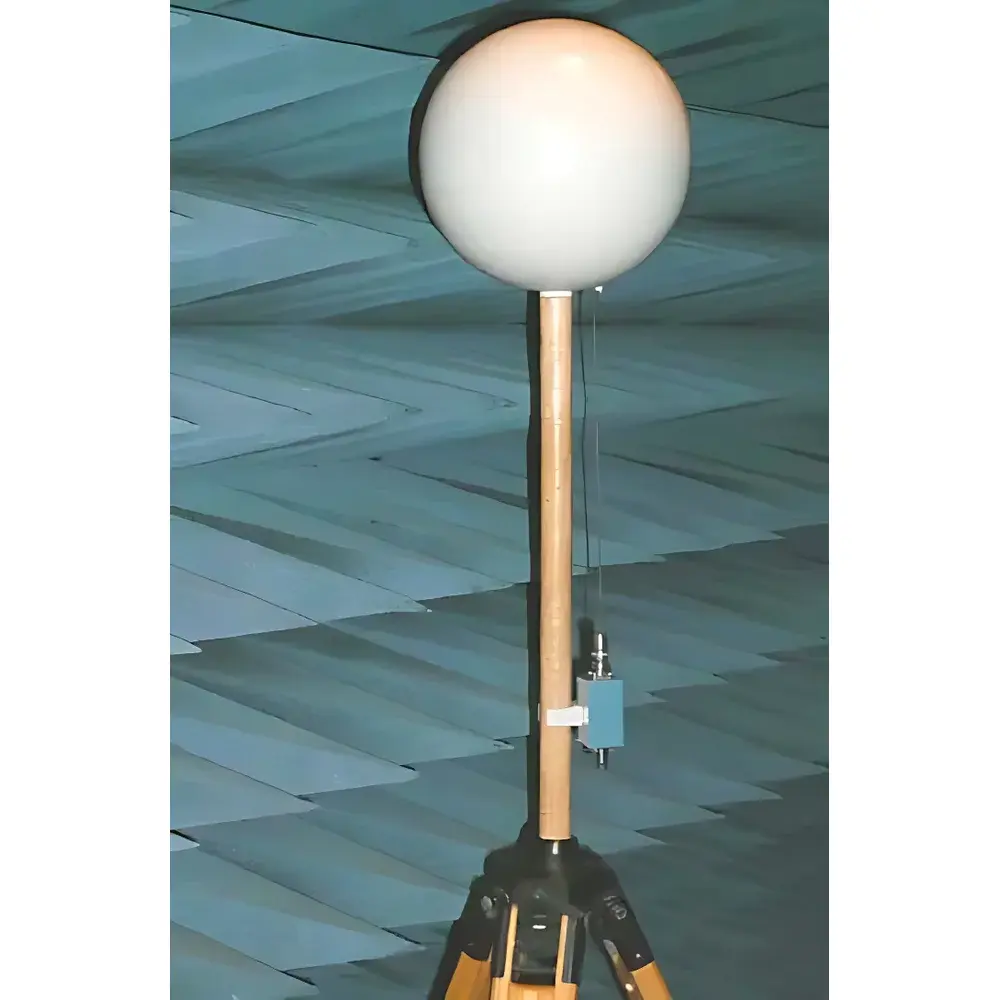
| Components | Measurement Probe, Protection Network, Coaxial Cables, Wooden Tripod |
| Optional Accessories | RF Switching Unit, PMM 9010 EMI Receiver |
Overview
The PMM VDH-01 IEC 62493 Human Exposure Assessment System is a dedicated, standards-compliant measurement platform engineered to quantify electromagnetic field (EMF) emissions from lighting equipment in accordance with the internationally recognized safety standard IEC 62493:2015+A1:2021. This system implements the standardized method for evaluating compliance of luminaires and lighting control gear with human exposure limits to electric and magnetic fields in the frequency range of 20 kHz to 10 MHz — a critical band where quasi-static and low-frequency near-field coupling dominates exposure assessment. Unlike broadband survey meters or general-purpose EMI receivers, the VDH-01 integrates a calibrated isotropic probe, passive protection network, and impedance-matched signal conditioning path specifically designed to replicate the defined test setup per Clause 6 of IEC 62493. Its architecture ensures traceable, repeatable measurements under controlled laboratory or pre-compliance testing conditions, supporting both manufacturer self-assessment and third-party verification workflows.
Key Features
- Full compliance with IEC 62493:2015+A1:2021 for lighting equipment — including LED drivers, electronic ballasts, dimmers, and smart luminaires.
- Calibrated, three-axis isotropic electric field probe optimized for the 20 kHz–10 MHz range, enabling spatially averaged field strength evaluation as required by the standard.
- Integrated passive protection network (PN) that replicates the standardized 50 Ω load impedance and provides overvoltage/overcurrent safeguarding per Annex B of IEC 62493.
- BNC interface with 50 Ω characteristic impedance ensures minimal signal reflection and preserves measurement integrity during connection to compatible spectrum analyzers or EMI receivers.
- Lightweight, portable design (1.7 kg total system mass) with wooden tripod mount minimizes perturbation of the measured EMF field — consistent with the non-metallic fixture requirements specified in Clause 7.2.
- Modular architecture allows seamless integration with PMM’s 9010 EMI receiver or other CISPR-compliant measurement receivers equipped with quasi-peak and RMS detectors.
Sample Compatibility & Compliance
The VDH-01 is validated for use with all categories of lighting equipment covered by IEC 62493, including but not limited to: mains-powered and Class III luminaires, integrated LED modules, external and internal control gear, DALI-enabled devices, and wireless-controlled lighting systems. It supports standardized test configurations — such as the 20 cm and 30 cm separation distances defined for portable and stationary equipment — and accommodates both horizontal and vertical orientation testing per Clause 7. The system enables full implementation of the “reference measurement method” described in Section 6, including probe positioning, grounding protocols, and ambient background subtraction procedures. All components are supplied with calibration certificates traceable to national metrology institutes (NMI), satisfying ISO/IEC 17025 requirements for accredited laboratories conducting conformity assessments under EU Directive 2014/30/EU (EMC Directive) and relevant national regulatory frameworks.
Software & Data Management
While the VDH-01 itself is a hardware-based measurement interface, its operation is fully supported within PMM’s WinIQ software environment when paired with the PMM 9010 EMI receiver. WinIQ provides automated test sequencing aligned with IEC 62493 scan parameters (e.g., step size, dwell time, detector mode), real-time field strength visualization, and pass/fail margin reporting against the standard’s exposure limit values (ELVs). Data export is available in CSV and XML formats for audit trail documentation, and the software supports user-defined report templates compliant with GLP (Good Laboratory Practice) documentation requirements. When used in regulated environments, the full measurement chain — including probe calibration records, instrument firmware versions, and operator logs — can be maintained in accordance with FDA 21 CFR Part 11 principles via optional electronic signature and audit trail modules.
Applications
- Pre-compliance EMF evaluation during luminaire R&D and design validation phases.
- Verification testing prior to CE marking or UKCA certification under the EMC Directive.
- Technical file preparation for Notified Body submissions (e.g., TÜV, SGS, UL).
- Internal quality assurance audits for lighting manufacturers operating under ISO 9001 or IATF 16949.
- Academic and metrological research on low-frequency EMF coupling mechanisms in modern solid-state lighting systems.
- Support for technical documentation required under the EU Eco-design Regulation (EU) 2019/2020 for lighting products.
FAQ
Does the VDH-01 include built-in detection circuitry or require an external receiver?
The VDH-01 is a passive measurement interface and does not incorporate active detection or signal processing. It must be connected to a compliant EMI receiver (e.g., PMM 9010) or spectrum analyzer with appropriate detector functions (quasi-peak, RMS) and calibrated amplitude response.
Is calibration of the probe included with purchase?
Each VDH-01 system is delivered with a factory calibration certificate for the probe and protection network, traceable to PTB or NIST. Recommended recalibration interval is 12 months or after any mechanical impact or environmental exposure exceeding specification limits.
Can the system be used for measurements outside the scope of IEC 62493?
While optimized for IEC 62493, the probe and protection network may support supplementary assessments per IEC 62311 or ICNIRP guidelines at the user’s responsibility — however, no formal validation or uncertainty budget is provided for such applications.
What is the role of the wooden tripod in the measurement setup?
The non-conductive wooden tripod prevents field distortion and satisfies IEC 62493 Clause 7.2, which mandates that support structures shall not influence measurement results through metallic coupling or resonance effects.
Are there international equivalents to IEC 62493 accepted in North America or Asia?
In the U.S., FCC Part 18 and IEEE C95.1 inform exposure assessments, though no direct harmonized standard exists for lighting-specific EMF. Japan’s JIS C 61000-3-2 and China’s GB/T 17626.3-2016 address emission limits but do not replicate the exposure methodology of IEC 62493. Regulatory acceptance depends on jurisdictional interpretation and technical justification.