
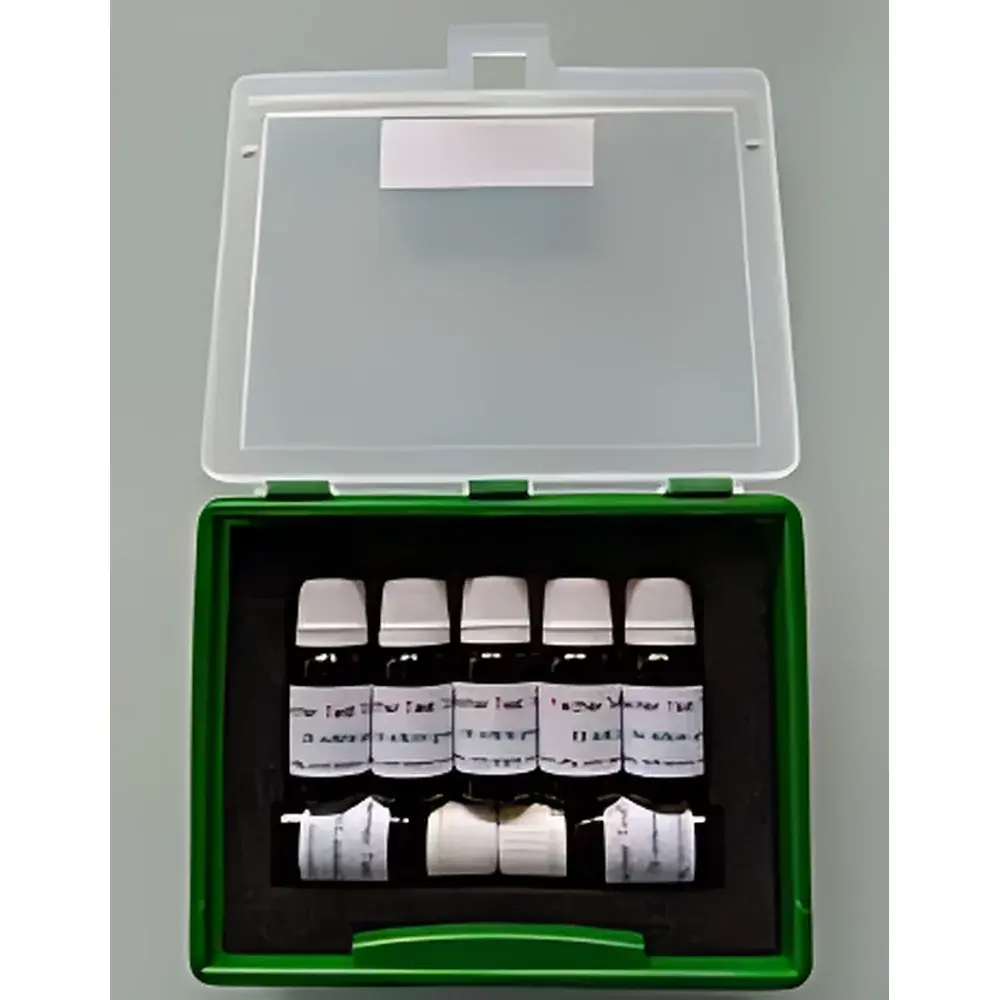
Fischer Test Tinten Surface Energy Test Liquids (28–105 mN/m)
| Brand | Diener |
|---|---|
| Origin | Germany |
| Model | 26422 |
| Package | 10 mL per bottle |
| Set Includes | 28, 38, 48, 56, 64, 72, and 105 mN/m test liquids |
| Compliance | Non-toxic, non-irritating, odorless formulation |
| Application | Contact angle-based surface energy evaluation of polymers, films, coatings, and substrates |
Overview
Fischer Test Tinten Surface Energy Test Liquids are a certified set of calibrated dyne solutions engineered for rapid, qualitative assessment of solid surface wettability and effective surface energy—expressed in millinewtons per meter (mN/m). Developed by Fischer, a German specialist headquartered in Steinen-Mühlheim (Baden-Württemberg), these test liquids operate on the fundamental principle of contact angle collapse: when applied to a substrate via droplet or swab method, immediate wetting (spreading without beading) indicates that the surface energy of the solid equals or exceeds the surface tension of the test liquid. This empirical, ASTM D2578-compliant approach provides lab technicians and production QA personnel with an accessible, field-deployable proxy for quantifying surface activation levels prior to printing, coating, laminating, or adhesive bonding.
Key Features
- Non-toxic, non-irritating, and odorless formulation—eliminates occupational exposure risks associated with traditional chlorinated or alcohol-based dyne solutions
- Individually calibrated and traceably verified surface tension values: 28, 38, 48, 56, 64, 72, and 105 mN/m—covering the full functional range for polyolefins, PET, PP, PE, PTFE, metallized films, and plasma- or corona-treated surfaces
- Stable shelf life under ambient storage conditions; no refrigeration required; minimal evaporation rate ensures consistent performance across repeated use cycles
- Supplied in precision-labeled 10 mL amber glass bottles with controlled-dose dropper caps to minimize contamination and ensure reproducible application volume
- Manufactured in Germany under ISO 9001-certified quality management systems; each batch includes certificate of conformance referencing DIN 53364 and ISO 8296 test methodologies
Sample Compatibility & Compliance
The Fischer Test Tinten series is validated for use on low-energy polymer substrates—including untreated and surface-modified polyethylene (PE), polypropylene (PP), polyethylene terephthalate (PET), polyvinyl chloride (PVC), and fluoropolymer films—as well as metalized foils, vacuum-deposited layers, and UV-cured coatings. It complies with OSHA HCS 2012 and EU CLP Regulation (EC No. 1272/2008) requirements for hazard classification, carrying no GHS pictograms or signal words. The absence of halogenated solvents ensures compatibility with cleanroom environments and eliminates interference with downstream GC-MS or FTIR analysis of surface residues. While not a substitute for quantitative contact angle goniometry, this kit meets the acceptance criteria defined in ASTM D2578 (Standard Test Method for Surface Tension of Polyethylene and Polypropylene Films by Dyne Solutions) and supports GLP-aligned documentation protocols when paired with standardized observation forms and operator training records.
Software & Data Management
As a physical reference standard—not an instrument—the Fischer Test Tinten set does not integrate with digital software platforms. However, its use is fully compatible with structured data capture workflows: users may log pass/fail results per test liquid alongside substrate lot number, treatment date, operator ID, and environmental conditions (temperature/humidity) in LIMS or paper-based QA checklists. For laboratories operating under FDA 21 CFR Part 11 or ISO/IEC 17025 requirements, the kit supports audit-ready traceability when stored with retained batch certificates and used within its stated expiration window (typically 24 months from manufacture date, printed on each bottle label). Diener, as the authorized European distributor, provides technical documentation in English and German, including safety data sheets (SDS) compliant with REACH Annex II.
Applications
- Pre-print verification of corona or plasma treatment efficacy on flexible packaging webs
- Routine QC screening of extruded film batches prior to slitting or converting
- Validation of cleaning efficiency after solvent wipe or alkaline wash of injection-molded components
- Troubleshooting adhesion failures in automotive interior trim lamination processes
- Baseline characterization of aged or weathered polymer surfaces in R&D stability studies
- Training tool for new technicians learning surface energy fundamentals and wetting behavior interpretation
FAQ
How often should I replace my Fischer Test Tinten set?
Replace the entire set after 24 months from the date of manufacture (printed on each bottle) or immediately upon visible discoloration, phase separation, or inconsistent wetting behavior—even if within shelf life.
Can I reuse a droplet for multiple substrates?
No. Each droplet must be applied fresh per test location to prevent cross-contamination and solvent carryover effects that compromise result reliability.
Is calibration verification required before use?
While no user calibration is needed, laboratories under ISO/IEC 17025 accreditation must retain the manufacturer’s certificate of conformance and perform periodic inter-batch consistency checks using a reference substrate of known surface energy.
Do these test liquids interfere with subsequent analytical testing?
No. Their non-halogenated, volatile-organic-compound (VOC)-reduced composition leaves no persistent residue detectable by XPS or TOF-SIMS, making them suitable for pre-characterization in high-value material studies.
What environmental conditions affect test accuracy?
Perform tests at 23 ± 2 °C and 50 ± 5% RH. Deviations beyond ±5 °C or ±15% RH require documented justification and may necessitate correlation with contact angle measurements for critical applications.



