

Stresstech xstress3000 Portable X-Ray Residual Stress Analyzer
| Brand | Stresstech Oy |
|---|---|
| Country of Origin | Finland |
| Model | xstress3000 |
| Compliance | ASTM E915, ISO 21432, EN 15305 |
| Measurement Principle | Sin²ψ X-ray Diffraction (XRD) |
| Detector | High-resolution CCD or CMOS-based X-ray detector |
| X-ray Source | Cr or Co anode microfocus tube (switchable) |
| Beam Spot Size | ≤1 mm diameter |
| Angular Range (2θ) | 120°–160° |
| ψ-angle range | 0°–45° (motorized tilt stage) |
| Data Acquisition Time per Point | <60 s |
| Weight | <12 kg (system with battery option) |
| Power Supply | 100–240 V AC or internal Li-ion battery (optional) |
| Interface | USB 3.0 / Ethernet / Bluetooth 5.0 |
| Software Platform | xstress Suite v5.x (Windows 10/11, 64-bit) |
Overview
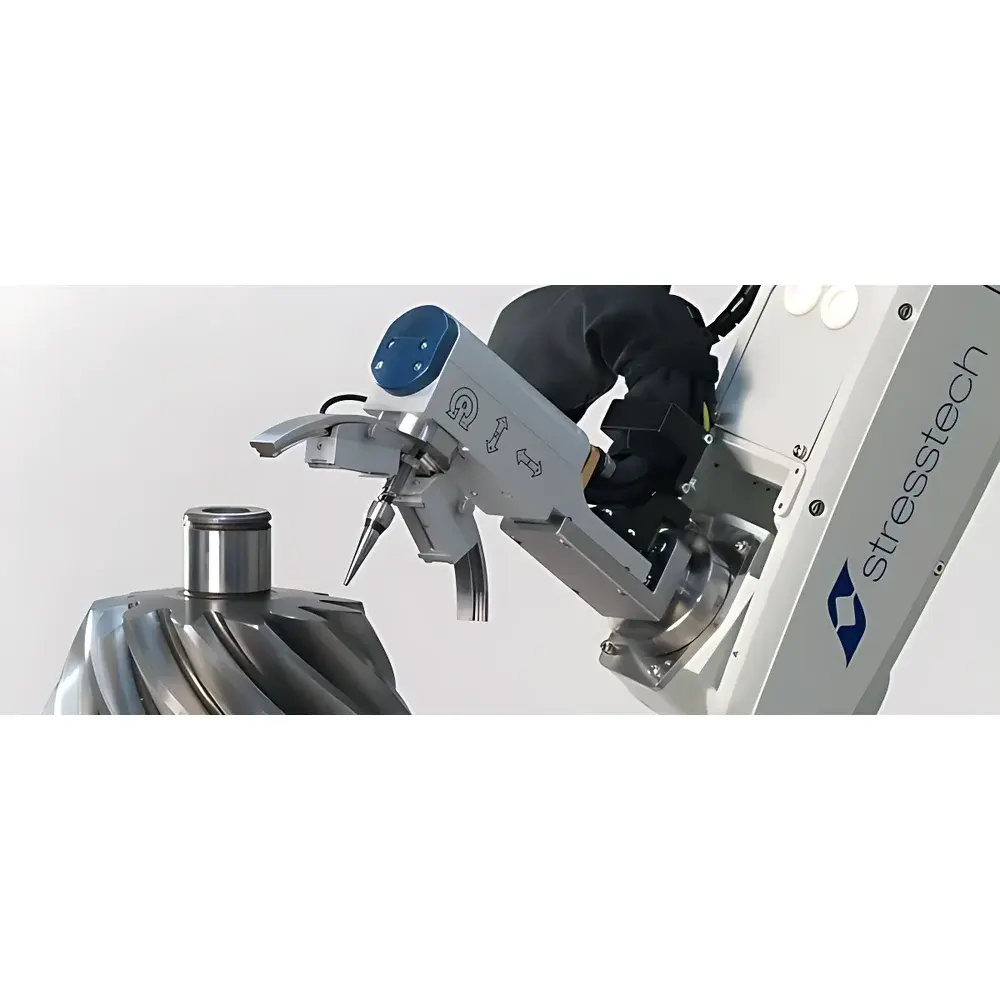
The Stresstech xstress3000 Portable X-Ray Residual Stress Analyzer is a field-deployable, laboratory-grade instrument engineered for non-destructive determination of near-surface residual stress states in polycrystalline metallic components using the sin²ψ X-ray diffraction (XRD) method. Based on Bragg’s law and lattice strain measurement, the system quantifies elastic strain in crystalline planes—typically {211} for steel or {311} for austenitic stainless steels—and converts it to macroscopic residual stress via Hooke’s law and known material elastic constants. Unlike conventional benchtop XRD systems, the xstress3000 integrates a motorized ψ-tilt stage, precision collimated X-ray optics, and real-time diffraction pattern evaluation within a ruggedized, handheld-compatible chassis. Its design conforms to internationally recognized standards for residual stress measurement, including ASTM E915 (Standard Test Method for Verifying the Alignment of X-Ray Diffraction Instrumentation for Residual Stress Measurement), ISO 21432 (Non-destructive testing — Test method for residual stress analysis by X-ray diffraction), and EN 15305 (Non-destructive testing — Qualification of residual stress measurement by X-ray diffraction). The system operates without vacuum requirements and functions reliably under ambient lighting and moderate environmental fluctuations—making it suitable for both shop-floor QA/QC and in-service structural health monitoring.
Key Features
- True portable architecture: complete measurement system weighs under 12 kg; includes integrated battery option for cordless operation up to 4 hours.
- Motorized sin²ψ goniometer with ±45° ψ-tilt range and <0.1° angular reproducibility, enabling full stress tensor component extraction (σ₁₁, σ₂₂, τ₁₂).
- Laser-assisted optical alignment system ensures precise positioning of the X-ray beam onto the measurement spot (≤1 mm diameter), minimizing operator-induced error.
- Automatic calibration routine executed at startup and user-triggered—validates detector response, tube output stability, and geometric alignment without external reference samples.
- No manual zeroing required: real-time background subtraction and peak centroid fitting algorithms deliver direct stress output (MPa) with directional vector indication.
- Integrated Windows-based computing module (Microsoft Surface Pro-class embedded processor) enables standalone operation; full data acquisition, visualization, and preliminary reporting occur on-device.
Sample Compatibility & Compliance
The xstress3000 supports residual stress analysis on ferrous alloys (e.g., carbon steels, tool steels, stainless steels), aluminum alloys (e.g., 2xxx, 7xxx series), titanium alloys (e.g., Ti-6Al-4V), and nickel-based superalloys. Surface preparation requirements align with ISO 21432: ground, polished, or EDM-finished surfaces with Ra < 0.8 µm are recommended. The system complies with IEC 61000-6-3 (EMC emission limits) and IEC 61000-6-2 (immunity), and meets radiation safety requirements per IEC 61010-1 (Safety Requirements for Electrical Equipment for Measurement, Control, and Laboratory Use). All measurement workflows support audit-ready documentation in accordance with GLP and GMP principles, including timestamped raw diffraction frames, parameter logs, and operator ID tagging.
Software & Data Management
The xstress Suite v5.x software provides a validated, configurable environment for stress measurement, data reduction, and report generation. It supports automated multi-point mapping (grid or contour mode), stress depth profiling (via electropolishing or layer removal integration), and comparative analysis across batches or timepoints. Raw diffraction data is stored in vendor-neutral HDF5 format with embedded metadata (instrument settings, sample ID, environmental conditions). The software includes built-in validation tools for peak fitting uncertainty estimation (based on FWHM and signal-to-noise ratio), and exports fully traceable reports compliant with ASTM E915 Annex A1. For regulated environments, optional 21 CFR Part 11 compliance modules provide electronic signatures, role-based access control, and immutable audit trails.
Applications
- Verification of shot peening, laser shock peening, and deep rolling process efficacy on aerospace landing gear, turbine disks, and compressor blades.
- In-process monitoring of welding-induced residual stresses in pressure vessels, pipelines, and offshore structural joints.
- Post-heat-treatment stress assessment in forged crankshafts, camshafts, and transmission gears.
- Failure analysis investigations where stress concentrations correlate with fatigue crack initiation sites.
- Validation of machining-induced surface integrity in high-value medical implants and orthopedic devices.
- Field inspection of rail welds, bridge gusset plates, and nuclear containment weldments under ASME Section XI or EN 13445 frameworks.
FAQ
Does the xstress3000 require external cooling or vacuum pumping?
No. The system uses air-cooled microfocus X-ray tubes and operates under atmospheric conditions—no vacuum chamber or chiller is needed.
Can it measure residual stress through coatings or platings?
Yes, provided the coating thickness is ≤20 µm and the substrate exhibits sufficient X-ray diffraction intensity; Cr Kα radiation is typically used for steel substrates beneath thin chrome or nickel plating.
Is operator certification required to use the instrument?
While no formal radiation safety license is mandated due to its Class I designation per IEC 61010, users must complete Stresstech’s certified training program covering measurement protocol selection, uncertainty evaluation, and regulatory documentation practices.
How is measurement uncertainty quantified?
Uncertainty is calculated per ISO/IEC 17025 guidelines using Type A (statistical repeatability across ≥5 ψ-positions) and Type B (calibration certificate tolerances, beam divergence, and lattice parameter variability) components—reported alongside each measurement.
Can the system integrate with third-party data management platforms?
Yes. Through OPC UA and RESTful API interfaces, xstress Suite supports bidirectional data exchange with LIMS, MES, and digital twin infrastructure for Industry 4.0 deployment.
Related Products






