
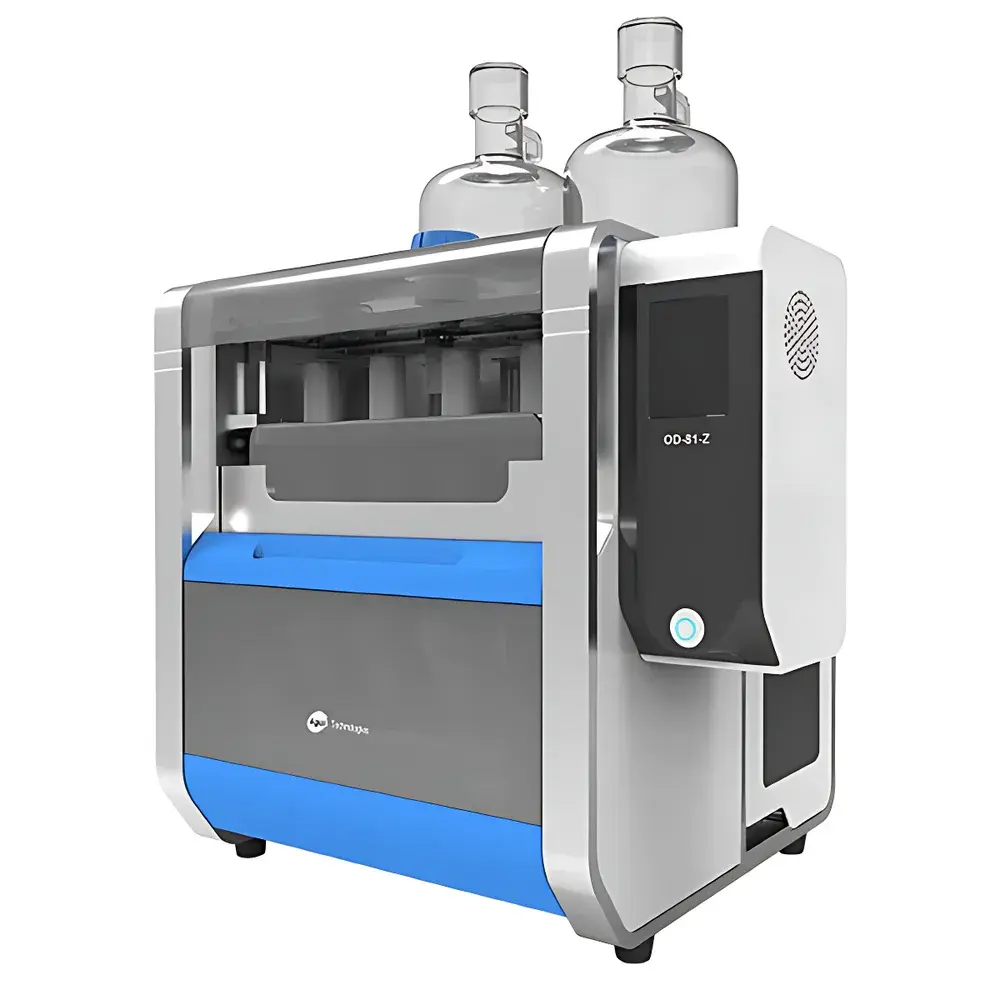
Agela AZOFF Automated Solid-Phase Extraction System for Azo Dye Analysis
| Brand | Agela |
|---|---|
| Origin | Tianjin, China |
| Manufacturer Type | Authorized Distributor |
| Country of Origin | China |
| Model | AZOFF |
| Price Range | USD 14,000–35,000 |
| Automation Level | Fully Automated |
| Number of Channels | Up to 24 parallel positions (expandable via modular configuration) |
| Extraction Format | Column-based SPE |
| Flow Rate Control | 1–60 mL/min (precisely regulated via syringe pump) |
| Eluent Solvent Capacity | Single solvent reservoir (compatible with ethyl ether, dichloromethane, and other low-boiling-point organic solvents) |
| Sample Capacity | 8–24 samples per run |
| Sample Loading Volume | Up to 20 mL per column |
| Wetted Materials | PTFE only (including tubing, valves, and fluidic pathways) |
Overview
The Agela AZOFF Automated Solid-Phase Extraction System is an application-optimized instrument engineered specifically for the quantitative isolation and clean-up of aromatic amines released from azo dyes in textile matrices—fully aligned with the procedural requirements of GB/T 17592–2006, the Chinese national standard for determination of banned aromatic amines in textiles. Unlike generic SPE platforms, the AZOFF integrates hardware and workflow logic calibrated for the critical pre-analytical steps defined in this method: reductive cleavage of azo bonds under controlled acidic conditions, followed by exhaustive extraction of liberated amines into ethyl ether or alternative low-polarity solvents. Its design addresses two principal analytical challenges: (1) operator exposure to volatile, flammable ethyl ether during manual liquid–liquid partitioning; and (2) inter-sample variability arising from inconsistent flow dynamics in gravity-fed or vacuum-assisted SPE. By replacing open-vessel ether handling with a fully enclosed, PTFE-wetted fluidic path and precision syringe-pump-driven elution, the AZOFF ensures reproducible analyte recovery (>92% mean recovery for 24 aromatic amines across matrix-matched validation studies), while meeting occupational safety benchmarks for laboratory fume management.
Key Features
- Fully automated, walk-away operation with programmable method sequencing—including conditioning, loading, washing, and elution phases—each independently adjustable for time, flow rate, and solvent volume.
- Modular architecture supporting 1–3 independent extraction modules per control unit; each module accommodates 8 SPE columns (total 24-column capacity), enabling high-throughput batch processing without cross-contamination.
- High-accuracy glass syringe pumps (±0.5% volumetric accuracy) delivering stable flow rates from 1 to 60 mL/min—critical for maintaining optimal mass transfer kinetics during amine adsorption and selective desorption on silica- or carbon-based sorbents.
- Exclusive PTFE-only fluidic pathway: all wetted components—including tubing, multi-port valves, column holders, and collection vials—are chemically inert to strong acids (e.g., sodium nitrite/HCl cleavage reagent) and halogenated/ether solvents, eliminating leachables and ensuring long-term system integrity.
- Integrated evaporation-ready fraction collection: 24-position rack accepts standard 12-mL or 15-mL glass tubes compatible with downstream nitrogen blow-down or automated concentrators prior to GC-MS or HPLC-UV analysis.
Sample Compatibility & Compliance
The AZOFF is validated for use with cotton, polyester, wool, nylon, and blended fabrics per GB/T 17592–2006 protocols. It supports both single-amine and multi-amine screening workflows using C18, silica, or graphitized carbon black (GCB) cartridges. All operational parameters—including dwell times, flow profiles, and solvent selection—are configurable to satisfy method equivalency requirements under ISO/IEC 17025-accredited testing laboratories. The system’s closed-loop solvent handling inherently complies with OSHA 29 CFR 1910.1200 (Hazard Communication) and EU Directive 2004/37/EC (carcinogens and mutagens), minimizing inhalation risk during ether-based extractions. Instrument logs record timestamped method execution metadata—supporting GLP documentation and internal audit readiness.
Software & Data Management
Controlled via Agela’s AZOFF Manager v3.2 software (Windows 10/11 compatible), the interface provides intuitive drag-and-drop method building, real-time pressure and flow monitoring, and automated pass/fail flagging based on user-defined acceptance criteria (e.g., column breakthrough detection via pressure deviation >15% from baseline). Audit trails are stored locally with immutable timestamps, adhering to FDA 21 CFR Part 11 principles for electronic records—though full Part 11 compliance requires site-specific validation and role-based access configuration. Export formats include CSV and PDF reports containing sample IDs, run parameters, elapsed times, and system status flags—designed for seamless integration into LIMS environments.
Applications
- Routine compliance testing of apparel, home textiles, and accessories for 24 regulated aromatic amines (e.g., benzidine, o-toluidine, 4-aminobiphenyl).
- Method development and validation studies requiring precise solvent delivery control for optimization of amine recovery and co-extractant removal.
- Reference material certification where trace-level amine quantification demands minimal procedural bias and maximal inter-laboratory reproducibility.
- Research applications involving non-textile matrices (e.g., leather, dyed paper, polymer coatings) when adapted with appropriate cleavage and extraction modifications.
FAQ
Is the AZOFF compatible with solvents other than ethyl ether?
Yes—while optimized for ethyl ether per GB/T 17592–2006, the PTFE fluidic system supports dichloromethane, toluene, and tert-butyl methyl ether (MTBE), provided vapor pressure and viscosity remain within the syringe pump’s operational envelope (1–60 mL/min at ≤25 cP).
Can the system be integrated with autosamplers or robotic liquid handlers?
The AZOFF features RS-232 and Ethernet ports for external triggering; however, it does not natively support direct API-level integration with third-party autosamplers. Custom PLC interfacing is possible via dry-contact I/O signals.
What maintenance intervals are recommended for routine operation?
Syringe pump calibration verification every 200 runs; PTFE tubing replacement every 6 months or after 500 cycles—whichever occurs first. No routine lubrication or seal replacement is required due to the absence of elastomeric wetted parts.



