
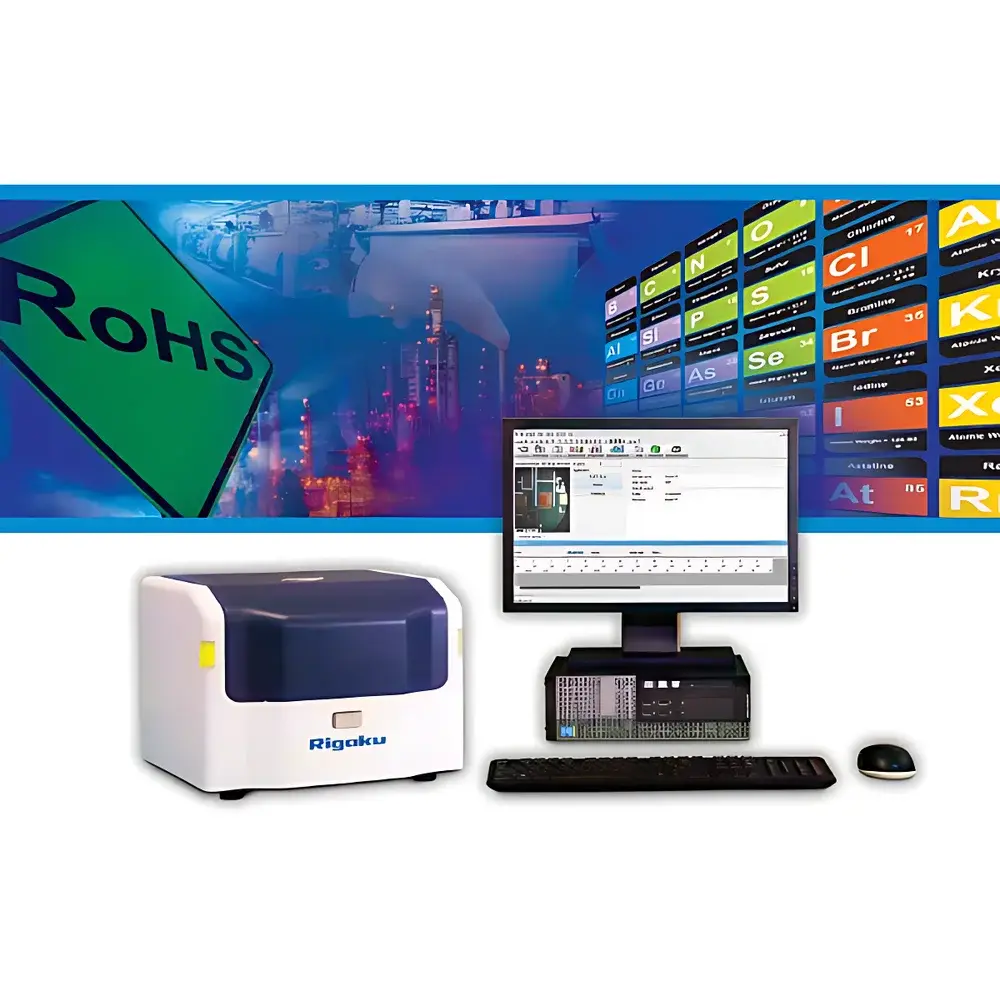
Rigaku NEX DE Energy-Dispersive X-Ray Fluorescence (ED-XRF) Analyzer for Total Sulfur and Multi-Element Analysis in Marine Fuel Oil
| Brand | Rigaku |
|---|---|
| Origin | USA |
| Model | NEX DE |
| Detection Range | Na to U |
| Sample Volume | 5 mL |
| Analysis Time | 30–900 s (standard: 300 s) |
| Compliance | ASTM D4294, ASTM D8252, ASTM D6481, GB/T 17040 |
| Excitation Filtration | Multi-layer composite filters |
| Operating Temperature | 10–35 °C |
| Relative Humidity | <80% RH (non-condensing) |
| Data Output | USB + Ethernet |
| Software | QuantEZ |
Overview
The Rigaku NEX DE is a benchtop energy-dispersive X-ray fluorescence (ED-XRF) spectrometer engineered for rapid, non-destructive quantification of total sulfur and multi-element composition in liquid hydrocarbon fuels—specifically optimized for marine fuel oil, diesel, vacuum gas oil, residue, and crude oil. Based on fundamental parameter (FP)-driven ED-XRF physics, the system utilizes a high-stability X-ray tube with selectable anode materials and multi-layer composite beam filtration to optimize excitation efficiency across the Na–U elemental range. Unlike wavelength-dispersive systems, the NEX DE achieves high spectral throughput without mechanical scanning, enabling consistent precision at trace-level concentrations (ppm) while maintaining robustness under routine laboratory or onboard-support facility conditions. Its design adheres to international regulatory frameworks governing marine fuel compliance, including IMO MARPOL Annex VI sulfur cap enforcement and ISO 8217 specifications.
Key Features
- Optimized excitation geometry with multi-layer composite filters for enhanced signal-to-background ratio in low-Z elements (e.g., S, Cl, Ca) critical for fuel specification testing
- High-resolution silicon drift detector (SDD) with Peltier cooling, delivering <145 eV Mn Kα resolution for accurate peak deconvolution in complex fuel matrices
- Fixed-sample cup configuration accommodating 5 mL liquid samples in standardized polypropylene or quartz vials—no sample digestion or dilution required
- Automated calibration verification using built-in reference standards; drift correction supported via daily intensity monitoring
- Compact, vibration-insensitive chassis rated for operation in environments with minimal mechanical disturbance (e.g., shore-based QC labs, vessel support offices)
- Compliance-ready hardware architecture: no moving parts in the optical path, sealed detector housing, and corrosion-resistant internal surfaces
Sample Compatibility & Compliance
The NEX DE accepts homogenized liquid fuel samples as received—no acid digestion, ashing, or matrix-matching dilutions are necessary. It supports direct analysis of marine distillates (MGO), residual fuels (HFO), blended bunker fuels, and refinery intermediates. Method validation aligns with ASTM D4294 (sulfur in petroleum products), ASTM D8252 (low-sulfur diesel and marine fuels), ASTM D6481 (phosphorus in gasoline), and Chinese national standard GB/T 17040. Instrument performance meets the repeatability and reproducibility criteria outlined in ISO/IEC 17025 for accredited testing laboratories. All measurement protocols are fully documented and support GLP audit trails when integrated with QuantEZ’s secure user authentication and electronic signature modules.
Software & Data Management
QuantEZ software provides full method development, calibration management, and automated reporting compliant with FDA 21 CFR Part 11 requirements—including audit trail logging, role-based access control, and electronic record integrity safeguards. Users define custom calibration curves using certified reference materials (CRMs) traceable to NIST SRMs. The software applies matrix correction algorithms based on fuel density, aromaticity, and heteroatom content to minimize inter-element interference effects. Data export supports CSV, PDF, and XML formats; results synchronize seamlessly with LIMS via Ethernet or USB transfer. Remote diagnostics and firmware updates are enabled through encrypted HTTPS connections—no third-party cloud dependency.
Applications
- Regulatory sulfur screening of marine fuels pre-bunkering and post-delivery per IMO 2020 global cap (0.50 wt% S)
- Multi-element impurity profiling: V, Ni, Na, Al, Si, Ca, Mg, Zn, and Pb for catalyst poisoning assessment and refinery feedstock qualification
- Quality assurance of blending components and additive packages in fuel manufacturing
- Root-cause analysis of fouling, corrosion, or combustion inefficiency through trace metal trend monitoring
- Support for ISO 8217:2024 Annex A elemental limits verification in delivery certificates
FAQ
Does the NEX DE require helium purge or vacuum for sulfur analysis?
No—its optimized air-path geometry and high-efficiency SDD enable reliable sulfur detection down to 1 ppm in ambient atmosphere.
Can it analyze viscous residual fuels without preheating?
Yes, provided samples are homogenized at 40–50 °C prior to loading; viscosity does not affect measurement integrity due to fixed-volume cup geometry.
Is QuantEZ validated for 21 CFR Part 11 compliance?
Yes—full electronic signature, audit trail, and data integrity features are pre-validated and configurable per site-specific SOPs.
What CRM sets are recommended for initial calibration?
Rigaku-certified fuel CRMs covering 0.1–5000 ppm S and 0.1–100 ppm metals (e.g., AccuStandard FUEL-1 series), traceable to NIST.
How often must the instrument be recalibrated?
Calibration stability exceeds 72 hours under controlled lab conditions; daily intensity checks are recommended, with full recalibration every 30 days or after maintenance.





