
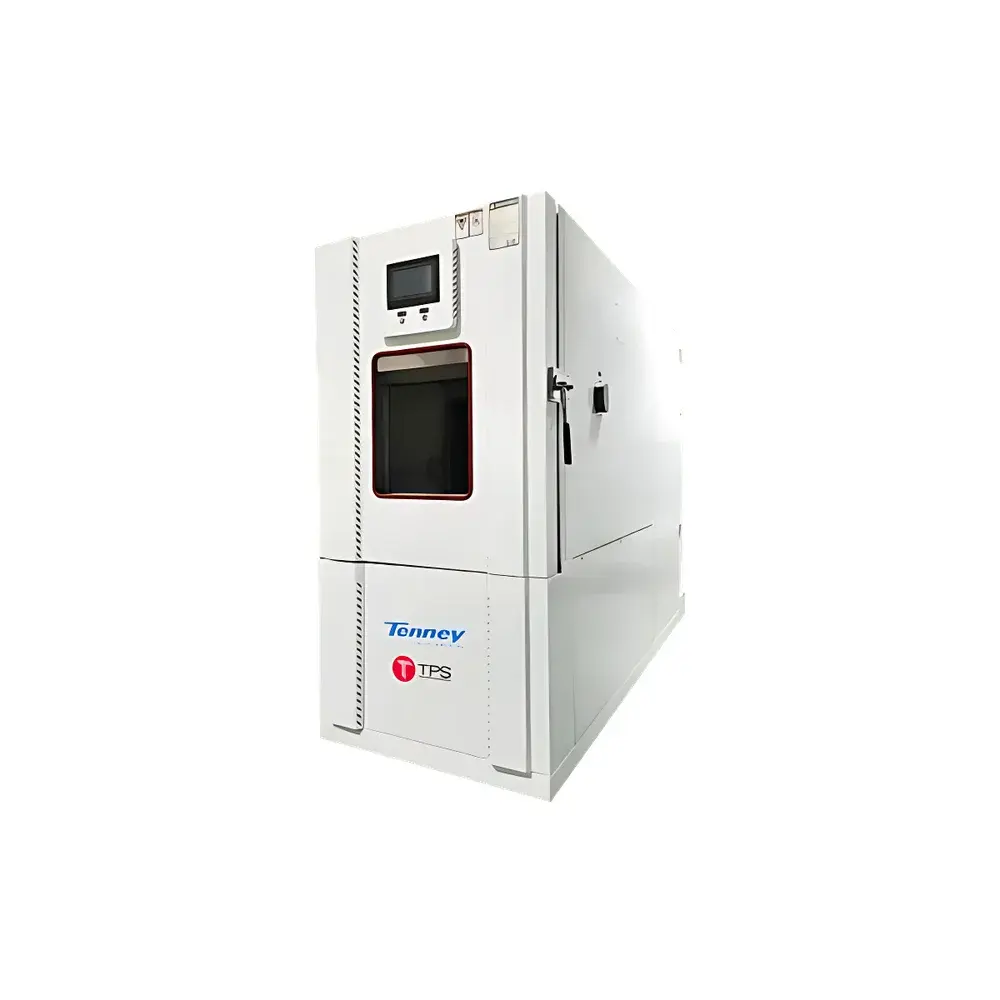
Blue M Tenney Asia Environmental Test Chamber
| Brand | Blue M |
|---|---|
| Origin | USA |
| Model | Asia |
| Temperature Range | -70°C to 180°C |
| Temperature Uniformity | ±1.0°C |
| Temperature Stability | ±0.5°C |
| Temperature Deviation | ±1.0°C |
| Max Operating Temperature | 200°C (short-term) |
| Internal Chamber Dimensions (W×H×D) | 521 mm × 508 mm × 559 mm |
| Construction | Interior – SUS#304 stainless steel |
| Air Circulation | Forced convection |
| Humidity Capability | 20–95% RH (optional, standard range), 10–95% RH (custom range) |
| System Type | Single-stage or cascade refrigeration (for sub-zero operation) |
| Application Class | High-Temperature Aging Test Chamber, Thermal Cycling Chamber |
Overview
The Blue M Tenney Asia Environmental Test Chamber is a precision-engineered thermal aging and temperature cycling system designed for reliability-critical applications in materials science, electronics, automotive component validation, and polymer stability testing. Built upon Blue M’s legacy of robust chamber architecture since 1946, the Asia model delivers consistent thermal performance across its full operating range of −70°C to +180°C—achievable via either single-stage or cascade refrigeration configurations depending on low-temperature requirements. Its core measurement principle relies on closed-loop PID-controlled heating/cooling combined with high-efficiency forced-air circulation, ensuring minimal thermal gradients and repeatable exposure profiles. This chamber is specifically optimized for non-hazardous, non-explosive environments where long-duration thermal stress evaluation—such as ASTM D573, ISO 188, and USP accelerated aging protocols—is required. It meets fundamental design criteria for GLP-compliant laboratories and supports traceable calibration per ISO/IEC 17025 standards when paired with external validation hardware.
Key Features
- Stainless steel interior (SUS#304) resistant to oxidation, corrosion, and thermal fatigue—ensuring long-term dimensional stability and ease of cleaning.
- Thermally insulated double-wall construction with high-density polyurethane foam insulation (≥100 mm thickness) for minimized heat transfer and energy efficiency.
- Precision air distribution system with adjustable axial fans and baffled airflow paths to maintain ±1.0°C temperature uniformity across the full working volume.
- Dual-mode temperature control: standard single-stage compression for ambient-to-180°C operation; optional cascade refrigeration for stable sub-zero performance down to −70°C.
- Programmable digital controller with real-time data logging, ramp-soak profiles, and alarm-triggered shutdown (over-temperature, sensor fault, door open).
- Optional humidity control module enabling 20–95% RH operation (standard) or extended 10–95% RH range with enhanced condensation management and dew-point monitoring.
Sample Compatibility & Compliance
The Tenney Asia chamber accommodates samples up to 521 mm (W) × 508 mm (H) × 559 mm (D), making it suitable for PCB assemblies, elastomeric seals, battery modules, packaging materials, and small mechanical subassemblies. Its non-explosion-proof classification limits use to Class I, Division 2 environments per NEC Article 500. The chamber complies with key international test standards including ASTM D3045 (heat aging of plastics), ISO 22088-3 (elastomer thermal degradation), and IEC 60068-2-2 (environmental testing — Part 2: Tests — Test B: Dry heat). All units undergo factory thermal mapping (per ISO 17025 Annex A.3) and include NIST-traceable calibration certificates for primary temperature sensors.
Software & Data Management
Equipped with Blue M’s proprietary T-COMM™ control interface, the chamber supports RS-485 Modbus RTU and optional Ethernet/IP connectivity for integration into centralized lab management systems. Data logging records temperature (and humidity, if equipped) at user-defined intervals (1 sec to 60 min), storing up to 30 days of continuous history onboard. Export formats include CSV and PDF reports compliant with FDA 21 CFR Part 11 requirements—including electronic signatures, audit trails, and user-level access control (admin/operator/guest). Optional software packages enable automated test sequencing, statistical process control (SPC) charting, and deviation alerting via email/SNMP trap.
Applications
- Accelerated thermal aging of polymers, adhesives, and composite laminates per ASTM D573 and ISO 188.
- Pre-conditioning of lithium-ion battery cells prior to cycle life testing (UN 38.3 Section 38.3.4.1).
- Thermal shock screening of surface-mount components using programmable ramp rates (0.5–10°C/min).
- Stability testing of pharmaceutical packaging under ICH Q1A(R2) long-term and accelerated conditions.
- Qualification of aerospace gaskets and O-rings per SAE AS5678 and MIL-DTL-25988.
- Validation of solder paste shelf life and reflow profile sensitivity in electronics manufacturing.
FAQ
What is the maximum allowable continuous operating temperature?
The chamber is rated for continuous operation up to 180°C; short-term excursions to 200°C are permitted for ≤30 minutes per cycle, provided thermal mass loading remains within specifications.
Can this chamber be validated for GMP-regulated environments?
Yes—when equipped with calibrated PT100 sensors, 21 CFR Part 11-compliant software, and documented IQ/OQ protocols, it supports qualification under EU Annex 15 and FDA guidance for equipment used in pharmaceutical stability studies.
Is remote monitoring supported out-of-the-box?
Standard RS-485 communication enables integration with SCADA or building management systems; Ethernet-based remote access requires optional T-NET™ gateway module and TLS-secured firmware.
How often does the chamber require preventative maintenance?
Compressor oil and filter replacement is recommended every 2,000 operational hours or annually—whichever occurs first—while door gasket integrity and sensor calibration should be verified semiannually per ISO/IEC 17025.
Does Blue M provide installation and commissioning services in Asia?
Yes—authorized regional service partners offer turnkey installation, site acceptance testing (SAT), and operator training aligned with local regulatory expectations across APAC markets.
Related Products



