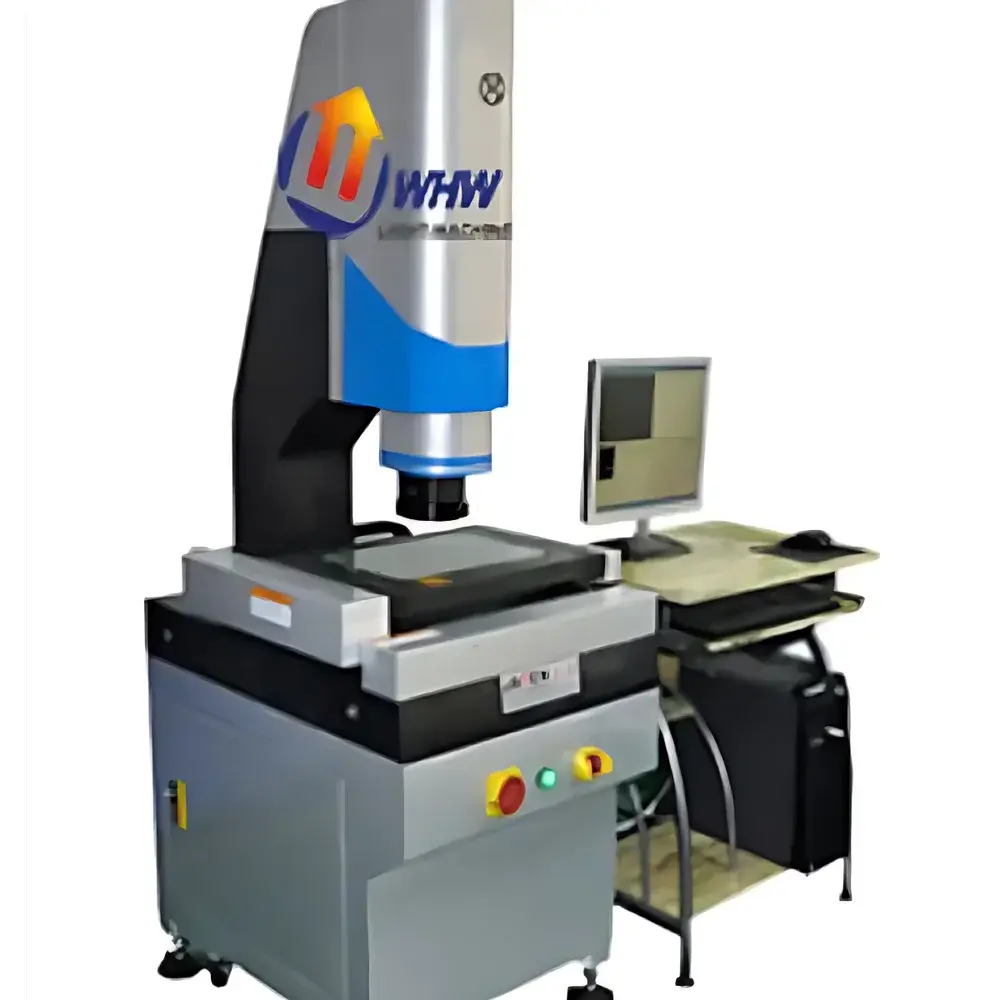
YANRUN YR-Q2010 Intelligent Automatic Vision Measuring Machine
| Brand | YANRUN |
|---|---|
| Origin | Shanghai, China |
| Manufacturer Type | Direct Manufacturer |
| Model | YR-Q2010 |
| Operation Mode | Fully Automatic |
| Travel Range (X×Y×Z) | 200 × 100 × 200 mm |
| Overall Dimensions (L×W×H) | 750 × 550 × 1712 mm |
| Measurement Accuracy | X/Y-axis ≤ (3 + L/200) µm |
| Encoder Resolution | 0.5 µm (High-Precision Linear Encoders) |
| Imaging Sensor | Sony Color CCD Camera |
| Optical System | Motorized Zoom Lens (Auto-Change Magnification) |
| Illumination | Programmable LED Ring Light (Surface Illumination) and Coaxial Contour Light with Brightness Control Synchronized to Magnification |
| Software | Proprietary Automated Vision Metrology Suite |
| Power Supply | AC 220 V ±10%, 50 Hz |
| Environmental Requirements | Temperature 20 °C ±3 °C |
Overview
The YANRUN YR-Q2010 Intelligent Automatic Vision Measuring Machine is a high-precision coordinate metrology system engineered for non-contact, two- and three-dimensional geometric inspection of small- to medium-sized mechanical components, electronic assemblies, precision molds, and optical elements. It operates on the principle of digital image-based coordinate metrology: real-time video capture via a calibrated Sony color CCD sensor is geometrically mapped to the machine’s Cartesian coordinate space using high-resolution linear encoders (0.5 µm resolution) mounted on all three axes. The system integrates motorized zoom optics and programmable multi-angle LED illumination to optimize edge contrast and surface feature visibility across varying part geometries and material finishes—including translucent substrates such as optical glass, where simultaneous thickness and flatness evaluation is enabled via optional laser displacement probing. Designed for integration into quality control laboratories and production-line verification stations, the YR-Q2010 complies with fundamental traceability requirements defined in ISO 10360-7 (coordinate measuring machines — acceptance and reverification tests) and supports measurement uncertainty estimation per ISO/IEC 17025 guidelines when operated under controlled environmental conditions (20 °C ±3 °C, 45–75% RH).
Key Features
- Fully automated operation with programmable measurement routines, eliminating manual operator intervention during routine inspections.
- Motorized auto-zoom optical system enabling seamless magnification changes without refocusing—critical for multi-feature inspection within a single program.
- Dual-illumination architecture: independently controllable ring light (surface illumination) and coaxial contour light, both intensity-modulated in real time based on selected magnification level to maintain optimal signal-to-noise ratio.
- Optional integrated laser displacement sensor for Z-axis height profiling, step-height measurement, and flatness assessment of transparent or reflective surfaces—extending capability beyond conventional silhouette-based 2D metrology.
- High-stiffness granite base and precision-ground linear motion stages ensure thermal stability and mechanical repeatability over extended operational cycles.
- Real-time encoder feedback on all axes enables closed-loop positioning accuracy conforming to stated specifications: X/Y ≤ (3 + L/200) µm and Z ≤ (4 + L/200) µm (where L is measured length in mm).
Sample Compatibility & Compliance
The YR-Q2010 accommodates parts up to 200 mm (X) × 100 mm (Y) × 200 mm (Z) in volume, with maximum weight capacity of 25 kg. Its open-stage design permits flexible fixturing of irregularly shaped components using standard kinematic or vacuum chucks. The system is routinely deployed for dimensional verification of machined metal parts (e.g., connectors, housings), PCB stencils, semiconductor lead frames, injection-molded plastic components, and optical lens mounts. All measurement workflows are compatible with ISO 9001, IATF 16949, and ISO 13485 quality management frameworks. Audit-ready data logging—including timestamped operator ID, environmental parameters, calibration status, and raw image archives—is supported through configurable software settings aligned with GLP and GMP documentation expectations.
Software & Data Management
The proprietary vision metrology software provides a Windows-based graphical interface supporting CAD-based alignment (DXF import), geometric tolerance evaluation (GD&T per ASME Y14.5 and ISO 1101), statistical process control (SPC) charting, and automated report generation in PDF or Excel formats. Measurement programs include full scriptability via embedded macro language, enabling conditional logic, looped inspections, and pass/fail decision trees tied to user-defined specification limits. Raw image files and coordinate datasets are stored with SHA-256 checksums to ensure data integrity. Software revision history, user access logs, and electronic signature functionality comply with FDA 21 CFR Part 11 requirements for regulated industries when configured with appropriate IT infrastructure controls.
Applications
- Precision validation of hole position, diameter, and concentricity in automotive engine components.
- Flatness and thickness characterization of display cover glass and touch panel laminates.
- Lead pitch, coplanarity, and solder paste deposit geometry analysis in SMT process control.
- Tool wear monitoring via periodic measurement of cutting edge geometry on micro-milling inserts.
- Geometric fidelity verification of additive-manufactured lattice structures and microfluidic channel networks.
- First-article inspection (FAI) reporting in aerospace subcontractor workflows requiring AS9102 compliance.
FAQ
What standards does the YR-Q2010 support for measurement traceability?
The system is designed to operate within the environmental and procedural constraints specified in ISO 10360-7 and supports uncertainty budgeting in accordance with ISO/IEC 17025 Annex A.4 when used with certified reference artifacts and documented calibration procedures.
Can the YR-Q2010 measure features on glossy or transparent materials?
Yes—through synchronized contour lighting, adjustable polarization filters (optional), and optional laser probe integration, the system achieves robust edge detection on polished metals, anodized aluminum, and optical-grade glass substrates.
Is remote programming and data export supported?
The software includes TCP/IP API support for external PLC or MES integration, and exports measurement results in CSV, XML, and industry-standard DMIS formats for downstream SPC or MRP systems.
What maintenance is required for long-term accuracy?
Annual recalibration of encoder scales and optical axis alignment is recommended. Daily verification using certified step gauges and sphere artifacts ensures ongoing conformance to stated accuracy specifications.
Does the system support multi-sensor fusion?
While the base configuration uses vision-only metrology, the modular design allows integration of tactile probes and laser line scanners via standardized I/O interfaces and software plugin architecture.